
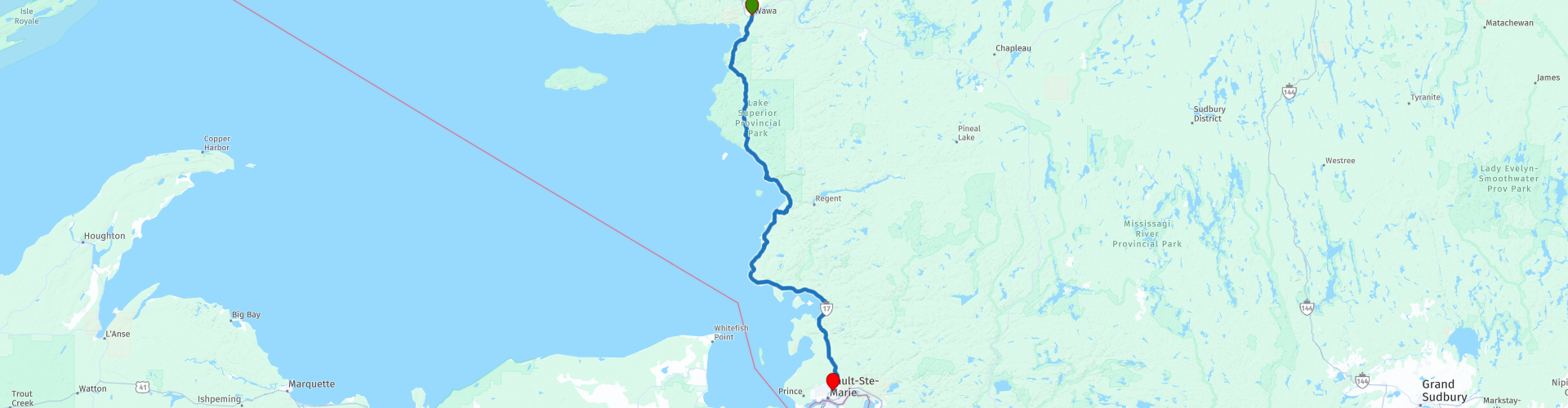
Day 17 TCH Wawa to Sault Ste Marie

Questo percorso è stato creato da:
RouteXpert René Plücken (MRA Master)
Ultima modifica: 09-11-2025
 Riepilogo percorso
 Questa è la sezione 17 che va da Wawa a Sault Ste Marie.
La Trans-Canada Highway attraversa tutte le province meridionali del Paese. Il percorso può essere percorso in vari modi, poiché esistono diversi percorsi alternativi che fanno parte della Trans-Canada Highway. La distanza totale è di circa 8.000 km. Non percorreremo esclusivamente la Trans-Canada Highway, ma percorreremo il maggior numero possibile di strade secondarie del Paese, poiché guidare in autostrada da solo è troppo noioso e il Canada vanta numerose strade meravigliose che attraversano paesaggi mozzafiato.
Attraverserai tutte le province e i paesaggi più vari e pittoreschi, dalle Montagne Rocciose a ovest, alle Praterie Centrali, alle Marittime orientali e alle foreste settentrionali.
La stagione equestre va generalmente da aprile a ottobre, con periodi più lunghi sulla costa occidentale e nel sud dell'Ontario.
Assicuratevi di avere un abbigliamento adatto a tutte le stagioni o di portare con voi un impermeabile. A seconda della provincia e della stagione, il meteo può cambiare improvvisamente e potreste essere sorpresi da un acquazzone, o persino da una nevicata o grandine, quindi siate preparati.
In Canada si utilizza il sistema metrico, quindi la velocità è indicata in km/h. Il casco è obbligatorio in tutto il Canada (approvato dal Dipartimento dei Trasporti).
In tutto il Canada, potrete osservare una grande varietà di animali selvatici. Animali simili variano da provincia a provincia, tra cui cervi, bufali, alci, caribù, lupi, puma, orsi, stambecchi, pecore, linci, coyote, volpi, procioni, tassi, vari roditori e una varietà di uccelli.
Anche se è molto allettante fermarsi per una foto, non fatelo: può essere molto pericoloso.
Questo è un tour fantastico che merita un bel 5*****. Ha molto da offrire ed è piacevole dall'inizio alla fine, con diverse soste previste lungo il percorso. Attraverseremo uno splendido parco naturale e, per chi lo desidera, questa giornata può essere prolungata di uno o due giorni per godere di tutta la bellezza che questo parco ha da offrire.
 Condividi questo percorso


Animation

Verdetto


Durata
8h 50m

Modalità di viaggio
Auto o moto

Distanza
226.08 km

Paesi

 Revisione RouteXpert
 L'itinerario di oggi prevede un viaggio che offre tutto: natura, cultura e panorami infiniti. Attraverseremo l'imponente Parco Provinciale del Lago Superiore, un'area con così tanto da offrire che potreste facilmente dedicarci un giorno (o due) in più.
Prima di lasciare Wawa, facciamo rifornimento di cibo e bevande. Dopo circa 15 chilometri, raggiungiamo l'ingresso del Parco Provinciale del Lago Superiore. Con i suoi 1.550 km² di natura selvaggia, è uno dei parchi provinciali più grandi dell'Ontario. Scogliere, spiagge, valli fluviali, cascate e innumerevoli laghi interni creano un paesaggio che non dimenticherete facilmente. Tutto è ben segnalato con cartelli marroni e gialli e, per chi lo desidera, è possibile fare escursioni, andare in canoa, pescare o persino campeggiare in uno dei 200 campeggi nell'entroterra.
Le nostre tappe obbligate nel parco:
• Old Woman Bay, una lunga spiaggia sabbiosa circondata da scogliere alte 200 metri. La vista su Entrance Island e sulle acque aperte del Lago Superiore è mozzafiato. Perfetta per un picnic o una foto ricordo.
• Katherine Cove, un'insenatura idilliaca con una piccola spiaggia e acqua cristallina. Un luogo dove fermarsi e godersi il mare.
• Pittogrammi rupestri di Agawa, uno dei siti archeologici più famosi del Canada. Qui potrete ammirare antiche pitture rupestri Ojibwe, storie di sogni e visioni. Rispettate questo luogo sacro; non toccatelo, limitatevi ad ammirarlo.
• Agawa Bay Scenic Lookout, una vista panoramica della baia, ideale per una foto.
• Centro visitatori, per ulteriori informazioni sul parco e una vista dell'isola di Montreal.
• Diga del fiume Montreal: una breve deviazione per scattare una foto di una delle quattro dighe idroelettriche sul fiume.
A metà strada pranzeremo al Northgate Chip Wagon Plus, dove ci aspettano deliziosi piatti fatti in casa. Attenzione: si accettano solo contanti!
Dopo pranzo, la strada prosegue lungo la costa. Tra gli alberi, si possono intravedere scorci del Lago Superiore e delle sue baie: Mica Bay, Flour Bay e Cottrell Cove.
A Pancake Bay, potrete fare rifornimento, bere qualcosa e magari assaggiare un pezzo di trota fresca. C'è anche un negozio di souvenir.
Per chi desidera rilassarsi sulla spiaggia, il Batchawana Bay Provincial Park offre una splendida spiaggia sabbiosa.
La nostra ultima tappa è alle Cascate Chippewa, non una cascata alta, ma un lungo e ampio corso d'acqua che si snoda fino alla baia. Dall'altra parte, troverete un ristorante e un negozio di souvenir.
Poi ci aspettano altri 50 chilometri tra rocce, foreste e viste sulla baia di Batchawana, fino ad arrivare a Sault Ste. Marie, una città ricca di storia e natura.
Il mio voto: ★★★★★, Cinque stelle per una tappa che ha tutto: paesaggi spettacolari, storia culturale e una strada che ti sorprende ancora e ancora. Prenditi il tuo tempo, fermati spesso e assapora ogni chilometro.
Buon viaggio!


 Collegamenti
  Utilizzo
 Vuoi scaricare questo percorso?
Puoi scaricare il percorso gratuitamente senza un account MyRoute-app. Per farlo, apri il percorso e fai clic su 'Salva con nome'. Vuoi modificare questa rotta?
Nessun problema, inizia aprendo il percorso. Segui il tutorial e crea il tuo account MyRoute-app personale. Dopo la registrazione, la tua prova inizia automaticamente.  Disclaimer
L'utilizzo di questo percorso GPS è a tue spese e rischio. Il percorso è stato accuratamente composto e controllato da un RouteXpert accreditato dall'app MyRoute per l'utilizzo su TomTom, Garmin e navigazione dell'app MyRoute.
Ciononostante potrebbero essersi verificati cambiamenti a causa di mutate circostanze, deviazioni stradali o chiusure stagionali. Si consiglia pertanto di controllare ciascun percorso prima dell'uso.
Utilizzare preferibilmente la tracklog del percorso nel sistema di navigazione. Maggiori informazioni sul l'uso dell'app MyRoute può essere trovato sul sito Web in 'Community' o 'Academy'.
Ciononostante potrebbero essersi verificati cambiamenti a causa di mutate circostanze, deviazioni stradali o chiusure stagionali. Si consiglia pertanto di controllare ciascun percorso prima dell'uso.
Utilizzare preferibilmente la tracklog del percorso nel sistema di navigazione. Maggiori informazioni sul l'uso dell'app MyRoute può essere trovato sul sito Web in 'Community' o 'Academy'.
 Percorsi nelle vicinanze
Ontario
Informazioni su questa regione
L'Ontario è una delle tredici province del Canada, la più popolosa del paese (circa un terzo dei canadesi vive in Ontario). In questa provincia si trovano sia la più grande città del Canada, Toronto, che Ottawa, la capitale. È anche la seconda provincia in termini di superficie, subito dopo il Québec. La regione meridionale dell'Ontario è il punto più meridionale di tutto il Canada.
La principale fonte di reddito è l'industria. Il valore della produzione industriale dell'Ontario è maggiore della somma del valore totale di quella di tutte le altre province e territori del Canada. La forza della sua industria manifatturiera le ha fatto guadagnare il nome di Cuore industriale del Canada. La provincia si distingue per la sua forte industria automobilistica. Altre importanti fonti di entrate sono il turismo e i servizi finanziari e immobiliari.
L'Ontario fu originariamente colonizzato dai francesi, diventando parte della colonia del Canada, una delle province coloniali della Nuova Francia, che successivamente incluse la parte meridionale delle attuali province canadesi dell'Ontario e del Québec.
Nel 1763, il Regno Unito annesse il Canada. In tre decenni la regione sud-ovest divenne a maggioranza anglofona, motivo per cui il Regno Unito decise di dividere la colonia in due nel 1791. Entrambe le colonie si riunirono nuovamente nel 1840 nell'unica provincia del Canada. Con l'indipendenza, il 1º luglio 1867, la provincia del Canada venne definitivamente separata in due, nelle attuali province dell'Ontario e del Québec. Inizialmente provincia prevalentemente rurale ed agraria, l'Ontario divenne un importante centro industriale nei primi anni del XX secolo, assumendo il ruolo di principale centro economico del paese a partire dagli anni 1960.Nell'agosto 2006 risiedevano in Ontario 12.792.619 abitanti, che rappresentavano circa il 37,9% del totale della popolazione canadese, sparsi su una superficie di 1.076.395 km².La sua parte nord-orientale è inclusa nella regione territoriale detta del Canada francese.
Leggi di più su Wikipedia
La principale fonte di reddito è l'industria. Il valore della produzione industriale dell'Ontario è maggiore della somma del valore totale di quella di tutte le altre province e territori del Canada. La forza della sua industria manifatturiera le ha fatto guadagnare il nome di Cuore industriale del Canada. La provincia si distingue per la sua forte industria automobilistica. Altre importanti fonti di entrate sono il turismo e i servizi finanziari e immobiliari.
L'Ontario fu originariamente colonizzato dai francesi, diventando parte della colonia del Canada, una delle province coloniali della Nuova Francia, che successivamente incluse la parte meridionale delle attuali province canadesi dell'Ontario e del Québec.
Nel 1763, il Regno Unito annesse il Canada. In tre decenni la regione sud-ovest divenne a maggioranza anglofona, motivo per cui il Regno Unito decise di dividere la colonia in due nel 1791. Entrambe le colonie si riunirono nuovamente nel 1840 nell'unica provincia del Canada. Con l'indipendenza, il 1º luglio 1867, la provincia del Canada venne definitivamente separata in due, nelle attuali province dell'Ontario e del Québec. Inizialmente provincia prevalentemente rurale ed agraria, l'Ontario divenne un importante centro industriale nei primi anni del XX secolo, assumendo il ruolo di principale centro economico del paese a partire dagli anni 1960.Nell'agosto 2006 risiedevano in Ontario 12.792.619 abitanti, che rappresentavano circa il 37,9% del totale della popolazione canadese, sparsi su una superficie di 1.076.395 km².La sua parte nord-orientale è inclusa nella regione territoriale detta del Canada francese.
Visualizza regione
 Statistiche
  18
18Quantità di recensioni RX (Ontario)
 16817
16817Quantità di visitatori (Ontario)
 579
579Quantità di download (Ontario)
 Indirizza le collezioni in questa regione
 L'ultimo tour dei Grandi Laghi
Questo è un tour da Chicago a Staten Island, New York, visitando i 5 Grandi Laghi del Nord America.
A partire dal noleggio di motociclette EagleRider all'Illinois Harley-Davidson a Chicago e fino al noleggio di motociclette EagleRider a Staten Island.
Il tour Ultimate Great Lakes è un percorso attraverso gli Stati Uniti e il Canada verso destinazioni panoramiche lungo i laghi Michigan, Superior, Huron, Erie e Ontario.
Quali sono i Grandi Laghi? I Grandi Laghi sono una serie di cinque laghi d'acqua dolce interconnessi situati al confine tra Stati Uniti e Canada. Sono il più grande gruppo di laghi d'acqua dolce nel mondo per area e hanno caratteristiche simili al mare come onde ondulate, forti correnti, chilometri di spiagge sabbiose e rocciose e orizzonti lontani. Questo tour di 8 percorsi include luoghi in cui fermarsi per caffè, pranzo e pernottamento in hotel. Visita inoltre noti siti storici e panoramici lungo la strada evitando principalmente le principali autostrade. Ho suggerito 2 notti al Lago Superiore e 2 notti alle Cascate del Niagara, rendendo questo tour di 10 giorni, ma ovviamente dipende da te. Lo scenario e i paesaggi sono mozzafiato e ogni giorno è diverso da quello successivo. Divertitevi.
A partire dal noleggio di motociclette EagleRider all'Illinois Harley-Davidson a Chicago e fino al noleggio di motociclette EagleRider a Staten Island.
Il tour Ultimate Great Lakes è un percorso attraverso gli Stati Uniti e il Canada verso destinazioni panoramiche lungo i laghi Michigan, Superior, Huron, Erie e Ontario.
Quali sono i Grandi Laghi? I Grandi Laghi sono una serie di cinque laghi d'acqua dolce interconnessi situati al confine tra Stati Uniti e Canada. Sono il più grande gruppo di laghi d'acqua dolce nel mondo per area e hanno caratteristiche simili al mare come onde ondulate, forti correnti, chilometri di spiagge sabbiose e rocciose e orizzonti lontani. Questo tour di 8 percorsi include luoghi in cui fermarsi per caffè, pranzo e pernottamento in hotel. Visita inoltre noti siti storici e panoramici lungo la strada evitando principalmente le principali autostrade. Ho suggerito 2 notti al Lago Superiore e 2 notti alle Cascate del Niagara, rendendo questo tour di 10 giorni, ma ovviamente dipende da te. Lo scenario e i paesaggi sono mozzafiato e ogni giorno è diverso da quello successivo. Divertitevi.
Visualizza raccolta percorsi
Autostrada Trans Canada
La Trans-Canada Highway (TCH) o Trans-Canadian Highway è un sistema di autostrade che copre tutte le 10 province del Canada.
Il sistema autostradale federale e provinciale che ora costituisce il TCH fu autorizzato dal Trans-Canada Highway Act del 1948 e aperto nel 1962. Fu completato nel 1971. La lunghezza totale del TCH è di 7821 km.
Contrariamente all'American Interstate Highway System, il TCH non è costituito da una rete inequivocabile di autostrade, ma forma una rete di autostrade ad accesso limitato e altre strade principali che sono più simili alle strade provinciali olandesi. Il percorso è indicato da uno scudo verde con una foglia d'acero bianca.
La numerazione delle strade che fanno parte del TCH è il dominio delle province. Solo le province occidentali hanno allineato la loro numerazione e il TCH ha la denominazione Highway 1 lì.
La rotta principale del TCH inizia a Victoria, nella British Columbia, e attraversa Calgary e Regina fino a Winnipeg. Da Winnipeg il percorso conduce a Kenora in Ontario, dopo di che diversi rami passano dall'Ontario a Ottawa.
Più a est, il percorso passa attraverso la provincia del Quebec attraverso Montreal e Quebec, tra gli altri, fino a Moncton, nel New Brunswick. Quindi il TCH prosegue verso est attraverso la Nuova Scozia, dove un ramo (attraverso il Ponte della Confederazione) conduce all'Isola del Principe Edoardo. Un'altra sezione scende fino al mare nella città portuale di Sydney, dove parte un servizio di traghetti per Channel-Port aux Basques sull'isola di Terranova. Da lì il percorso prosegue per oltre 900 km fino al capoluogo di provincia di San Giovanni, nell'estremo sud-est dell'isola.
Non solo guidiamo la TCH, ma prenderemo le strade rurali il più possibile, perché solo la guida in autostrada è troppo noiosa e il Canada ha molte belle strade attraverso il suo bellissimo paesaggio. Guidi attraverso tutte le province e attraversa paesaggi molto vari e panoramici, dalle Montagne Rocciose a ovest, dalle praterie centrali alle marine orientali e dalla foresta settentrionale.
La stagione delle cavalcate è generalmente da aprile a ottobre, con stagioni più lunghe sulla costa occidentale e nell'Ontario meridionale. Fornisci un buon abbigliamento per tutte le stagioni o porta l'attrezzatura per la pioggia, a seconda della provincia e della stagione il tempo può cambiare e potresti essere sorpreso da una pioggia o persino da una pioggia di neve o grandine, quindi preparati.
In Canada viene utilizzato il sistema metrico, quindi le velocità sono indicate in Km / h. Un requisito di casco (approvato DOT) si applica in tutto il Canada.
Vedrai molti animali selvatici in tutto il Canada. Questo varia da provincia a provincia, come cervi, bufali, alci, caribù, lupi, puma, orsi, capre di montagna, pecore, lince, coyote, volpi, procioni, tassi, vari roditori e tutti i tipi di uccelli. Anche se è molto allettante fermarsi per una foto, non farlo, può essere molto pericoloso.
I percorsi descritti in questa recensione a volte si discostano dalla Trans Canada Highway, portando la lunghezza totale a 9.300 chilometri. I percorsi sono fatti in modo da guidare attraverso le splendide parti del Canada con panorami davvero belli e splendidi luoghi da visitare, questo differisce da musei, parchi a punti storici. I percorsi non sono troppo lunghi, quindi c'è tempo per fermarsi per le foto e le attrazioni lungo il percorso. Puoi anche scegliere di organizzare e combinare le tappe in modo diverso o di aggiungere altri percorsi per abbreviare o prolungare il tuo viaggio. I percorsi sono contrassegnati da un punteggio in stelle, alcuni percorsi sono meno impegnativi o interessanti ma sono necessari per passare al punto successivo, motivo per cui spesso hanno un punteggio inferiore.
Nella descrizione del percorso troverai maggiori dettagli su percorsi e punti di interesse lungo il percorso. Questi punti e anche hotel, ristoranti, stazioni di servizio ecc. Sono indicati con un PDI e talvolta anche con un punto di rotta. Nella descrizione troverai anche collegamenti a siti interessanti e ai percorsi che si collegano a quel giorno.
I percorsi descritti sono;
Giorno 01 TCH Vittoria a Nanaimo
Giorno 02 TCH Nanaimo a Speranza
Giorno 03 TCH Spero di Kamloops
Giorno 04 TCH Kamloops a Revelstoke
Giorno 05 TCH Revelstoke a Lake Louise
Giorno 06 TCH Lake Louise a Calgary
Giorno 07 TCH Calgary to Medicine Hat
Giorno 08 TCH Medicine Hat to Moose Jaw
Giorno 09 TCH Moose Jaw to Regina
Giorno 10 TCH Regina a Brandon
Giorno 11 TCH Brandon a Winnipeg
Giorno 12 TCH Winnipeg a Kenora
13 ° giorno TCH Kenora to Ignace
Giorno 14 TCH Ignace to Thunder Bay
Giorno 15 TCH Thunder Bay a Marathon
Giorno 16 Thunder Bay a Wawa
Giorno 17 TCH Wawa a Sault Ste Marie
18 ° giorno TCH Sault Ste Marie a Espanola
Giorno 19 TCH Espanola a Mattawa
Giorno 20 TCH Mattawa a Ottawa
21 ° giorno TCH da Ottawa a Montreal
22 ° giorno TCH da Montreal al Quebec
23 ° giorno TCH Quebec a Riviere du Loup
24 ° giorno TCH Riviere du Loup a Grand Falls
Giorno 25 TCH Grand Falls a Fredericton
26 ° giorno TCH Fredericton a Moncton
27 ° giorno TCH Moncton a Charlottetown
Giorno 28 TCH Charlottetown a Truro
Giorno 29 TCH Truro a North Sydney
Giorno 30 TCH North Sydney a Corner Brook
Giorno 31 TCH Corner Brook to Grand Falls
Giorno 32 TCH Grand Falls a Clarenville
Giorno 33 TCH da Clarenville a St John.
Divertiti a leggere le recensioni e pianificare il tuo prossimo viaggio.
Se hai guidato questo viaggio, sono molto curioso del tuo feedback!
Il sistema autostradale federale e provinciale che ora costituisce il TCH fu autorizzato dal Trans-Canada Highway Act del 1948 e aperto nel 1962. Fu completato nel 1971. La lunghezza totale del TCH è di 7821 km.
Contrariamente all'American Interstate Highway System, il TCH non è costituito da una rete inequivocabile di autostrade, ma forma una rete di autostrade ad accesso limitato e altre strade principali che sono più simili alle strade provinciali olandesi. Il percorso è indicato da uno scudo verde con una foglia d'acero bianca.
La numerazione delle strade che fanno parte del TCH è il dominio delle province. Solo le province occidentali hanno allineato la loro numerazione e il TCH ha la denominazione Highway 1 lì.
La rotta principale del TCH inizia a Victoria, nella British Columbia, e attraversa Calgary e Regina fino a Winnipeg. Da Winnipeg il percorso conduce a Kenora in Ontario, dopo di che diversi rami passano dall'Ontario a Ottawa.
Più a est, il percorso passa attraverso la provincia del Quebec attraverso Montreal e Quebec, tra gli altri, fino a Moncton, nel New Brunswick. Quindi il TCH prosegue verso est attraverso la Nuova Scozia, dove un ramo (attraverso il Ponte della Confederazione) conduce all'Isola del Principe Edoardo. Un'altra sezione scende fino al mare nella città portuale di Sydney, dove parte un servizio di traghetti per Channel-Port aux Basques sull'isola di Terranova. Da lì il percorso prosegue per oltre 900 km fino al capoluogo di provincia di San Giovanni, nell'estremo sud-est dell'isola.
Non solo guidiamo la TCH, ma prenderemo le strade rurali il più possibile, perché solo la guida in autostrada è troppo noiosa e il Canada ha molte belle strade attraverso il suo bellissimo paesaggio. Guidi attraverso tutte le province e attraversa paesaggi molto vari e panoramici, dalle Montagne Rocciose a ovest, dalle praterie centrali alle marine orientali e dalla foresta settentrionale.
La stagione delle cavalcate è generalmente da aprile a ottobre, con stagioni più lunghe sulla costa occidentale e nell'Ontario meridionale. Fornisci un buon abbigliamento per tutte le stagioni o porta l'attrezzatura per la pioggia, a seconda della provincia e della stagione il tempo può cambiare e potresti essere sorpreso da una pioggia o persino da una pioggia di neve o grandine, quindi preparati.
In Canada viene utilizzato il sistema metrico, quindi le velocità sono indicate in Km / h. Un requisito di casco (approvato DOT) si applica in tutto il Canada.
Vedrai molti animali selvatici in tutto il Canada. Questo varia da provincia a provincia, come cervi, bufali, alci, caribù, lupi, puma, orsi, capre di montagna, pecore, lince, coyote, volpi, procioni, tassi, vari roditori e tutti i tipi di uccelli. Anche se è molto allettante fermarsi per una foto, non farlo, può essere molto pericoloso.
I percorsi descritti in questa recensione a volte si discostano dalla Trans Canada Highway, portando la lunghezza totale a 9.300 chilometri. I percorsi sono fatti in modo da guidare attraverso le splendide parti del Canada con panorami davvero belli e splendidi luoghi da visitare, questo differisce da musei, parchi a punti storici. I percorsi non sono troppo lunghi, quindi c'è tempo per fermarsi per le foto e le attrazioni lungo il percorso. Puoi anche scegliere di organizzare e combinare le tappe in modo diverso o di aggiungere altri percorsi per abbreviare o prolungare il tuo viaggio. I percorsi sono contrassegnati da un punteggio in stelle, alcuni percorsi sono meno impegnativi o interessanti ma sono necessari per passare al punto successivo, motivo per cui spesso hanno un punteggio inferiore.
Nella descrizione del percorso troverai maggiori dettagli su percorsi e punti di interesse lungo il percorso. Questi punti e anche hotel, ristoranti, stazioni di servizio ecc. Sono indicati con un PDI e talvolta anche con un punto di rotta. Nella descrizione troverai anche collegamenti a siti interessanti e ai percorsi che si collegano a quel giorno.
I percorsi descritti sono;
Giorno 01 TCH Vittoria a Nanaimo
Giorno 02 TCH Nanaimo a Speranza
Giorno 03 TCH Spero di Kamloops
Giorno 04 TCH Kamloops a Revelstoke
Giorno 05 TCH Revelstoke a Lake Louise
Giorno 06 TCH Lake Louise a Calgary
Giorno 07 TCH Calgary to Medicine Hat
Giorno 08 TCH Medicine Hat to Moose Jaw
Giorno 09 TCH Moose Jaw to Regina
Giorno 10 TCH Regina a Brandon
Giorno 11 TCH Brandon a Winnipeg
Giorno 12 TCH Winnipeg a Kenora
13 ° giorno TCH Kenora to Ignace
Giorno 14 TCH Ignace to Thunder Bay
Giorno 15 TCH Thunder Bay a Marathon
Giorno 16 Thunder Bay a Wawa
Giorno 17 TCH Wawa a Sault Ste Marie
18 ° giorno TCH Sault Ste Marie a Espanola
Giorno 19 TCH Espanola a Mattawa
Giorno 20 TCH Mattawa a Ottawa
21 ° giorno TCH da Ottawa a Montreal
22 ° giorno TCH da Montreal al Quebec
23 ° giorno TCH Quebec a Riviere du Loup
24 ° giorno TCH Riviere du Loup a Grand Falls
Giorno 25 TCH Grand Falls a Fredericton
26 ° giorno TCH Fredericton a Moncton
27 ° giorno TCH Moncton a Charlottetown
Giorno 28 TCH Charlottetown a Truro
Giorno 29 TCH Truro a North Sydney
Giorno 30 TCH North Sydney a Corner Brook
Giorno 31 TCH Corner Brook to Grand Falls
Giorno 32 TCH Grand Falls a Clarenville
Giorno 33 TCH da Clarenville a St John.
Divertiti a leggere le recensioni e pianificare il tuo prossimo viaggio.
Se hai guidato questo viaggio, sono molto curioso del tuo feedback!
Visualizza raccolta percorsi