
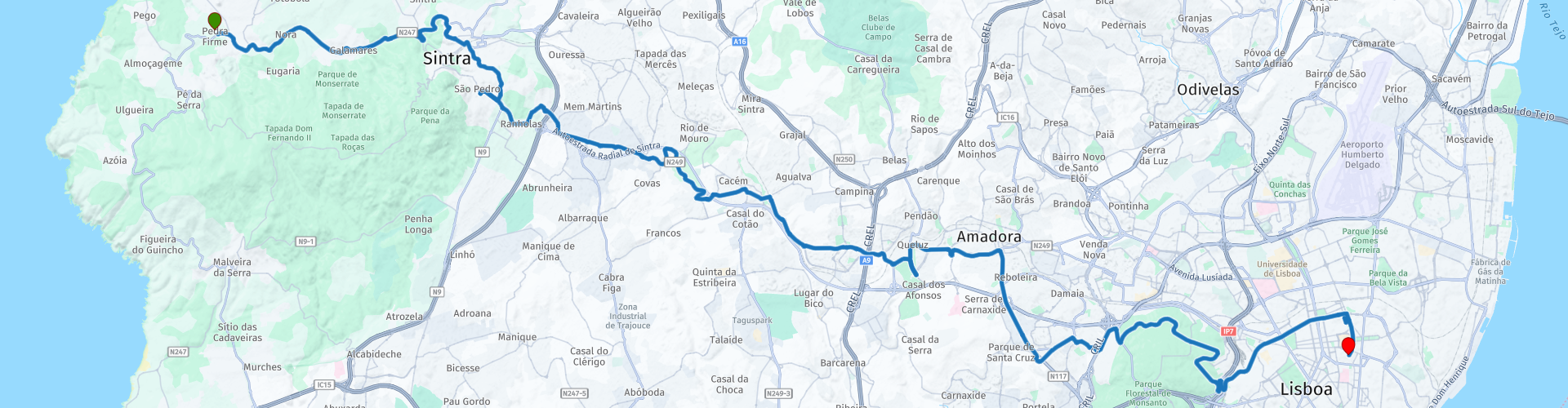
Cabo da Roca Scooter Trip 2nd Day

This route was brought to you by:
RouteXpert JR
Last edit: 27-01-2025
 Route Summary
 Rating: 5 stars
Sintra alone makes this route worth 5 stars. The charm of the national and regional roads adds to the overall appeal, making the ride even more captivating. The palaces on the route offer a perfect blend of beauty and Portuguese culture, making it a must-see for any traveler.
 Share this route


Animation

Verdict


Duration
5h 44m

Mode of travel
Car or motorcycle

Distance
45.52 km

Countries

 RouteXpert Review
 The ride continues through gorgeous national and regional roads, offering a peaceful and scenic journey back to Lisbon. The Queluz Palace is another fantastic stop, providing a glimpse of Portuguese royalty and exquisite architecture.
This route offers a perfect blend of scenic beauty, cultural landmarks, and historical sites, making it an ideal choice for anyone looking to enjoy a memorable scooter adventure. Sintra, in particular, stands out as a highlight, ensuring this leg of the journey is unforgettable.


 Links
Links  Usage
Usage Want to download this route?
You can download the route for free without MyRoute-app account. To do so, open the route and click 'save as'. Want to edit this route?
No problem, start by opening the route. Follow the tutorial and create your personal MyRoute-app account. After registration, your trial starts automatically.  Disclaimer
Use of this GPS route is at your own expense and risk. The route has been carefully composed and checked by a MyRoute-app accredited RouteXpert for use on TomTom, Garmin and MyRoute-app Navigation.
Changes may nevertheless have occurred due to changed circumstances, road diversions or seasonal closures. We therefore recommend checking each route before use.
Preferably use the route track in your navigation system. More information about the use of MyRoute-app can be found on the website under 'Community' or 'Academy'.
Changes may nevertheless have occurred due to changed circumstances, road diversions or seasonal closures. We therefore recommend checking each route before use.
Preferably use the route track in your navigation system. More information about the use of MyRoute-app can be found on the website under 'Community' or 'Academy'.
 Nearby routes
Lissabon
About this region
Lisbon (; Portuguese: Lisboa [liʒˈβo.ɐ] (listen)) is the capital and the largest city of Portugal, with an estimated population of 544,851 within its administrative limits in an area of 100.05 km2. Lisbon's urban area extends beyond the city's administrative limits with a population of around 2.0 million people, being the 10th-most populous urban area in the European Union. About 2.9 million people live in the Lisbon metropolitan area, which represents approximately 27% of the country's population. It is mainland Europe's westernmost capital city and the only one along the Atlantic coast. Lisbon lies in the western Iberian Peninsula on the Atlantic Ocean and the River Tagus. The westernmost portions of its metro area, the Portuguese Riviera, form the westernmost point of Continental Europe, culminating at Cabo da Roca.
Lisbon is recognised as an alpha-level global city because of its importance in finance, commerce, media, entertainment, arts, international trade, education and tourism. Lisbon is one of two Portuguese cities (alongside Porto) to be recognised as a global city. It is one of the major economic centres on the continent, with a growing financial sector and one of the largest container ports on Europe's Atlantic coast. Additionally, Humberto Delgado Airport served 29 million passengers in 2018, being the busiest airport in Portugal, the 3rd busiest in the Iberian Peninsula and the 20th busiest in Europe. The motorway network and the high-speed rail system of Alfa Pendular links the main cities of Portugal to Lisbon. The city is the 9th-most-visited city in Southern Europe, after Istanbul, Rome, Barcelona, Milan, Athens, Venice, Madrid and Florence with 3,539,400 tourists in 2018. The Lisbon region has a higher GDP PPP per capita than any other region in Portugal. Its GDP amounts to US$96.3 billion and thus $32,434 per capita. The city occupies the 40th place of highest gross earnings in the world. Most of the headquarters of multinational corporations in Portugal are located in the Lisbon area. It is also the political centre of the country, as its seat of government and residence of the head of state.
Lisbon is one of the oldest cities in the world, and the second-oldest European capital city (after Athens), predating other modern European capitals by centuries. Julius Caesar made it a municipium called Felicitas Julia, adding to the name Olissipo. After the fall of the Roman Empire it was ruled by a series of Germanic tribes from the 5th century; later it was captured by the Moors in the 8th century. In 1147 Afonso Henriques conquered the city and since then it has been the political, economic and cultural center of Portugal.
Read more on Wikipedia
Lisbon is recognised as an alpha-level global city because of its importance in finance, commerce, media, entertainment, arts, international trade, education and tourism. Lisbon is one of two Portuguese cities (alongside Porto) to be recognised as a global city. It is one of the major economic centres on the continent, with a growing financial sector and one of the largest container ports on Europe's Atlantic coast. Additionally, Humberto Delgado Airport served 29 million passengers in 2018, being the busiest airport in Portugal, the 3rd busiest in the Iberian Peninsula and the 20th busiest in Europe. The motorway network and the high-speed rail system of Alfa Pendular links the main cities of Portugal to Lisbon. The city is the 9th-most-visited city in Southern Europe, after Istanbul, Rome, Barcelona, Milan, Athens, Venice, Madrid and Florence with 3,539,400 tourists in 2018. The Lisbon region has a higher GDP PPP per capita than any other region in Portugal. Its GDP amounts to US$96.3 billion and thus $32,434 per capita. The city occupies the 40th place of highest gross earnings in the world. Most of the headquarters of multinational corporations in Portugal are located in the Lisbon area. It is also the political centre of the country, as its seat of government and residence of the head of state.
Lisbon is one of the oldest cities in the world, and the second-oldest European capital city (after Athens), predating other modern European capitals by centuries. Julius Caesar made it a municipium called Felicitas Julia, adding to the name Olissipo. After the fall of the Roman Empire it was ruled by a series of Germanic tribes from the 5th century; later it was captured by the Moors in the 8th century. In 1147 Afonso Henriques conquered the city and since then it has been the political, economic and cultural center of Portugal.
View region
 Statistics
  6
6Amount of RX reviews (Lissabon)
 14283
14283Amount of visitors (Lissabon)
 90
90Amount of downloads (Lissabon)
 Route Collections in this region
 Southern Spain and Portugal
The Iberian Border: A Journey Through Two Worlds
Here, in the far southwestern corner of the European continent, two countries lie side by side. At first glance, Spain and Portugal seem almost identical... and yet, once we cross the invisible border, we suddenly find ourselves in a completely different world.
It's a remarkable phenomenon. With just a single step—or the revolution of a wheel—everything changes. The language, the pulse of the music, the smells from the kitchen... even time itself shifts. It's an abrupt transition that captivates the senses.
Just look at this landscape. A spectacular display of Mother Nature. As we travel along the winding roads, we see vast olive groves give way to shady, cool cork oak forests. And there, where the land meets the ocean, we encounter a dramatic contrast: ancient, rugged cliffs standing guard over tranquil, golden beaches.
In the heart of Portugal lies Lisbon. A city pulsating with a life all its own. Here, you can hear the melancholic sounds of Fado, while historic trams weave their way through narrow streets, side by side with restless tuk-tuks. It's a place where history and culture are etched in every stone.
For the traveler on two wheels, this is paradise. The roads wind through the landscape like rivers, virtually undisturbed by heavy traffic. And so, with the rich taste of port wine in their luggage and the echo of flamenco still in their ears, the traveler completes their migration... and finally returns to the familiar port of Malaga. A truly... fascinating journey.
Here, in the far southwestern corner of the European continent, two countries lie side by side. At first glance, Spain and Portugal seem almost identical... and yet, once we cross the invisible border, we suddenly find ourselves in a completely different world.
It's a remarkable phenomenon. With just a single step—or the revolution of a wheel—everything changes. The language, the pulse of the music, the smells from the kitchen... even time itself shifts. It's an abrupt transition that captivates the senses.
Just look at this landscape. A spectacular display of Mother Nature. As we travel along the winding roads, we see vast olive groves give way to shady, cool cork oak forests. And there, where the land meets the ocean, we encounter a dramatic contrast: ancient, rugged cliffs standing guard over tranquil, golden beaches.
In the heart of Portugal lies Lisbon. A city pulsating with a life all its own. Here, you can hear the melancholic sounds of Fado, while historic trams weave their way through narrow streets, side by side with restless tuk-tuks. It's a place where history and culture are etched in every stone.
For the traveler on two wheels, this is paradise. The roads wind through the landscape like rivers, virtually undisturbed by heavy traffic. And so, with the rich taste of port wine in their luggage and the echo of flamenco still in their ears, the traveler completes their migration... and finally returns to the familiar port of Malaga. A truly... fascinating journey.
View Route Collection