
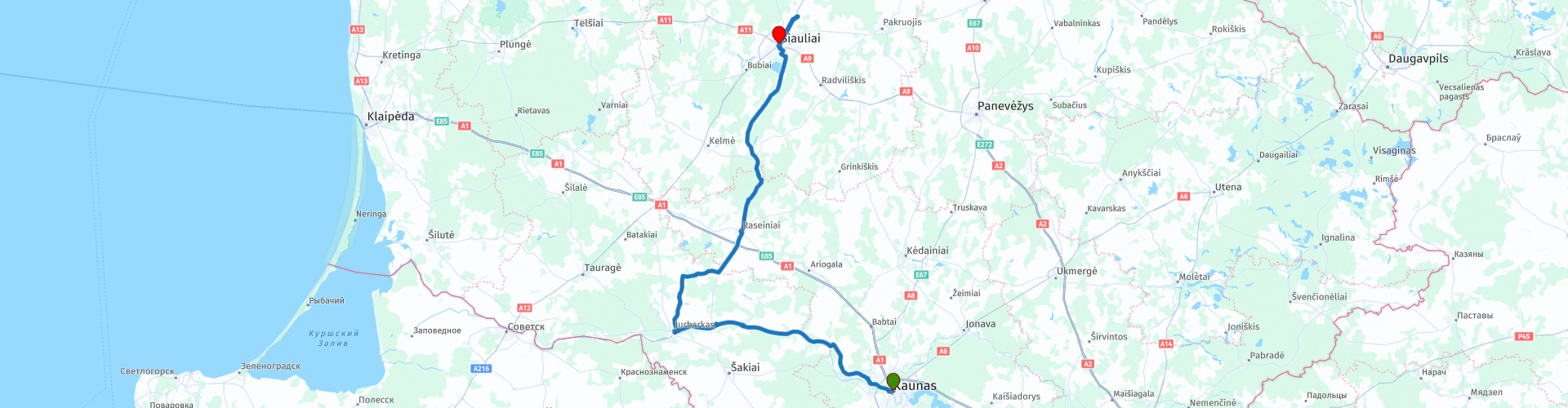
Lithuania from Kaunas

This route was brought to you by:
RouteXpert Jan Koelstra - Senior Rx
Last edit: 16-12-2025
 Route Summary
 Kaunas has many sights to see, including the largest church in the Baltic States and a picturesque old town.
At the edge of the city, explore a former air raid shelter, 6 meters underground, housing a KGB bunker. Further along the Memel River, you'll find beautiful country houses, some of which are open to visitors.
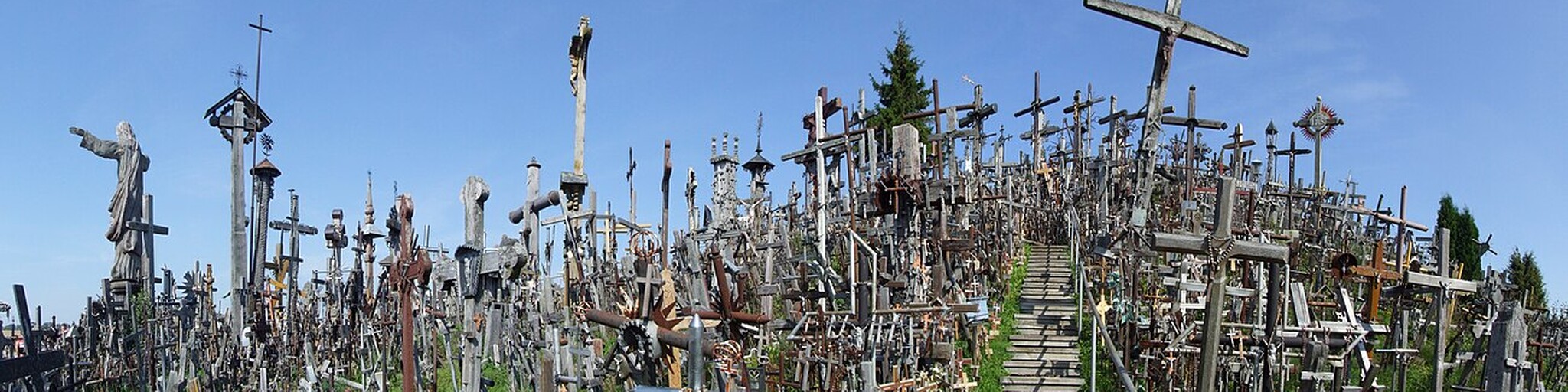
From Jurbarkas, a rolling route north begins, passing traditional villages with the occasional manor house and church, but there are also some gems. For example, you'll pass through Raseiniai, one of Lithuania's oldest towns. The legendary hill forts and the nearby, now-forgotten, ancient cemeteries scattered throughout the valleys of the Dubysa River prove that people have lived along the river since ancient times. Or Siluva, known since the early 16th century for its feast of indulgences and the first widely known apparition of the Virgin Mary in Europe. Today, Siluva is one of Lithuania's most important pilgrimage sites. The next stop is Tytuvenai. The Church of Our Lady of Tytuvėnai and the Bernardine Monastery complex are among the largest and most important examples of 17th- and 18th-century sacred architecture in Lithuania. The final stop on the tour is Cross Hill. The hill, with its approximately 100,000 crosses, is a historic architectural monument and a unique collection of folk art. Your tour ends in Siauliai, the regional capital in the north of the country.
This part of Lithuania is a surprising destination for those who love unspoiled nature, history, and exploring hidden gems; it has a 4-star rating.
 Share this route


Animation

Verdict


Duration
7h 37m

Mode of travel
Car or motorcycle

Distance
234.50 km

Countries

 RouteXpert Review
 Kaunas
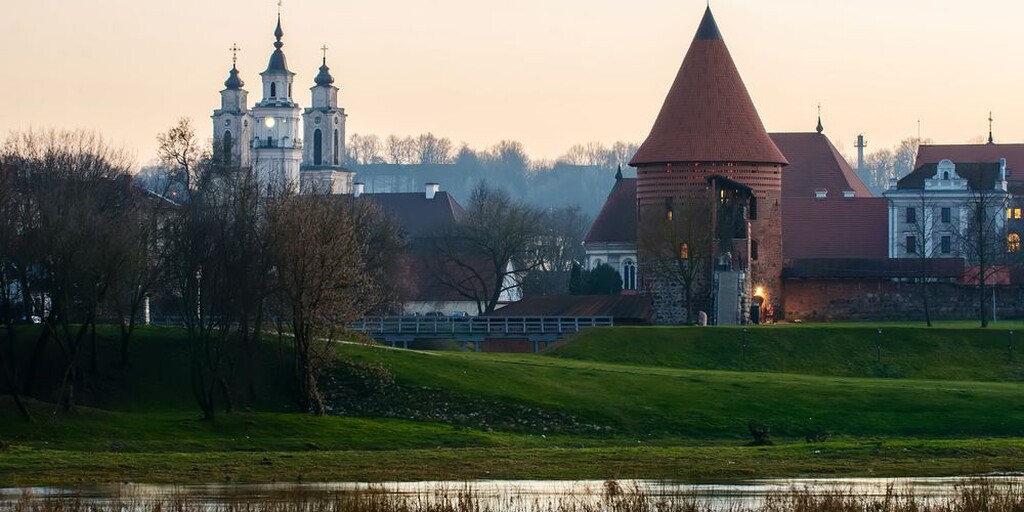
Kaunas, Lithuania's second city, was once a Hanseatic city and is now an important museum and university town. Town Hall Square and the surrounding streets reflect the city's former prosperity. The Old Town is the most beautiful part of Kaunas. The area is of great archaeological, historical, and architectural value. Many beautiful historic buildings surround Rotušė Square. The Old Town boasts many 15th- and 16th-century houses, but the most striking is the Town Hall. Dating back to the 16th century, the building is also known as the "White Swan" because of its color and slender shape. The Town Hall's basement is a particularly popular wedding venue. Looking around, you'll also see the Jesuit Church and the Basilica of St. Peter and St. Paul. Don't miss the Vytautas Church, the Great Church, and the Perkuno House. The medieval city center and the promenade have been completely renovated and are definitely worth a visit. Another highlight of the city is the castle. Archaeological findings suggest the castle was built around the 14th century in the Gothic style. Situated on the riverbank, the castle primarily served as a lookout post. A major reconstruction took place in 2010 and 2011, and the round tower now houses an art gallery.
What might be of interest to Soviet heritage and Cold War enthusiasts is the so-called "KGB nuclear bunker" on the west side of the city. Visits are by appointment only. In the former bomb shelter, 6 meters underground, you can see, among other things, surveillance technology used by the NKVD and the KGB, as well as a vast collection of gas masks.
From Kaunas, follow the Memel River (Nemunas) west to Jurbarkas. Along the river are several former manor houses, some of which are open to visitors. First, you'll stop at Belvederis Manor. This Renaissance Revival palace comprises five interconnected sections with decorative window frames, floral motifs, and a prominent tower with an ornamental frame. The complex includes well-preserved secondary buildings such as stables, administrative offices, and living quarters that once housed staff.
The manor house has limited public access and can only be visited by appointment, but can be viewed from the outside.
Veliuona
In the distant past, wooden castles also stood on hills along the river. Although they have since disappeared, later made of stone, the castle mounds on which they stood are sometimes well preserved. The inscription on the base reads: Veliuona II Hillfort with Chapel. Its maximum height is 30 meters. From the top, there is a beautiful view of the Nemunas River. The foundation for the monument in honor of the Lithuanian Duke Gediminas was laid in 1925, as evidenced by inscriptions on the granite stone. There is also a ceremonial altar. It is believed that the brick Veliuona Castle was rebuilt here in 1412.
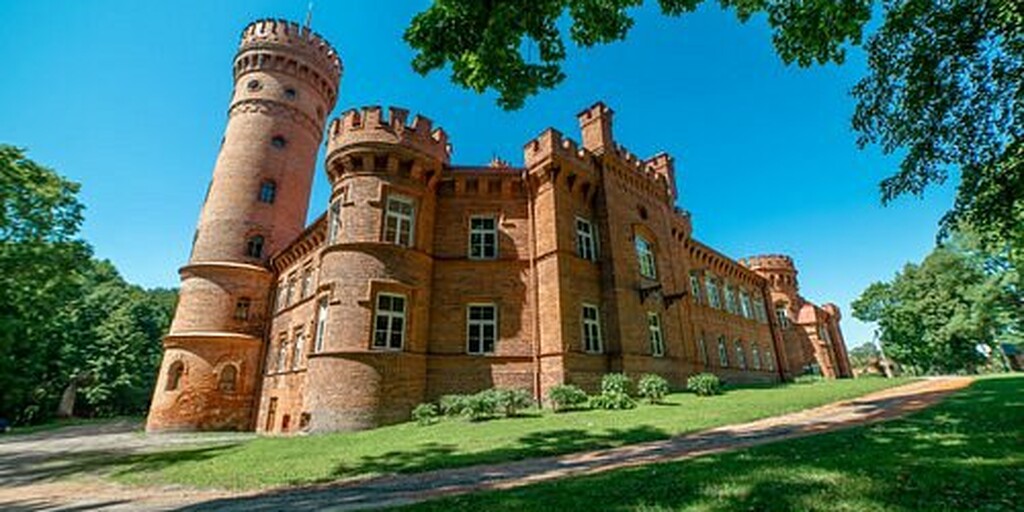
A little further on stands the 19th-century Raudonė Castle, which now serves as a school and is open to visitors. A tower of the 19th-century castle offers a magnificent view of the Nemunas Valley.
Panemunė Castle is a Renaissance fortified castle with four wings surrounding a central courtyard and corner towers. The complex is situated in a park with five stepped ponds that create visual depth and structure the landscape. You can explore all the restored sections of the castle and enjoy views from the towers over the river valley. The paths in the park allow you to stroll at your own pace and admire the scenery.
Jurbarkas (coffee break)
The town of Jurbarkas occupies a rather special place in the Lithuanian cultural and political landscape. Unlike other towns and villages in Lithuania, the residents of Jurbarkas are committed to preserving the history of their town, where Jews once lived and formed an integral part of the community, playing a central role in the urban and economic development of the region. Although no Jews live in Jurbarkas today, the Jurbarkas Jewish Cemetery, known as Yurburg in Yiddish, has been restored by those who cherish the town's memory. The cemetery is now managed by the authorities. Synagogue Square, adjacent to the historic site of Yurburg's two main synagogues, was chosen as the location for a monument honoring the Jewish community of Yurburg.
After Jurbarkas, a rolling northward route begins, passing traditional villages with the occasional manor house and church, but there are also some gems. For example, you'll pass through Raseiniai, one of Lithuania's oldest towns. The legendary hill forts and the nearby, now-forgotten, ancient cemeteries scattered throughout the valleys of the Dubysa River prove that people have lived along the river since ancient times. Or Siluva, known since the early 16th century for its feast of indulgences and the first widely known apparition of Mary in Europe. Today, Siluva is one of the most important pilgrimage sites in Lithuania.
Tytuvėnai (lunch stop)
You'll drive through Tytuvėnai Regional Park, which forms a landscape of hills, lowlands, and extensive peat forests. The park contains forests, wetlands, lakes, and open fields that together form a diverse ecosystem. The park was established in 1992 to protect Ice Age landscapes. These ancient geological processes created the terrain features we see today.
The Franciscan church and monastery in Tytuvėnai contains monks' cells decorated with frescoes and houses a gallery of Lithuanian works. Here you can experience religious art and monastic life from several centuries.
Siauliai (drink stop)
After a drink stop in Siauliai, you leave the town to first visit the Hill of Crosses and then return.
Hill of Crosses
Just beyond the town of Siauliai lies a remarkable monument. Over a period of about two hundred years, pilgrims have erected thousands of crosses on a small hill, creating a spectacular sight.
In the Middle Ages, a wooden castle stood on the hill in question, approximately twelve kilometers north of the present-day town of Siauliai. This castle was destroyed in the mid-14th century by members of the Livonian Order. According to some reports, Lithuanians began placing crosses on the historic hill from the mid-19th century onward, believing it to be a sacred site. In 1795, Lithuania became part of Russia. Poles and Lithuanians subsequently protested against the Russians twice, unsuccessfully, during the November Uprising (1830-1831) and the January Uprising (1863). These two uprisings were connected to the birth of the Kryžiu Kalnas (Clark Hill). Families were unable to find the bodies of fallen rebels and therefore placed symbolic crosses on the site of a former defensive hill. It has become a national symbol of resistance. The Soviets razed the hill three times, and each time they started erecting new crosses. In 1993, Pope John Paul II had the large white (now gray) statue of Christ erected at the entrance. The number of crosses is now countless!
Siauliai (end point)
As special as the Hill of Crosses is, the nearby town of Siauliai seems ordinary. It seems so, because this town also boasts some remarkable sights. At first glance, the town of Siauliai appears to be an average provincial city. However, the town is brimming with street art. The main street, as well as several side streets, is adorned with various murals, statues, and other sculptures. Every corner holds a surprise, and after walking through the town center three times, you'll still discover new statues and murals.
Chaimo Frenkelio's villa survived both the First and Second World Wars. The beautiful Art Nouveau house, dating from 1908, tells the story of the life and work of this wealthy Jewish leather baron. At its peak, just before the First World War, some 1,000 people worked in his factories. He was also one of the few industrialists who lived next to his factories. After the war, the family never regained that level of success, partly due to the departure of most of the family from Lithuania. The house and its associated factories were eventually transferred to the local government, which completely renovated the house and its garden and converted it into a local museum. The adjacent factory halls still lie somewhat abandoned, awaiting a new purpose. Besides this villa, Siauliai boasts many other small museums, numbering over twenty. These include a bicycle museum, a cat museum, a chocolate museum, and a radio and television museum. The photography museum provides insights into Lithuanian photography. On the roof is a still-functioning camera obscura, and on the balcony you can see how the city has changed since the First World War by comparing old photos with the current situation.
Sometimes it's those seemingly boring towns that surprise you the most. Siauliai certainly falls into that category. So seize the opportunity to spend a day and/or night here before or after your visit to the Hill of Crosses.
 Links
Links  Usage
Usage Want to download this route?
You can download the route for free without MyRoute-app account. To do so, open the route and click 'save as'. Want to edit this route?
No problem, start by opening the route. Follow the tutorial and create your personal MyRoute-app account. After registration, your trial starts automatically.  Disclaimer
Use of this GPS route is at your own expense and risk. The route has been carefully composed and checked by a MyRoute-app accredited RouteXpert for use on TomTom, Garmin and MyRoute-app Navigation.
Changes may nevertheless have occurred due to changed circumstances, road diversions or seasonal closures. We therefore recommend checking each route before use.
Preferably use the route track in your navigation system. More information about the use of MyRoute-app can be found on the website under 'Community' or 'Academy'.
Changes may nevertheless have occurred due to changed circumstances, road diversions or seasonal closures. We therefore recommend checking each route before use.
Preferably use the route track in your navigation system. More information about the use of MyRoute-app can be found on the website under 'Community' or 'Academy'.
 Nearby routes
iauliai
About this region
Linkuva (pronunciation ); is a city in the Pakruojis district municipality, Lithuania. It is located 18 km (11 mi) north-east of Pakruojis.The town is more than 500 years old. Linkuva is a state-protected urbanistic monument. It is one of the oldest towns of Lithuanian Semigalia. 7 streets are coming into the central square of Linkuva.
Read more on Wikipedia
View region
 Statistics
  1
1Amount of RX reviews (iauliai)
 120
120Amount of visitors (iauliai)
 0
0Amount of downloads (iauliai)
 Route Collections in this region
 Lithuania
Lithuania, the largest and southernmost Baltic state and the geographic center of Europe, boasts castles, palaces, numerous natural lakes, and excellent infrastructure. The Lithuanian capital, Vilnius, is considered a Baroque masterpiece with countless churches. It is also known for the modern architecture of its business centers and residential towers. Beyond the major cities, there's much more to see on your holiday in Lithuania, such as the numerous lakes, forests, and fortress hills, Trakai Castle, the Cold War Museum housed in a former Russian nuclear missile base, the coastal spit, and the Rumsiskes Open-Air Museum.
Five national nature parks have been established across the country for the protection and study of Lithuania's nature and historical heritage.
You'll get a good idea of the country with the tours below, spread throughout the country, each with its own character.
There are five routes set out in Lithuania:
Route 1 northwest from Klaipeda, with a focus on the Curonian Spit and Žemaitija National Park.
Route 2 east around Vilnius, the baroque capital with many churches, Trakai with its island castle.
Route 3 south from Druskininka, spa town, Grūtas Park (Soviet Sculpture Park) and Kernave World Heritage site
Route 4 northeast from Visaginas along the Ignalina nuclear power plant and through the Aukštaitija National Park
Route 5 central from Kaunas, modern city and visit to the mysterious Hill of Crosses near Šiauliai
Five national nature parks have been established across the country for the protection and study of Lithuania's nature and historical heritage.
You'll get a good idea of the country with the tours below, spread throughout the country, each with its own character.
There are five routes set out in Lithuania:
Route 1 northwest from Klaipeda, with a focus on the Curonian Spit and Žemaitija National Park.
Route 2 east around Vilnius, the baroque capital with many churches, Trakai with its island castle.
Route 3 south from Druskininka, spa town, Grūtas Park (Soviet Sculpture Park) and Kernave World Heritage site
Route 4 northeast from Visaginas along the Ignalina nuclear power plant and through the Aukštaitija National Park
Route 5 central from Kaunas, modern city and visit to the mysterious Hill of Crosses near Šiauliai
View Route Collection
Lithuania
Lithuania is the headstrong rebel of the Baltic states. While its neighbors can sometimes be a bit reserved, Lithuania surprises with a warm blend of baroque splendor, deep forests, and a healthy dose of artistic quirkiness. It's a destination for travelers who prefer to discover a good story rather than follow a well-trodden tourist trail. The emphasis is therefore primarily on the countryside with its diverse landscapes and simply enjoying the ride. Of course, the real tourist attractions are also visited.
Vilnius: The capital, Vilnius, boasts one of the largest medieval city centers in Europe. But its true character lies in the "republic" of Užupis. This artists' quarter declared itself independent and has a constitution that states that "a dog has the right to be a dog." It's charming, creative, and a touch absurdist.
Trakai: This fairytale-like red-brick castle sits on an island in Lake Galvė. It looks like something straight out of a Disney film, but its history is purely Baltic. Be sure to try the kibinai, traditional pastries from the local Karaite community.
The Curonian Spit: This narrow spit of land on the Baltic Sea offers an almost otherworldly landscape of towering, wandering dunes and fragrant pine forests. It's the perfect spot for those seeking peace and quiet and a breath of fresh air on the coast.
The Hill of Crosses: A surreal and deeply moving place near Siauliai. Tens of thousands of crosses form a monument to resistance and religious hope. Whether you are religious or not, the atmosphere leaves no one unmoved.
Are you looking for a series of road trips full of historic cities, picturesque villages, unique spots, and impressive nature? Then this collection of five routes, including a circular route, will make for a truly enjoyable holiday. Moreover, they're easy to combine, as each route explores a different part of Lithuania.
Vilnius: The capital, Vilnius, boasts one of the largest medieval city centers in Europe. But its true character lies in the "republic" of Užupis. This artists' quarter declared itself independent and has a constitution that states that "a dog has the right to be a dog." It's charming, creative, and a touch absurdist.
Trakai: This fairytale-like red-brick castle sits on an island in Lake Galvė. It looks like something straight out of a Disney film, but its history is purely Baltic. Be sure to try the kibinai, traditional pastries from the local Karaite community.
The Curonian Spit: This narrow spit of land on the Baltic Sea offers an almost otherworldly landscape of towering, wandering dunes and fragrant pine forests. It's the perfect spot for those seeking peace and quiet and a breath of fresh air on the coast.
The Hill of Crosses: A surreal and deeply moving place near Siauliai. Tens of thousands of crosses form a monument to resistance and religious hope. Whether you are religious or not, the atmosphere leaves no one unmoved.
Are you looking for a series of road trips full of historic cities, picturesque villages, unique spots, and impressive nature? Then this collection of five routes, including a circular route, will make for a truly enjoyable holiday. Moreover, they're easy to combine, as each route explores a different part of Lithuania.
View Route Collection