
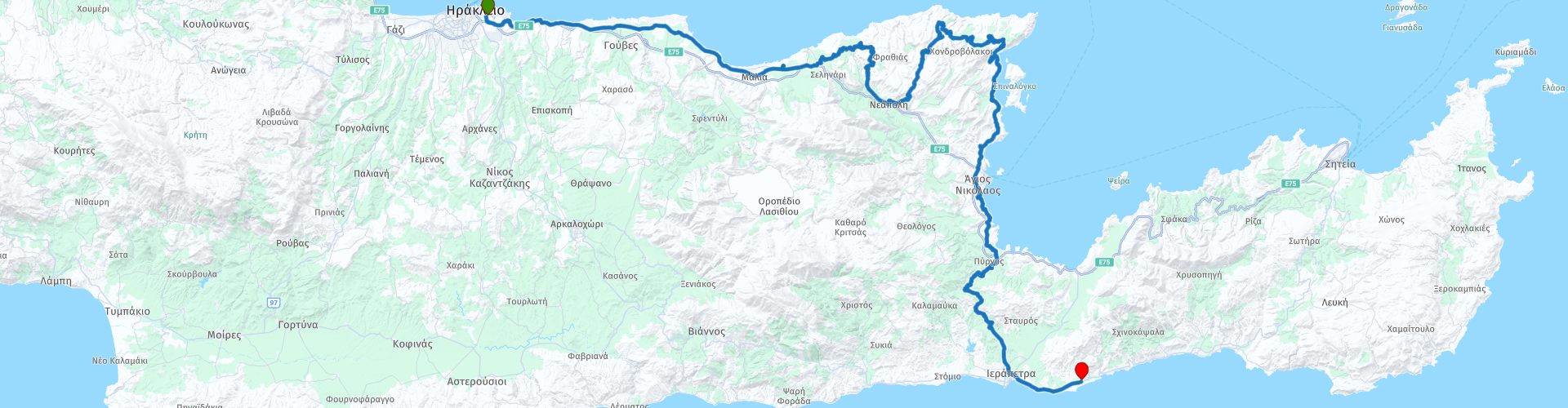
Roadtrip Crete Day 1 Heraklion to Koutsounari

This route was brought to you by:
RouteXpert René Plücken (MRA Master)
Last edit: 26-11-2025
 Route Summary
 Motorcycling in Crete is a true pleasure. This island has many beautiful winding roads with thousands of bends, idyllic villages, stunning views of the sea, bays, beautiful passes, and ravines.
The locals are very hospitable. The roads are reasonable, but it's recommended to rent an all- or off-road motorcycle, as there are also many poor roads with potholes and unpaved sections.
This highly touristy island boasts many hotels, particularly along the coast. There are also B&Bs and several campsites. This tour will focus on campsites.
The routes can be explored by motorcycle, car, or quad bike, and there are several rental companies in Crete where you can rent all-road, custom, quad bikes, buggies, scooters, and cars. Prices for a weekly motorcycle rental range from €280 to €900, depending on the model.
Renting from Eurodriver has the advantage that they can deliver your motorcycle anywhere, so you can hop on your motorcycle at the airport and start your journey.
This first day is already a great start to the Crete Road Trip, with beautiful winding roads, stunning panoramas, and a number of potential sights to visit. That's why I rate this route 5***** stars.
 Share this route


Animation

Verdict


Duration
7h 19m

Mode of travel
Car or motorcycle

Distance
141.54 km

Countries

 RouteXpert Review
 We drive along the coast with beautiful views of the Cretan Sea, the southern part of the Aegean Sea, located north of Crete and south of the Cyclades. To the west, the sea borders the island of Kythira, and to the east, the Dodecanese archipelago. Along the route, there are several small parking areas where you can stop to enjoy the panorama and take a photo.
We pass a number of seaside resorts along the coast; you can choose to deviate from the route and visit one of the beautiful beaches.
The first possible stop is Dinosauria Park, where dinosaur enthusiasts can explore the park, which began as an idea in 2013 and was first housed in the former US base. There were 30 different dinosaur species from all periods of the Mesozoic Era, as well as other prehistoric animals. In 2014, the exhibits were moved to their own dedicated space. New species were added, as were new sections, such as a dinosaur hospital where you can witness the birth of a dinosaur.
In the creative activity area, everyone becomes a child again. Try to find as many dinosaurs as possible in the tidal zone and play various "dinosaur games." Visitors can watch themed films released in 5D and 7D cinema.
Another fun stop is Aquaworld, Crete's first aquarium, in Hersonissos. Aquaworld showcases local marine life and reptiles from all over! Hands-on interaction with many of the animals is possible, and you can take wonderful photos at Aquaworld. Most of the animals were rescued or injured and now have a loving home at Aquaworld.
We continue our journey along the coast, overlooking the beautiful Bay of Malia and its lovely beaches. You can visit the Malia Archaeological Site, a small archaeological site with some ruins and excavations. Admission costs €6. There are no restrooms or shops, and a guided tour takes about an hour.
Now we're driving out of the populated area and into the mountains. The roads are getting serious, with wonderful (hairpin) bends and stunning panoramas. Wherever possible, we stop to enjoy the scenery and take a photo.
You can visit the Cave of Milatos, which is best known for the events that took place there during the Greek War of Independence. To suppress a threatening uprising against the Ottoman Empire, an Egyptian-Turkish army led by Hassan Pasha was sent to Crete in 1822. When Hassan arrived in the city of Neapoli in 1823, many residents fled to the Cave of Milatos. The cave reportedly held between 2,000 and 3,600 people. Among them were approximately 300 armed men, the rest women and children. On February 3, 1823, Hassan Pasha blocked the exits to the valley where the cave is located and then ordered the army to shell the entrance. The siege lasted until February 15, when the refugees were forced to surrender to avoid dying of thirst. The men were killed or taken to Spinalonga, where they were later executed. The older women were also killed. The younger women and children were sold as slaves.
An inscription at the entrance to the cave commemorates the events of 1823. A chapel was built in the cave in honor of the apostle Thomas. The accompanying ossuary contains some of the victims' bones. Every year on the Sunday after Easter, a feast is held here in honor of Thomas, and the dead are commemorated.
We continue our journey along a beautiful, narrow, winding road that marks the border of the Latsidiani Kefala Nature Reserve. A mountainous landscape of dry rocks, heathland, and trees. The road winds back down through this beautiful landscape.
You can visit Amazon Park, a small zoo/park with beautiful birds and monkeys. Afterward, we'll drive through a beautiful valley on a narrow, winding road that occasionally passes through a small village. Enjoy the beautiful scenery and drive east along the winding road, then take the scenic coastal road along the Gulf of Mirabello south to the fishing village of Elounda, where we'll stop for lunch and perhaps a stroll through the village, including a visit to the bazaar. Just before Elounda, there are differences in the routes between TomTom, OSM, and Here due to the one-way system in the village. So, follow the signs to visit the village.
After lunch, we continue along the Gulf of Mirabello, offering stunning panoramas. There are several viewpoints to enjoy the beautiful vistas. Just before the small town of Kalo Chorio, we leave the coastal road and head south through the interior. From here, the roads wind through a beautiful mountainous area. The roads here are generally of good quality, but narrow, so be aware of oncoming traffic. We follow this road to Daidalou on the Mediterranean Sea.
From Daidalou, we follow the coastal road to our final destination in Koutsounari, where we'll stay for two days. This first day is a wonderful start to our Crete road trip, with beautiful winding roads, stunning panoramas, and a number of potential sights to visit. That's why I rate this route 5***** stars.


 Links
Links  Usage
Usage Want to download this route?
You can download the route for free without MyRoute-app account. To do so, open the route and click 'save as'. Want to edit this route?
No problem, start by opening the route. Follow the tutorial and create your personal MyRoute-app account. After registration, your trial starts automatically.  Disclaimer
Use of this GPS route is at your own expense and risk. The route has been carefully composed and checked by a MyRoute-app accredited RouteXpert for use on TomTom, Garmin and MyRoute-app Navigation.
Changes may nevertheless have occurred due to changed circumstances, road diversions or seasonal closures. We therefore recommend checking each route before use.
Preferably use the route track in your navigation system. More information about the use of MyRoute-app can be found on the website under 'Community' or 'Academy'.
Changes may nevertheless have occurred due to changed circumstances, road diversions or seasonal closures. We therefore recommend checking each route before use.
Preferably use the route track in your navigation system. More information about the use of MyRoute-app can be found on the website under 'Community' or 'Academy'.
 Nearby routes
Crete
About this region
Crete (Greek: Κρήτη, Modern: Kríti, Ancient: Krḗtē, [krέːtεː]) is the largest and most populous of the Greek islands, the 88th largest island in the world and the fifth largest island in the Mediterranean Sea, after Sicily, Sardinia, Cyprus, and Corsica. Crete rests approximately 160 km (99 mi) south of the Greek mainland. It has an area of 8,336 km2 (3,219 sq mi) and a coastline of 1,046 km (650 mi). It bounds the southern border of the Aegean Sea, with the Sea of Crete (or North Cretan Sea) to the north and the Libyan Sea (or South Cretan Sea) to the south.
Crete and a number of islands and islets that surround it constitute the Region of Crete (Greek: Περιφέρεια Κρήτης), which is the southernmost of the 13 top-level administrative units of Greece, and the fifth most populous of Greece's regions. Its capital and largest city is Heraklion, located on the north shore of the island. As of 2020, the region had a population of 636,504. The Dodecanese are located to the northeast of Crete, while the Cyclades are situated to the north, separated by the Sea of Crete. The Peloponnese is to the region's northwest.
Humans have inhabited the island since at least 130,000 years ago, during the Paleolithic age. Crete was the centre of Europe's first advanced civilization, the Minoans, from 2700 to 1420 BC. The Minoan civilization was overrun by the Mycenaean civilization from mainland Greece. Crete was later ruled by Rome, then successively by the Byzantine Empire, Andalusian Arabs, the Venetian Republic, and the Ottoman Empire. In 1898 Crete, whose people had for some time wanted to join the Greek state, achieved independence from the Ottomans, formally becoming the Cretan State. Crete became part of Greece in December 1913.
The island is mostly mountainous, and its character is defined by a high mountain range crossing from west to east. It includes Crete's highest point, Mount Ida, and the range of the White Mountains (Lefka Ori) with 30 summits above 2000 metres in altitude and the Samaria Gorge, a World Biosphere Reserve. Crete forms a significant part of the economy and cultural heritage of Greece, while retaining its own local cultural traits (such as its own poetry and music). The Nikos Kazantzakis airport at Heraklion and the Daskalogiannis airport at Chania serve international travelers. The palace of Knossos, a Bronze Age settlement and ancient Minoan city, is also located in Heraklion.
Read more on Wikipedia
Crete and a number of islands and islets that surround it constitute the Region of Crete (Greek: Περιφέρεια Κρήτης), which is the southernmost of the 13 top-level administrative units of Greece, and the fifth most populous of Greece's regions. Its capital and largest city is Heraklion, located on the north shore of the island. As of 2020, the region had a population of 636,504. The Dodecanese are located to the northeast of Crete, while the Cyclades are situated to the north, separated by the Sea of Crete. The Peloponnese is to the region's northwest.
Humans have inhabited the island since at least 130,000 years ago, during the Paleolithic age. Crete was the centre of Europe's first advanced civilization, the Minoans, from 2700 to 1420 BC. The Minoan civilization was overrun by the Mycenaean civilization from mainland Greece. Crete was later ruled by Rome, then successively by the Byzantine Empire, Andalusian Arabs, the Venetian Republic, and the Ottoman Empire. In 1898 Crete, whose people had for some time wanted to join the Greek state, achieved independence from the Ottomans, formally becoming the Cretan State. Crete became part of Greece in December 1913.
The island is mostly mountainous, and its character is defined by a high mountain range crossing from west to east. It includes Crete's highest point, Mount Ida, and the range of the White Mountains (Lefka Ori) with 30 summits above 2000 metres in altitude and the Samaria Gorge, a World Biosphere Reserve. Crete forms a significant part of the economy and cultural heritage of Greece, while retaining its own local cultural traits (such as its own poetry and music). The Nikos Kazantzakis airport at Heraklion and the Daskalogiannis airport at Chania serve international travelers. The palace of Knossos, a Bronze Age settlement and ancient Minoan city, is also located in Heraklion.
View region
 Statistics
  8
8Amount of RX reviews (Crete)
 10564
10564Amount of visitors (Crete)
 368
368Amount of downloads (Crete)
 Route Collections in this region
 Eight beautiful routes in Crete Greece
This is a collection of 8 routes for an 8-day tour on the Greek island of Crete.
Motorcycling in Crete is a real pleasure, this island has many beautiful winding roads with thousands of bends, idyllic villages, beautiful views of the sea, bays, beautiful passes and ravines.
The locals are very hospitable. The roads are decent, but it is advisable to rent an All or Off Road motorcycle, as there are also many bad roads with potholes and unpaved areas.
On the very tourist island there are many hotels, especially along the coast, there are also B&B and a number of campsites. In these routes we assume camping accommodation.
The routes can be driven by motorcycle, car or quads and there are several rental companies in Crete where you can rent All Road, Custom, Quads, Buggies, scooters and cars.
Motorcycling in Crete is a real pleasure, this island has many beautiful winding roads with thousands of bends, idyllic villages, beautiful views of the sea, bays, beautiful passes and ravines.
The locals are very hospitable. The roads are decent, but it is advisable to rent an All or Off Road motorcycle, as there are also many bad roads with potholes and unpaved areas.
On the very tourist island there are many hotels, especially along the coast, there are also B&B and a number of campsites. In these routes we assume camping accommodation.
The routes can be driven by motorcycle, car or quads and there are several rental companies in Crete where you can rent All Road, Custom, Quads, Buggies, scooters and cars.
View Route Collection