
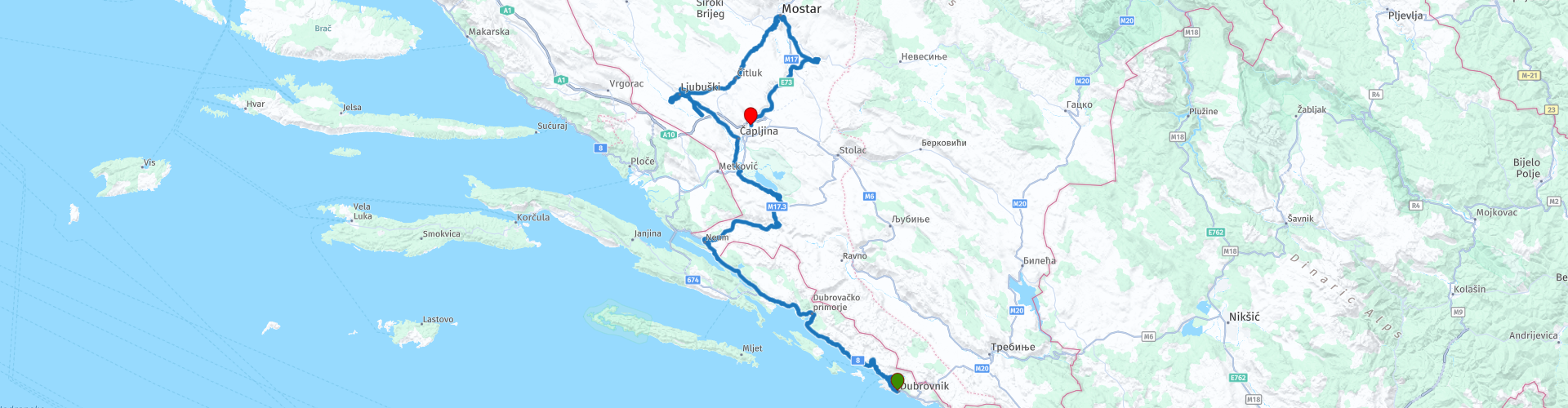
Ragusa Mostar from Dubrovnik

This route was brought to you by:
RouteXpert Jan Koelstra - Senior Rx
Last edit: 09-10-2025
 Route Summary
 This route heads north from Dubrovnik, passing the many beaches and villages of the southern Dalmatian coast to Neum, Bosnia-Herzegovina's only coastal town, before taking a detour along the Neretva River to Mostar to explore, among other things, the famous Stari Most bridge. Bosnia-Herzegovina boasts several well-preserved Roman and medieval sites to explore.
The many cultural discoveries, such as Počitelj and Mostar, and the beautiful landscapes, including the magnificent Kravica waterfalls, make this a wonderful 5-star route.
 Share this route


Animation

Verdict


Duration
9h 17m

Mode of travel
Car or motorcycle

Distance
232.29 km

Countries


 RouteXpert Review
 Dubrovnik was founded in the first half of the 7th century by a group of refugees from Epidaurum, present-day Cavtat, and is known as the "Pearl of the Adriatic." Situated on the Dalmatian coast, the city became a major Mediterranean power from the 13th century onward. Although severely damaged by an earthquake in 1667, Dubrovnik managed to preserve its magnificent Gothic, Renaissance, and Baroque churches, monasteries, palaces, and fountains. The old town was again damaged by armed conflict in the 1990s. Within the historic city walls, no corner remains unused. Immerse yourself in history and stroll through Dubrovnik's narrow streets and charming squares. Culture, architecture, history, and art all converge here in a truly unique way.
You'll drive north out of the city; perhaps visit the famous 15th-century Trsteno Arboretum, until you reach the coastal town of Neum, driving along the southern Dalmatian coast. To prevent the aggressive Venetian Empire from attacking the Republic of Ragusa (Dubrovnik) from the north, the republic ceded a small area near Neum to the Ottoman Empire in 1699. This created a strip of land that remains part of Bosnia and Herzegovina today, separating it from the Republic of Ragusa (now Croatia).
Neum
This small town is a surprisingly peaceful stopover on the often-busy Croatian coastal route. Neum is the only coastal town in Bosnia and Herzegovina, giving it a unique appeal. Its short stretch of coastline, just 24 kilometers long, makes Neum a unique enclave on the Adriatic Sea. The atmosphere is relaxed and laid-back, without the hustle and bustle of nearby Croatian towns. What immediately strikes you as you approach Neum is the fairly steep descent to the sea. The town itself is built against a hillside, with whitewashed buildings cascading down to the crystal-clear water. The view from the higher parts of Neum is well worth it.
After a short visit, you'll leave Neum and head towards the interior of Bosnia-Herzegovina. You'll soon pass Hutovo Fortress, strategically situated on a hill that served as protection for salt shipments from Ston to the interior. Further on, Hutovo Blato Nature Park begins, a haven for countless bird species and known for its tranquil landscapes. You'll drive along the serene waters of Lake Svitavsko and arrive in Čapljina for a coffee break, although coffee is also available next to the excavation site of a Roman villa, Mogorjelo.
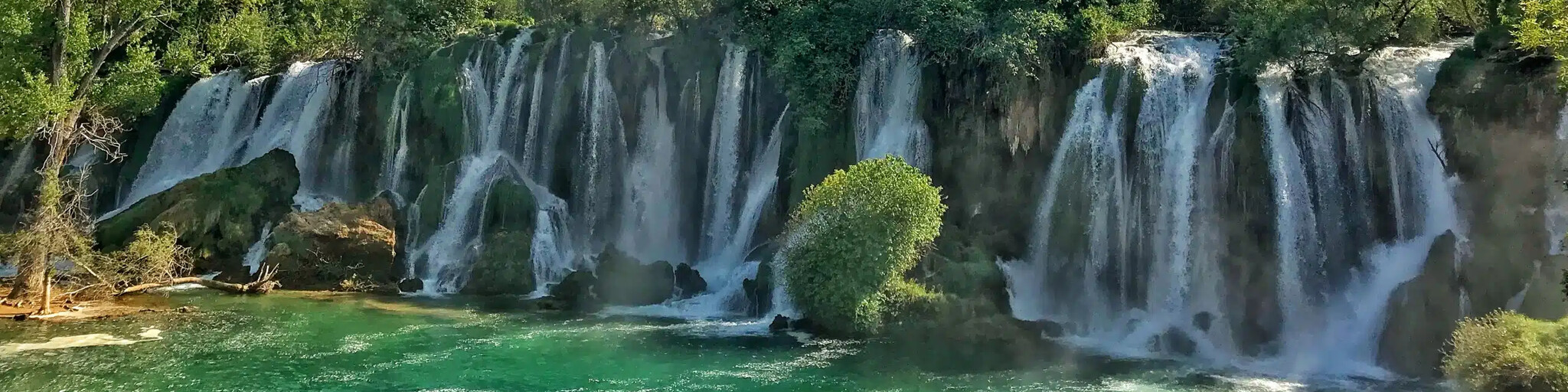
Kravica waterfall
After coffee, a visit to the Kravica Waterfall is on the agenda. This waterfall is one of Bosnia's most beautiful sights. The waterfall is approximately 25 meters high and consists of a series of cascades that converge into a large pool in the Trebižat River. From the parking lot, the Kravica Waterfall is easily accessible via a hiking trail. The walk down takes about 10 minutes, passing a platform where you immediately have a magnificent view of the waterfall.
Ljubuški
Descending along the beautiful riverbed of the Trebižat River, you will come to the Roman military camp of Gračine, from where you can take a wonderful journey into antiquity.
A little further on is the oldest museum in Bosnia and Herzegovina, which houses the oldest monument in Croatian: the Humač stone tablet from the 12th century. A visit to the museum, the Franciscan Monastery of St. Anthony of Padua on Humac, takes every visitor on an incredible prehistoric journey spanning 16,000 years.
You drive a short distance back to Ljubuški, where on the other side of the town stands a fortress dating back to 1444, built on a solid, rocky site. There, on Butorovići Hill, stand the imposing walls of the fortress of Herceg Stjepan. Duke (Herceg) Stjepan Vukčić Košacan (1404-1466) is the namesake of Herzegovina.
Medjugorje
Medjugorje is a mountain village in southern Bosnia and Herzegovina. It became known for a series of apparitions of Mary that have reportedly occurred there since 1981. It has since become a place of pilgrimage. Six children witnessed the apparitions, and although the Roman Catholic Church has permitted religious pilgrimages, this does not constitute recognition of the apparitions themselves. Medjugorje has become an important place of pilgrimage, attracting millions of visitors annually.
Mostar (lunch)
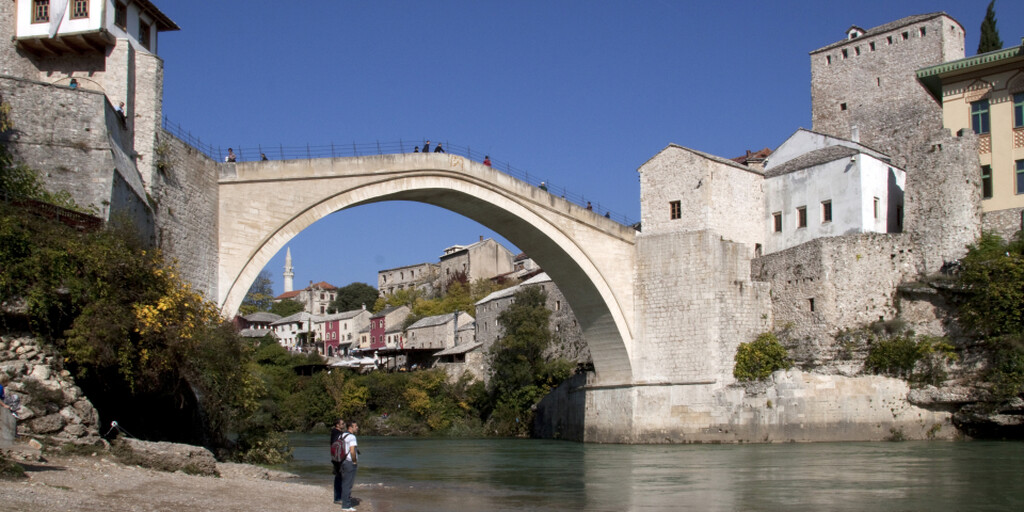
Mostar is perhaps the most charming city in Bosnia-Herzegovina. There are many historical sights; Mostar is a city with a rich history. Stari Most is Mostar's most famous landmark. The bridge connects the banks of the Neretva River in the heart of Mostar's Old Town. Built in the 16th century, the bridge was destroyed in 1993 during the Croat-Bosniak War. It was only restored in 2004. Stari Most and Mostar's Old Town are on the UNESCO World Heritage List. It's an old custom for young men to jump from the Mostar Bridge. Only after jumping off the bridge are you considered a real man. Slowly, the tradition is changing. Young men now jump from the bridge after collecting money from tourists. The limit is often around 35 euros. However, this Mostar Bridge is not the oldest bridge in the city. The oldest bridge is a few minutes' walk away: the curved bridge (Kriva Cuprija) is the prototype of Mostar's most famous bridge, Stari Most.
Across the Neretva River lies Mostar's main mosque, the Koski Mehmed Pasha Mosque. For 6 euros, you can visit the mosque and climb the minaret. The climb is long and narrow, but the reward is worth it. The view of Mostar's landmarks from the minaret is phenomenal. At the end of the climb, you can catch your breath in the beautiful Ottoman prayer hall or the serene garden. From here, you also have a beautiful view of Stari Most.
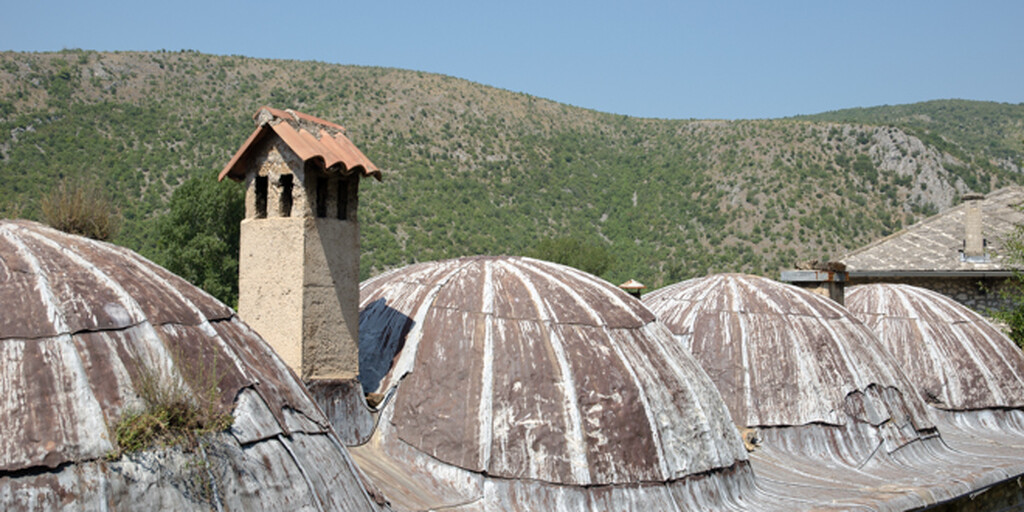
Right next to the mosque begins Mostar's bazaar. In the old madrassa (prayer school), brightly colored scarves, T-shirts, and other Bosnian souvenirs are now sold.
Near Mostar Airport lies an old airport hangar. Like so many military structures from the former Yugoslavia, this one also lies abandoned. For a long time, the hangar was hidden, but now you can easily visit it. Tito's secret fleet was once hidden in this hangar nestled in the hills. Today, there's little more than darkness.
Blagaj
The Dervish House, Blagaj Tekija, is the main reason to visit Blagaj. The history of this building is not entirely clear, but it was probably built during the Ottoman era around 1520. The Tekija's Musafirhana (guest house) and Türbe (mausoleum) remain well preserved to this day.
Blagaj Fort, known locally as Stjepan-grad, is a fortress complex within walking distance of the town center. The fortress is built on a karst hill, 266 meters above the source of the Buna River. Blagaj Fort has a rich history and is a national monument of Bosnia and Herzegovina.
Počitelj (drink stop and end point)
Picturesque Počitelj is one of Bosnia's best-preserved historic towns, nestled in a photogenic hillside location. It's like stepping back in time as you stroll through the hills, lined with cobblestone streets and lined with beautiful historic houses. Incidentally, this village, too, was damaged during the war. But the residents' efforts to restore their town's old charm have certainly been successful. Its unique location, with historic houses scattered across the green hillside, makes Počitelj a particularly photogenic spot. The medieval houses have retained their authentic character, characterized by their distinctive flat stone roofs and heavy wooden gates. From one of the beautiful viewpoints, you can see them beautifully, nestled among the greenery and pomegranate trees.
 Links
Links  Usage
Usage Want to download this route?
You can download the route for free without MyRoute-app account. To do so, open the route and click 'save as'. Want to edit this route?
No problem, start by opening the route. Follow the tutorial and create your personal MyRoute-app account. After registration, your trial starts automatically.  Disclaimer
Use of this GPS route is at your own expense and risk. The route has been carefully composed and checked by a MyRoute-app accredited RouteXpert for use on TomTom, Garmin and MyRoute-app Navigation.
Changes may nevertheless have occurred due to changed circumstances, road diversions or seasonal closures. We therefore recommend checking each route before use.
Preferably use the route track in your navigation system. More information about the use of MyRoute-app can be found on the website under 'Community' or 'Academy'.
Changes may nevertheless have occurred due to changed circumstances, road diversions or seasonal closures. We therefore recommend checking each route before use.
Preferably use the route track in your navigation system. More information about the use of MyRoute-app can be found on the website under 'Community' or 'Academy'.
 Nearby routes
Federation of Bosnia and Herzegovina
About this region
The Federation of Bosnia and Herzegovina is one of the two entities that compose the State of Bosnia and Herzegovina, the other being Republika Srpska. The Federation of Bosnia and Herzegovina consists of 10 autonomous cantons with their own governments and legislatures.
The Federation was created by the 1994 Washington Agreement, which ended the Croat–Bosniak war within the Bosnian war, and established a constituent assembly that continued its work until October 1996.
The Federation has a capital, government, president, parliament, customs and police departments and two postal systems. From 1996 until 2005 it had its own army, the Army of the Federation of Bosnia and Herzegovina, later merged in the Armed Forces of Bosnia and Herzegovina. The capital and largest city is Sarajevo with 438,443 inhabitants, out of a total population of 688,354 in its metropolitan area.
Read more on Wikipedia
The Federation was created by the 1994 Washington Agreement, which ended the Croat–Bosniak war within the Bosnian war, and established a constituent assembly that continued its work until October 1996.
The Federation has a capital, government, president, parliament, customs and police departments and two postal systems. From 1996 until 2005 it had its own army, the Army of the Federation of Bosnia and Herzegovina, later merged in the Armed Forces of Bosnia and Herzegovina. The capital and largest city is Sarajevo with 438,443 inhabitants, out of a total population of 688,354 in its metropolitan area.
View region
 Statistics
  6
6Amount of RX reviews (Federation of Bosnia and Herzegovina)
 7342
7342Amount of visitors (Federation of Bosnia and Herzegovina)
 459
459Amount of downloads (Federation of Bosnia and Herzegovina)
 Route Collections in this region
 Roundtrip Eastern Europe via Slovenia Croatia and Bosnia Herzegovina
This route collection builds up to one great adventure in Eastern Europe. All routes combined make a 19 day roundtrip through Germany, Austria, Italy, Slovenia, Croatia, and Bosnia Herzegovina. It aims to show the beauty of Eastern Europe, displaying how relaxed it can be to ride here. Quiet roads, friendly people, good food and impressive nature and culture will be your host throughout the trip.
As there’s so much to see and experience along the route, you might want to plan a longer trip than the 19 days. What about staying an extra day at Lake Bled (Slovenia)? Or taking some time in Zadar (Croatia) to marvel at the old city and its beautiful sea view. Or what about the idea to stay an extra day in Mostar (Bosnia and Herzegovina) to soak up the coffee culture and the city’s atmosphere? Or go hiking at the Plitvice Lakes (Croatia)? Or do a via Ferrata in Logarska Dolina (Slovenia)? Or … The options are too numerous to mention them all.
And off course, travelling through the Black Forest, the Alps and Dolomites is always a beautiful experience. Along your way you’ll have plenty opportunities to enjoy impressive sights, both natural and cultural.
The length of the routes are long enough so you can cover distances, as well as spend time to stop and enjoy natural and cultural highlights. Please do note that the routes may demand solid riding skills and a good condition. The main roads in Eastern Europe are definitely improving, but for this collection a large number of smaller scenic roads have been selected to make the riding more adventurous. Please be aware that these smaller roads can be in poor condition as they are not so frequently used and maintained.
As there’s so much to see and experience along the route, you might want to plan a longer trip than the 19 days. What about staying an extra day at Lake Bled (Slovenia)? Or taking some time in Zadar (Croatia) to marvel at the old city and its beautiful sea view. Or what about the idea to stay an extra day in Mostar (Bosnia and Herzegovina) to soak up the coffee culture and the city’s atmosphere? Or go hiking at the Plitvice Lakes (Croatia)? Or do a via Ferrata in Logarska Dolina (Slovenia)? Or … The options are too numerous to mention them all.
And off course, travelling through the Black Forest, the Alps and Dolomites is always a beautiful experience. Along your way you’ll have plenty opportunities to enjoy impressive sights, both natural and cultural.
The length of the routes are long enough so you can cover distances, as well as spend time to stop and enjoy natural and cultural highlights. Please do note that the routes may demand solid riding skills and a good condition. The main roads in Eastern Europe are definitely improving, but for this collection a large number of smaller scenic roads have been selected to make the riding more adventurous. Please be aware that these smaller roads can be in poor condition as they are not so frequently used and maintained.
View Route Collection
Slavonia you know
Have you ever heard of Slavonia? It's located in the northeasternmost tip of Croatia, where the country borders Hungary, Serbia, and Bosnia. Here, where the three major rivers—Drava, Sava, and Danube—flow, a beautiful region lies hidden. This relatively unknown part of Croatia boasts a rich history, culture, and natural beauty.
This collection consists of a series of four connected rides, spread across Slavonia.
Your first ride starts in Osijek and ends in Ilok; it runs through the Baranja region, through the Kopački Rit Nature Park and then following the Danube along the border with Serbia.
The second route starts in Ilok, goes through the Syrmia region, along the border with Serbia and then via Vinkovci ending in the cathedral town of Dakovo.
The third route starts in Dakovo and ends in Požega; it runs along the border with Bosnia, through the Kutjevo wine region and then through Papuk Nature Park.
The fourth route starts in Požega, runs through the Papuk Geological Nature Park, then follows the meandering Drava River on the border with Hungary via the Križnica area, visits a stud farm and finally ends in Našice.
A great way to explore this region is by following the "Slavonia you know" routes. Driving along these routes, you'll encounter unspoiled river landscapes as well as Slavonia's cultural highlights. This offers a unique opportunity to experience Croatia authentically, away from the hustle and bustle of popular coastal destinations. While the predominantly flat landscape sometimes offers little variety, enhanced by the large plots of land dedicated to agriculture and viticulture, this is more than compensated for by the combination of rich folk culture, traditional villages, meadows, marshes, forests, and delicious cuisine, making this region a destination not to be missed.
This collection consists of a series of four connected rides, spread across Slavonia.
Your first ride starts in Osijek and ends in Ilok; it runs through the Baranja region, through the Kopački Rit Nature Park and then following the Danube along the border with Serbia.
The second route starts in Ilok, goes through the Syrmia region, along the border with Serbia and then via Vinkovci ending in the cathedral town of Dakovo.
The third route starts in Dakovo and ends in Požega; it runs along the border with Bosnia, through the Kutjevo wine region and then through Papuk Nature Park.
The fourth route starts in Požega, runs through the Papuk Geological Nature Park, then follows the meandering Drava River on the border with Hungary via the Križnica area, visits a stud farm and finally ends in Našice.
A great way to explore this region is by following the "Slavonia you know" routes. Driving along these routes, you'll encounter unspoiled river landscapes as well as Slavonia's cultural highlights. This offers a unique opportunity to experience Croatia authentically, away from the hustle and bustle of popular coastal destinations. While the predominantly flat landscape sometimes offers little variety, enhanced by the large plots of land dedicated to agriculture and viticulture, this is more than compensated for by the combination of rich folk culture, traditional villages, meadows, marshes, forests, and delicious cuisine, making this region a destination not to be missed.
View Route Collection