
03 Middlesbrough to Dundee

This route was brought to you by:
RouteXpert Nick Carthew - (MRA Master)
Last edit: 19-02-2026
 Route Summary
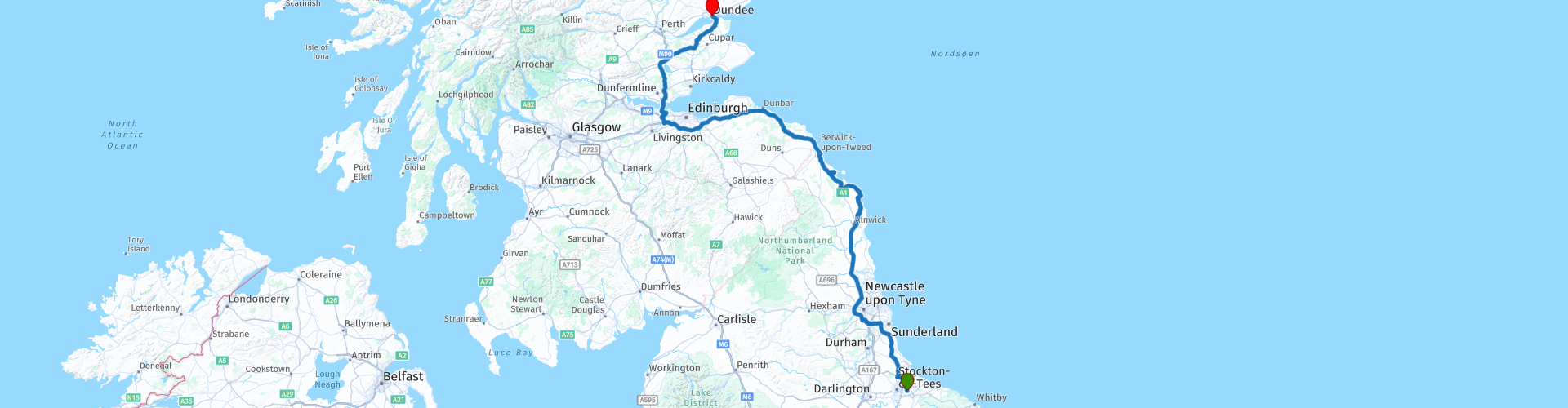
 A journey through the beautiful countryside and coast of east England and up into Scotland. Including the Tees Newport Bridge, a vertical-lift bridge, The Angel of the North, Bamburgh Castle, the spiritual Holy Island of Lindisfarne and then across the border into Scotland. The Holy Island is accessed across a tidal road and a knowledge of tide times is crucial, a link for tide times is provided in review below.
The route has earned 4⭐⭐⭐⭐ stars from me because of the scenery and attractions despite many miles on fast roads. Using the fast roads allows time to visit these attractions.
 Share this route


Animation

Verdict


Duration
7h 8m

Mode of travel
Car or motorcycle

Distance
379.02 km

Countries

 RouteXpert Review
 The route uses the A19 dual carriageway to travel north, it's a fast road but quite pleasant to use and in less than an hour from the bridge you'll be at the giant 'Angel of the North' art installation. Since spreading its wings in February 1998, Antony Gormley's The Angel of the North has become one of the most talked about pieces of public art ever produced.
Rising 20 metres from the earth near the A1 in Gateshead, the Angel dominates the skyline, dwarfing all those who come to see it. Made from 200 tonnes of steel, it has a wingspan of 54 metres and a red-brown colour that comes from the weathering steel which can withstand winds of more than 100 miles per hour. Getting up close and personal with the Angel is an experience you'll never forget! There is often a coffee van parked in the car park.
Joining another fast dual carriageway road to leave Newcastle, you can take a short detour to see a small section of Hadrian's Wall . Hadrian’s Wall was the north-west frontier of the Roman empire for nearly 300 years. It was built by the Roman army on the orders of the emperor Hadrian following his visit to Britain in AD 122. At 73 miles (80 Roman miles) long, it crossed northern Britain from Wallsend on the River Tyne in the east to Bowness-on-Solway in the west. The most famous of all the frontiers of the Roman empire, Hadrian’s Wall was made a World Heritage Site in 1987.
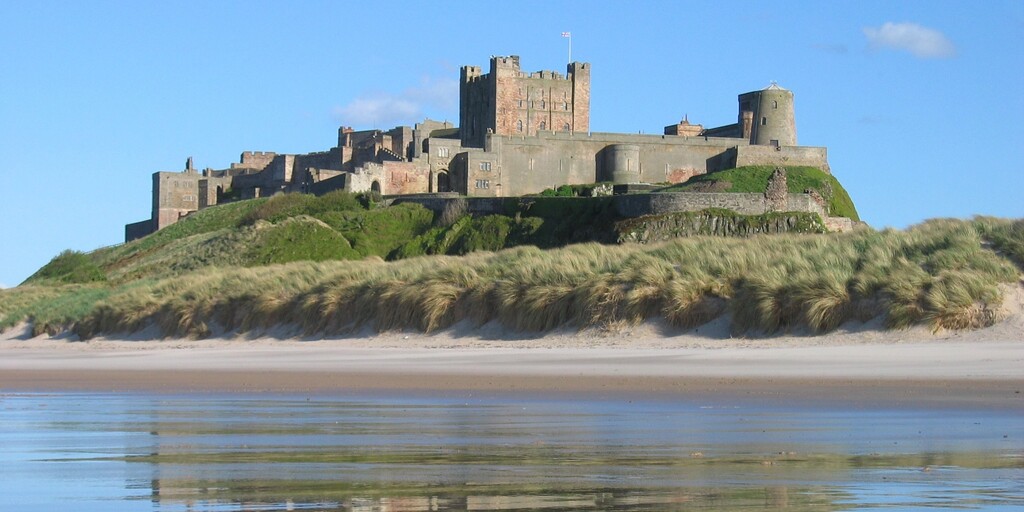
The route leaves the A1 briefly for a view of the Farne Islands and Bamburgh Castle. With its origins in the Anglo-Saxon period, Bamburgh Castle has dominated its volcanic outcrop and the surrounding countryside for centuries. From its humble wooden palisade to the impressive stone walls of today it strikes an iconic pose on the Northumbrian coastline. Open all year round it welcomes visitors to enjoy the grounds and staterooms.
Back onto the A1 again for a short ride to the jewel in the crown of this route, the Holy Island of Lindisfarne. Just a few miles south of the border with Scotland. The island is linked to the mainland by a tidal causeway which twice a day is covered by the tide. Possibly the holiest site of Anglo-Saxon England, Lindisfarne was founded by St. Aidan, an Irish monk, who came from Iona the centre of Christianity in Scotland. St Aidan converted Northumbria to Christianity at the invitation of its king, Oswald. St. Aidan founded Lindisfarne Monastery on Holy Island in 635, becoming its first Abbot and Bishop.
The tidal causeway not only becomes covered twice a day, but it can be slippery and those using two wheels need to be cautious. The island is a thriving community, with a busy harbour, shops, hotels and inns. There is much to see on the island and although a return trip to the centre is only a 15 minute ride, I would advise you to stay a while and enjoy the beauty and history, whether you have religion or not. Check the tide times in the link below. Ever since 635, when King Oswald gave the Holy Island of Lindisfarne to St. Aidan to establish his monastery, the island has been a place of pilgrimage. The road was not constructed until 1954 and until then the vertical poles were the only indicators of the safe route between the mainland and island. The sight of the poles stretching across the sand and mud is one of the most iconic views in Northumberland.
Rejoin the A1, again briefly as the route passes through Berwick-upon-Tweed by crossing over the River Tweed on the Royal Tweed Bridge that runs alongside the lovely old stone bridge. Berwick-upon-Tweed is a facinating English border town just 2.5 miles south of Scotland, renowned for its 13-time change of ownership between the two nations before becoming definitively English in 1482. Berwick Barracks built between 1719–1721, are among England's earliest purpose-built military barracks and stand as a testament to the fighting that took place here. It is the northernmost town in England, featuring remarkably preserved Elizabethan walls, three major bridges, a Scottish-league football team, and a temperate, cool coastal climate.
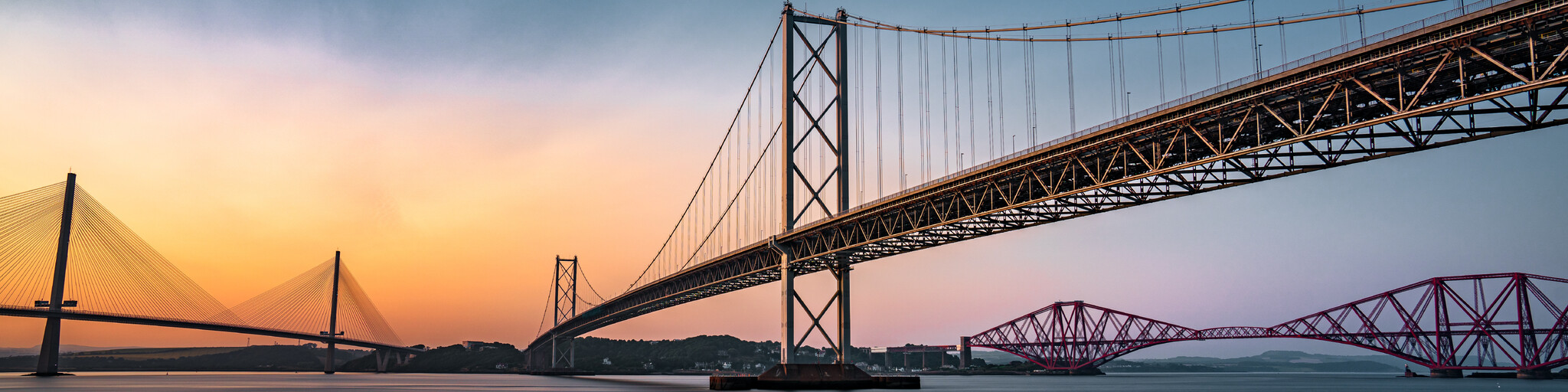
Follow the A1 again and cross the Scottish border and then onto the Queensferry Crossing bridge to the east of Edinburgh. The Queensferry Crossing opened to traffic on 30 August 2017. The 1.7 miles (2.7km) structure is the longest three-tower, cable-stayed bridge in the world and also by far the largest to feature cables which cross mid-span. This innovative design provides extra strength and stiffness, allowing the towers and the deck to be more slender and elegant. As you cross over the Firth of Forth you'll see the Forth Road Bridge and the iconic red Forth Rail Bridge
From here, it's an hours ride through some really nice countryside to the River Tay. The Premier Inn Hotel at Dundee is the end of the route and situated on the north bank of the River Tay. This is reached by using the unspectacular but long 1.3 mile (2.1 km) Tay Road Bridge. The hotel is next to the Royal Research Ship Discovery and Discovery Point. Discovery Point is home to RRS Discovery, a barque-rigged auxiliary steamship built in Dundee for Antarctic research. Launched in 1901, she was the last traditional wooden three-masted ship to be built in the United Kingdom. Her first mission was the British National Antarctic Expedition, carrying Robert Falcon Scott and Ernest Shackleton on their first, and highly successful, journey to the Antarctic, known as the Discovery Expedition.
This award-winning visitor attraction tells the story of the iconic ship ‘Discovery’ from her beginnings in Dundee, her amazing Antarctic expedition with Captain Scott and her voyages thereafter. I would suggest 2 nights in the hotel to allow you to visit this attraction and perhaps a short ride up the coast to Arbroath to sample some Arbroath Smokies from where they are made. No visit to East Scotland is complete without a visit to Arbroath and the chance to eat Arbroath Smokies in this fishing town. These haddock are salt-dried and hot-smoked. They can be eaten cold or warm or used in a variety of recipes employing smoked fish. The Arboath Smokie has a pronounced smoke aroma, as well as a smoked flavor, almost sweet, with a bit of salt. The outside of the fish is dry while the flesh is cream-coloured, moist, and flaky. Aficionados say the flavor has more depth than other types of smoked haddock. I have added a POI to the map for The Old Boatyard Restaurant in Arbroath.
Enjoy

 Links
Links  Usage
Usage Want to download this route?
You can download the route for free without MyRoute-app account. To do so, open the route and click 'save as'. Want to edit this route?
No problem, start by opening the route. Follow the tutorial and create your personal MyRoute-app account. After registration, your trial starts automatically.  Disclaimer
Use of this GPS route is at your own expense and risk. The route has been carefully composed and checked by a MyRoute-app accredited RouteXpert for use on TomTom, Garmin and MyRoute-app Navigation.
Changes may nevertheless have occurred due to changed circumstances, road diversions or seasonal closures. We therefore recommend checking each route before use.
Preferably use the route track in your navigation system. More information about the use of MyRoute-app can be found on the website under 'Community' or 'Academy'.
Changes may nevertheless have occurred due to changed circumstances, road diversions or seasonal closures. We therefore recommend checking each route before use.
Preferably use the route track in your navigation system. More information about the use of MyRoute-app can be found on the website under 'Community' or 'Academy'.
 Nearby routes
 .jpg)
Scotland
About this region
Scotland (Scots: Scotland, Scottish Gaelic: Alba [ˈal̪ˠapə] (listen)) is a country that is part of the United Kingdom. Covering the northern third of the island of Great Britain, mainland Scotland has a 96-mile (154-kilometre) border with England to the southeast and is otherwise surrounded by the Atlantic Ocean to the north and west, the North Sea to the northeast and east, and the Irish Sea to the south. It also contains more than 790 islands, principally in the archipelagos of the Hebrides and the Northern Isles. Most of the population, including the capital Edinburgh, is concentrated in the Central Belt—the plain between the Scottish Highlands and the Southern Uplands—in the Scottish Lowlands.
Scotland is divided into 32 administrative subdivisions or local authorities, known as council areas. Glasgow City is the largest council area in terms of population, with Highland being the largest in terms of area. Limited self-governing power, covering matters such as education, social services and roads and transportation, is devolved from the Scottish Government to each subdivision. Scotland is the second-largest country in the United Kingdom, and accounted for 8.3% of the population in 2012.The Kingdom of Scotland emerged as an independent sovereign state in the 9th century and continued to exist until 1707. By inheritance in 1603, James VI of Scotland became king of England and Ireland, thus forming a personal union of the three kingdoms. Scotland subsequently entered into a political union with the Kingdom of England on 1 May 1707 to create the new Kingdom of Great Britain. The union also created the Parliament of Great Britain, which succeeded both the Parliament of Scotland and the Parliament of England. In 1801, the Kingdom of Great Britain entered into a political union with the Kingdom of Ireland to create the United Kingdom of Great Britain and Ireland (in 1922, the Irish Free State seceded from the United Kingdom, leading to the latter being officially renamed the United Kingdom of Great Britain and Northern Ireland in 1927).Within Scotland, the monarchy of the United Kingdom has continued to use a variety of styles, titles and other royal symbols of statehood specific to the pre-union Kingdom of Scotland. The legal system within Scotland has also remained separate from those of England and Wales and Northern Ireland; Scotland constitutes a distinct jurisdiction in both public and private law. The continued existence of legal, educational, religious and other institutions distinct from those in the remainder of the UK have all contributed to the continuation of Scottish culture and national identity since the 1707 incorporating union with England.In 1999, a Scottish Parliament was re-established, in the form of a devolved unicameral legislature comprising 129 members, having authority over many areas of domestic policy. The head of the Scottish Government is the first minister of Scotland, who is supported by the deputy first minister of Scotland. Scotland is represented in the United Kingdom Parliament by 59 members of parliament (MPs). It is also a member of the British–Irish Council, sending five members of the Scottish Parliament to the British–Irish Parliamentary Assembly, as well as being part of the Joint Ministerial Committee, represented by the first minister.
Read more on Wikipedia
Scotland is divided into 32 administrative subdivisions or local authorities, known as council areas. Glasgow City is the largest council area in terms of population, with Highland being the largest in terms of area. Limited self-governing power, covering matters such as education, social services and roads and transportation, is devolved from the Scottish Government to each subdivision. Scotland is the second-largest country in the United Kingdom, and accounted for 8.3% of the population in 2012.The Kingdom of Scotland emerged as an independent sovereign state in the 9th century and continued to exist until 1707. By inheritance in 1603, James VI of Scotland became king of England and Ireland, thus forming a personal union of the three kingdoms. Scotland subsequently entered into a political union with the Kingdom of England on 1 May 1707 to create the new Kingdom of Great Britain. The union also created the Parliament of Great Britain, which succeeded both the Parliament of Scotland and the Parliament of England. In 1801, the Kingdom of Great Britain entered into a political union with the Kingdom of Ireland to create the United Kingdom of Great Britain and Ireland (in 1922, the Irish Free State seceded from the United Kingdom, leading to the latter being officially renamed the United Kingdom of Great Britain and Northern Ireland in 1927).Within Scotland, the monarchy of the United Kingdom has continued to use a variety of styles, titles and other royal symbols of statehood specific to the pre-union Kingdom of Scotland. The legal system within Scotland has also remained separate from those of England and Wales and Northern Ireland; Scotland constitutes a distinct jurisdiction in both public and private law. The continued existence of legal, educational, religious and other institutions distinct from those in the remainder of the UK have all contributed to the continuation of Scottish culture and national identity since the 1707 incorporating union with England.In 1999, a Scottish Parliament was re-established, in the form of a devolved unicameral legislature comprising 129 members, having authority over many areas of domestic policy. The head of the Scottish Government is the first minister of Scotland, who is supported by the deputy first minister of Scotland. Scotland is represented in the United Kingdom Parliament by 59 members of parliament (MPs). It is also a member of the British–Irish Council, sending five members of the Scottish Parliament to the British–Irish Parliamentary Assembly, as well as being part of the Joint Ministerial Committee, represented by the first minister.
View region
 Statistics
  67
67Amount of RX reviews (Scotland)
 25005
25005Amount of visitors (Scotland)
 5560
5560Amount of downloads (Scotland)
 Route Collections in this region
 The Ultimate 10 Day (North) UK Tour
Starting from and returning to Harwich ferry port, this tour follows the east coast of England up to the Highlands of Scotland and returns via the Lake District. It visits 6 of the UK's national parks and explores 2 islands and visits 2 James Bond 007 film locations.
Daily highlights.
Day 1, Harwich to Wells Next the Sea:
Southwold lighthouse, Cromer Crab lunch and sleeping on a Dutch barge.
Day 2, Wells Next the Sea to Middlesbrough:
Royal Sandringham Estate, Humber Bridge, a lap of Oliver's Mount, North York Moors National Park, Whitby Abbey the inspiration for Dracula.
Day 3, Middlesbrough to Dundee:
Tees Transporter Bridge, Angel of the North, Bamburgh Castle, Holy Island of Lindisfarne.
Day 4, Dundee to Inverness:
Cairngorms National Park, Balmoral Castle, Whisky Distilleries.
Day 5, Inverness to Ullapool:
Exceptional Landscapes, Falls of Shin, Loch Drumbeg Viewpoint, Kylesku Bridge.
Day 6, Ullapool to Dornie:
Kinlochewe viewpoint, Applecross Pass, Isle of Skye.
Day 7, Dornie to Keswick:
Eilean Donan Castle (007), Glencoe Pass, Glen Etive (007), Loch Lomond and Trossachs National Park.
Day 8, Keswick to Kendal:
A tour of the Lake District National Park visiting 6 of the best passes including Wrynose Pass and Hardknott Pass and 7 of the great lakes including Ullswater and Windermere.
Day 9, Kendal to Matlock:
Yorkshire Dales National Park, Ribblehead Viaduct, Peak District National Park, Snake Pass, Matlock Bath (motorcycle Mecca).
Day 10, Matlock to Harwich:
Heckington Windmill, Moulton Windmill, Dutch Quarter in Colchester.
By starting from Harwich, this tour avoids the traffic congestion of the south east and London making it perfect for European visitors wanting to see some of the best landscapes and sights that the north of the UK has to offer.
The cost of the ferry from Hoek Van Holland to Harwich return for motorcycle and rider costs £139.00 (163.51 Euro) (in 2019) which includes a cabin on the outward leg.
Where possible, motorways have been avoided and scenic routes are used every day.
Enjoy.
Daily highlights.
Day 1, Harwich to Wells Next the Sea:
Southwold lighthouse, Cromer Crab lunch and sleeping on a Dutch barge.
Day 2, Wells Next the Sea to Middlesbrough:
Royal Sandringham Estate, Humber Bridge, a lap of Oliver's Mount, North York Moors National Park, Whitby Abbey the inspiration for Dracula.
Day 3, Middlesbrough to Dundee:
Tees Transporter Bridge, Angel of the North, Bamburgh Castle, Holy Island of Lindisfarne.
Day 4, Dundee to Inverness:
Cairngorms National Park, Balmoral Castle, Whisky Distilleries.
Day 5, Inverness to Ullapool:
Exceptional Landscapes, Falls of Shin, Loch Drumbeg Viewpoint, Kylesku Bridge.
Day 6, Ullapool to Dornie:
Kinlochewe viewpoint, Applecross Pass, Isle of Skye.
Day 7, Dornie to Keswick:
Eilean Donan Castle (007), Glencoe Pass, Glen Etive (007), Loch Lomond and Trossachs National Park.
Day 8, Keswick to Kendal:
A tour of the Lake District National Park visiting 6 of the best passes including Wrynose Pass and Hardknott Pass and 7 of the great lakes including Ullswater and Windermere.
Day 9, Kendal to Matlock:
Yorkshire Dales National Park, Ribblehead Viaduct, Peak District National Park, Snake Pass, Matlock Bath (motorcycle Mecca).
Day 10, Matlock to Harwich:
Heckington Windmill, Moulton Windmill, Dutch Quarter in Colchester.
By starting from Harwich, this tour avoids the traffic congestion of the south east and London making it perfect for European visitors wanting to see some of the best landscapes and sights that the north of the UK has to offer.
The cost of the ferry from Hoek Van Holland to Harwich return for motorcycle and rider costs £139.00 (163.51 Euro) (in 2019) which includes a cabin on the outward leg.
Where possible, motorways have been avoided and scenic routes are used every day.
Enjoy.
View Route Collection
Top 10 Downloaded UK routes by RouteXpert Nick Carthew
Hello and welcome to this collection of the Top 10 MyRoute app downloaded routes in the UK.
There will be a great new event to be announced soon, where all these routes can be ridden.
Download them all now and place them in a new "Top 10" folder, so that you always have them at hand.
If you are going to drive one of these routes in the meantime, track them with the MRA Mobile App or with MRA Navigation. Take some photos (moments) along the way as these will come in handy.
Create a travelstory of your Top 10 driven routes and add the recorded track to it.
There will also be some great prizes on offer, so keep an eye on the MRA-RouteXperts page and your email.
There will be a great new event to be announced soon, where all these routes can be ridden.
Download them all now and place them in a new "Top 10" folder, so that you always have them at hand.
If you are going to drive one of these routes in the meantime, track them with the MRA Mobile App or with MRA Navigation. Take some photos (moments) along the way as these will come in handy.
Create a travelstory of your Top 10 driven routes and add the recorded track to it.
There will also be some great prizes on offer, so keep an eye on the MRA-RouteXperts page and your email.
View Route Collection