
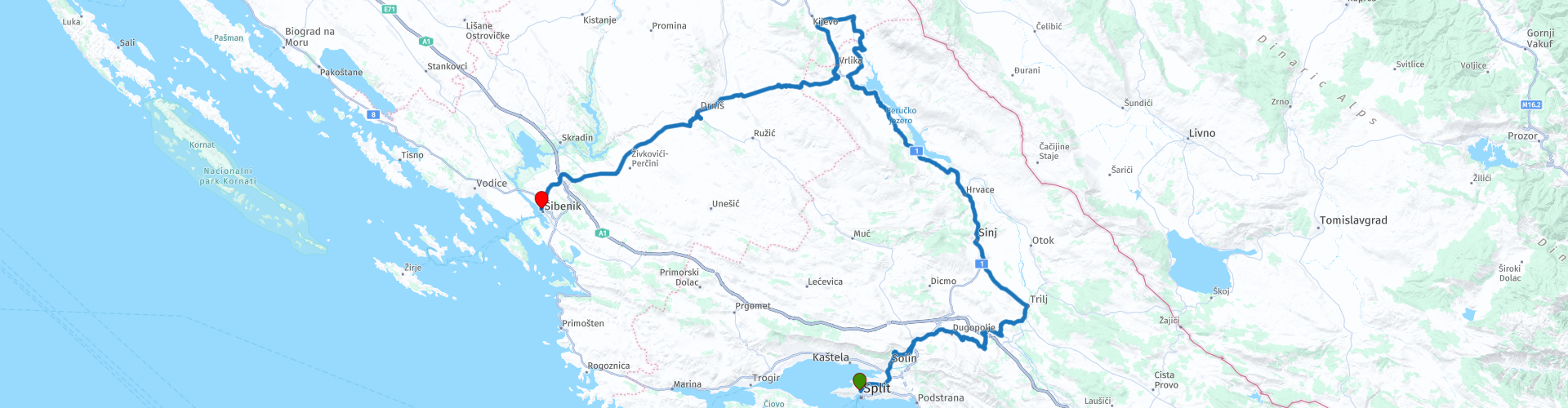
Zagora from Split

This route was brought to you by:
RouteXpert Jan Koelstra - Senior Rx
Last edit: 12-12-2025
 Route Summary
 This tour from Split primarily takes you through the hinterland around Split and Šibenik, including the fortresses of Klis and Nutjak, the Vranjača Cave, and Lake Peruća. It also includes a visit to Croatia's oldest church and the source of the Cetina River.
The trail has been awarded a 5-star rating for its varied landscape, passing through a relatively unknown part of the Zagora, traditional villages and towns such as Dugopolje, Sinj, and Drniš, with the architecture and charm of the historic cities of Split and Šibenik.
 Share this route


Animation

Verdict


Duration
7h 35m

Mode of travel
Car or motorcycle

Distance
174.09 km

Countries

 RouteXpert Review
 Split
Your route begins in Split. There's no shortage of sights here, and you can easily spend a few days exploring the city. Highlights include the gardens surrounding the Peristyle, the Cathedral of St. Dominic, the Temple of Jupiter, and the Golden Gate. It's a maze of narrow streets and alleys that will leave you speechless! You can climb the cathedral's bell tower for one of the best views of the city. And in the mausoleum, you can admire magnificent frescoes and numerous wood carvings.
Burdock
After refueling, take the road northeast. Where the outskirts of Split give way to the village of Klis, a mighty fortress sits on a hill. This remarkable fortress served as a defensive structure during the Middle Ages. Both the fortress and the village have a rich history dating back 2,000 years. From the castle, you also have a magnificent view of the landscape, with vineyards, and the Adriatic Sea. The main reason for many tourists to visit the fortress is its role in the series Game of Thrones. The fortress is a frequent filming location in the series.
Dugopolje (coffee break)
In the center of the bustling town, you'll find a few coffee shops where you can enjoy a cup of coffee. Nearby, there's a cave on private property that's worth exploring. The Vranjaca Cave is still relatively unknown. It's located in the village of Kotlenice, a short distance from Dugopolje. In the past, the Vranjaca Cave served as a shelter for hunters, as evidenced by the wall paintings. During a visit, you'll follow the route past beautiful stalactites, stalagmites, and unique wall paintings. If it's quiet, the owner will give you a tour and tell you all about the history of this unique attraction.
Nutjak
Built in the late 15th century, the fortress reflects strategic efforts to protect the region from ongoing threats. As military strategies evolved, Nutjak's importance declined. Today, the ruins of Nutjak fortress, with its large round tower and the remains of living quarters, underscore its historical significance. Archaeological findings suggest the site was important even in prehistoric times, making Nutjak a symbol of regional resilience and a testament to the complex history of Croatian defense against various enemies.
Sinj (lunch break)
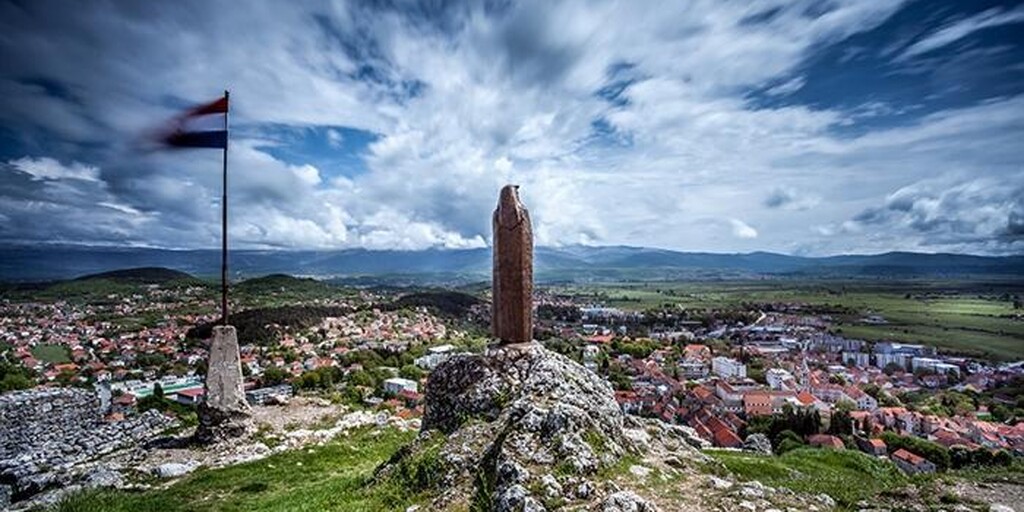
One of the most popular activities in Sinj is the Sinjska Alka (Sinj Alka). The Sinjska Alka is a horse-riding competition held every Sunday in August. Thousands of tourists flock to this unique event each year. During the event, 17 knights on horseback compete in a ring. This medieval festival and tradition is a must-see during a holiday in Zagora. The town naturally boasts a castle on a hill—actually two on two hills, and again with a view.
Lake Peruca
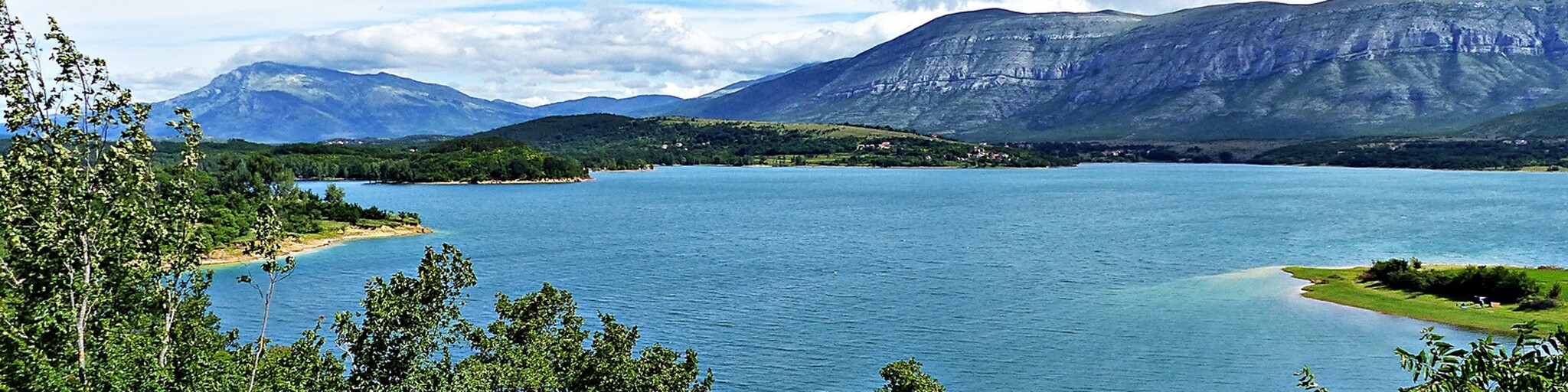
At 20 km long, Lake Peruč is the largest lake in Croatia. The lake is a haven for water sports enthusiasts. Beneath the water lies a centuries-old monastery and three small villages. Occasionally, when the water level is very low, you can see part of the monastery peeking out above the water. Lake Peruč is the second-largest artificial lake in Croatia (after Lake Dubrava) and was created as a result of the construction of a dam and power plant on the Cetina River.
Cetina (church)
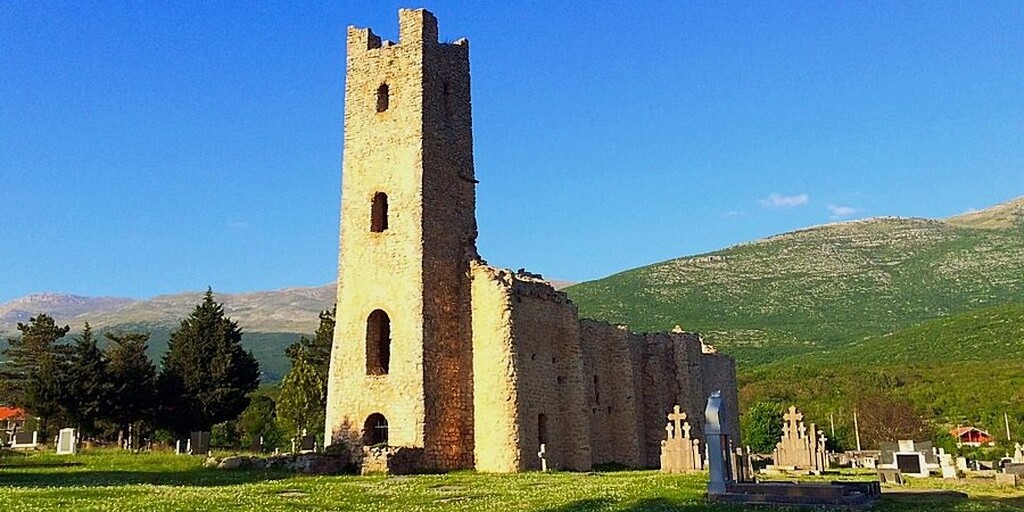
The area around the source of the Cetina River, with the Church of St. Spasa, is known as the oldest sacral monument of early medieval church architecture in Croatia. It is also the only church from the 9th century whose tower still stands. Nearly 1,200 ancient Croatian graves containing rich archaeological finds have been discovered around this church. The most valuable piece is a gilded censer belonging to the missionaries who baptized Croatians at the end of the 8th and beginning of the 9th century.
The Cetina spring
The mysterious thing about this blue hole is that it has never been precisely measured. Divers and the Croatian Nature Institute have taken measurements and reached a depth of 155 meters, but that was far from the bottom. The water of the karst spring of the Cetina River shimmers in various shades of blue and green. The crystal-clear water reveals its infinite depth. If you stand in front of the spring, you can see the water being carried away by a small stream. It's so remarkable that this is the beginning of a gigantic river that flows through a large part of Croatia.
Drniš (drink stop)
The town of Drniš, with its approximately 10,000 inhabitants, has a long and turbulent history. For centuries, the town was the scene of conflict between various religions. You'll find well-preserved medieval fortresses, churches, and traditional architecture. The town is known for its Drniški pršut (Croatian prosciutto), local wines, and the legacy of the famous sculptor Ivan Meštrović, who was born here. Want an epic view of Drniš, the surrounding foothills, and mountains? Then head to Drniš Fortress, Gradina. It sits 344 meters above the Čikola Canyon.
Sibenik (end point)
As the third-largest city in Dalmatia, Šibenik is a destination for those interested in history, culture, and architecture. It's less well-known as a holiday destination than many other towns along the Croatian coast, but it's certainly no less beautiful! Many of Croatia's towns have a long history and were founded by the Romans or the Greeks. This isn't the case with Šibenik; it was founded by the Croats themselves in the 9th century AD. They held it for two centuries until it was again conquered by the Hungarians in the 11th century. Then came the Venetians, the Byzantines, the Hungarians again, and the Italians. In 1991, Serbian troops attacked the city, forcing the Croats to defend it with all their might until 1995. So, you can understand why the Croats are very proud of Šibenik!
Šibenik has a long and turbulent history, in which its four fortresses have played a significant role. St. Ivan, St. Michael, St. Nicholas, and Barone Fortresses have effectively protected the city and its inhabitants over the years. The most beautiful fortress to visit is St. Michael's Fortress, whose location on the hill above the city offers stunning views of Šibenik!
 Links
Links  Usage
Usage Want to download this route?
You can download the route for free without MyRoute-app account. To do so, open the route and click 'save as'. Want to edit this route?
No problem, start by opening the route. Follow the tutorial and create your personal MyRoute-app account. After registration, your trial starts automatically.  Disclaimer
Use of this GPS route is at your own expense and risk. The route has been carefully composed and checked by a MyRoute-app accredited RouteXpert for use on TomTom, Garmin and MyRoute-app Navigation.
Changes may nevertheless have occurred due to changed circumstances, road diversions or seasonal closures. We therefore recommend checking each route before use.
Preferably use the route track in your navigation system. More information about the use of MyRoute-app can be found on the website under 'Community' or 'Academy'.
Changes may nevertheless have occurred due to changed circumstances, road diversions or seasonal closures. We therefore recommend checking each route before use.
Preferably use the route track in your navigation system. More information about the use of MyRoute-app can be found on the website under 'Community' or 'Academy'.
 Nearby routes
SibenikKnin
About this region
Šibenik-Knin County (pronounced [ʃîbeniːk-knîːn]; Croatian: Šibensko-kninska županija [ʃîbensko-knîːnskaː ʒupǎnija]) is a county in southern Croatia, located in the north-central part of Dalmatia. The biggest city in the county is Šibenik, which also serves as county seat. Other notable towns in the county are Knin, Vodice, Drniš and Skradin.
The county covers 2984 km2. It includes 242 islands and national parks, Krka and Kornati.
Read more on Wikipedia
The county covers 2984 km2. It includes 242 islands and national parks, Krka and Kornati.
View region
 Statistics
  3
3Amount of RX reviews (SibenikKnin)
 122
122Amount of visitors (SibenikKnin)
 2
2Amount of downloads (SibenikKnin)
 Route Collections in this region
 Dalmatian Zagora
Zagora. The part of Dalmatia nestled behind the Dinaric Alps falls under the name Dalmatian Zagora. Zagora literally means "behind the hills," a reference to the mountains that line much of the coast. Much of Zagora is a stony, arid region, known for its scrub-covered hills and rocky wastelands known as kamenjar ("stone fields")—but also for its charming towns with stone houses and intensively cultivated agricultural fields. Just a few kilometers from the Adriatic coast, this region offers a perfect contrast to the bustling summer resorts. Picturesque towns, authentic cuisine, and a fascinating historical and cultural heritage.
There are six routes set out in the Zagora.
Four routes explore the northern part of the Dalmatian Zagora:
Zagora from Gospic, passes Velebit, Udbina, Srb and Gračac
Zagora from Sibenik, passes Benkovac, Ervenik, Knin, Krka National Park and Skradin
Zagora from Split, passes Vranjača cave and takes you past Sinj, Cetina spring and Drniš
Dalmatia from Split, through Biokovo and Imotski National Park
Two routes partly pass through the southern Zagora:
Ragusa Mostar from Duvrovnik
Ragusa Kotor from Dubrovnik
There are six routes set out in the Zagora.
Four routes explore the northern part of the Dalmatian Zagora:
Zagora from Gospic, passes Velebit, Udbina, Srb and Gračac
Zagora from Sibenik, passes Benkovac, Ervenik, Knin, Krka National Park and Skradin
Zagora from Split, passes Vranjača cave and takes you past Sinj, Cetina spring and Drniš
Dalmatia from Split, through Biokovo and Imotski National Park
Two routes partly pass through the southern Zagora:
Ragusa Mostar from Duvrovnik
Ragusa Kotor from Dubrovnik
View Route Collection
Dalmatia
Dalmatia. Both the coast and the interior offer many attractions. The numerous picturesque harbor towns, beautiful beaches, and azure sea define the coastline. Vast green landscapes and hills, as well as stunning nature parks, form the scenery of a tour of the Dalmatian interior. Dalmatia can be roughly divided into three main regions: Northern Dalmatia, Central Dalmatia, and Southern Dalmatia. Croatia's sun-drenched coastline stretches along the Adriatic Sea, a perfect blend of rugged nature and ancient culture. From north to south, the landscape changes from island-dotted archipelagos to dramatic cliffs.
This collection consists of 12 tours in total, five of which are in the northern region, four in central Dalmatia and three in the southern regions.
North Dalmatia: Islands and Waterfalls
The capital of this region is Zadar. This city is known for its Roman forum and the modern Sea Organ, which plays music on the waves. Off the coast lies the Kornati archipelago, a labyrinth of uninhabited islands and crystal-clear waters. Inland, the spectacular waterfalls of Krka National Park dominate, where rivers carve their way through deep gorges to the sea. The nearby city of Šibenik, with its stone cathedral, serves as the gateway to this water-rich region.
Central Dalmatia: The Beating Heart
Further south lies Split, the vibrant center of the region. The city was literally built in and around the palace of the Roman Emperor Diocletian. This is the place where modern life merges with 1,700 years of history. Off the coast lie the most popular islands: sun-drenched Hvar, known for its lavender fields and nightlife, and Brač, famous for the iconic white pebble beach Zlatni Rat. South of Split stretches the Makarska Riviera, where the massive Biokovo Mountains rise steeply from the sea.
South Dalmatia: The Pearl of the Adriatic
Southern Dalmatia has become more accessible since the opening of the Pelješac Bridge. Previously, you had to drive through Bosnia to reach Dubrovnik, among other places. The bridge provides a direct connection to the Pelješac Peninsula, from where you can continue to southern Dalmatia and its islands. The region ends in the narrow strip of the deep south. Here lies the island of Korčula, according to legend the birthplace of Marco Polo, surrounded by dense forests and vineyards. The absolute highlight is Dubrovnik, the "Pearl of the Adriatic." Surrounded by medieval fortifications and marble streets, this city offers a majestic end to the Dalmatian coast, overlooking an azure horizon.
This collection consists of 12 tours in total, five of which are in the northern region, four in central Dalmatia and three in the southern regions.
North Dalmatia: Islands and Waterfalls
The capital of this region is Zadar. This city is known for its Roman forum and the modern Sea Organ, which plays music on the waves. Off the coast lies the Kornati archipelago, a labyrinth of uninhabited islands and crystal-clear waters. Inland, the spectacular waterfalls of Krka National Park dominate, where rivers carve their way through deep gorges to the sea. The nearby city of Šibenik, with its stone cathedral, serves as the gateway to this water-rich region.
Central Dalmatia: The Beating Heart
Further south lies Split, the vibrant center of the region. The city was literally built in and around the palace of the Roman Emperor Diocletian. This is the place where modern life merges with 1,700 years of history. Off the coast lie the most popular islands: sun-drenched Hvar, known for its lavender fields and nightlife, and Brač, famous for the iconic white pebble beach Zlatni Rat. South of Split stretches the Makarska Riviera, where the massive Biokovo Mountains rise steeply from the sea.
South Dalmatia: The Pearl of the Adriatic
Southern Dalmatia has become more accessible since the opening of the Pelješac Bridge. Previously, you had to drive through Bosnia to reach Dubrovnik, among other places. The bridge provides a direct connection to the Pelješac Peninsula, from where you can continue to southern Dalmatia and its islands. The region ends in the narrow strip of the deep south. Here lies the island of Korčula, according to legend the birthplace of Marco Polo, surrounded by dense forests and vineyards. The absolute highlight is Dubrovnik, the "Pearl of the Adriatic." Surrounded by medieval fortifications and marble streets, this city offers a majestic end to the Dalmatian coast, overlooking an azure horizon.
View Route Collection