
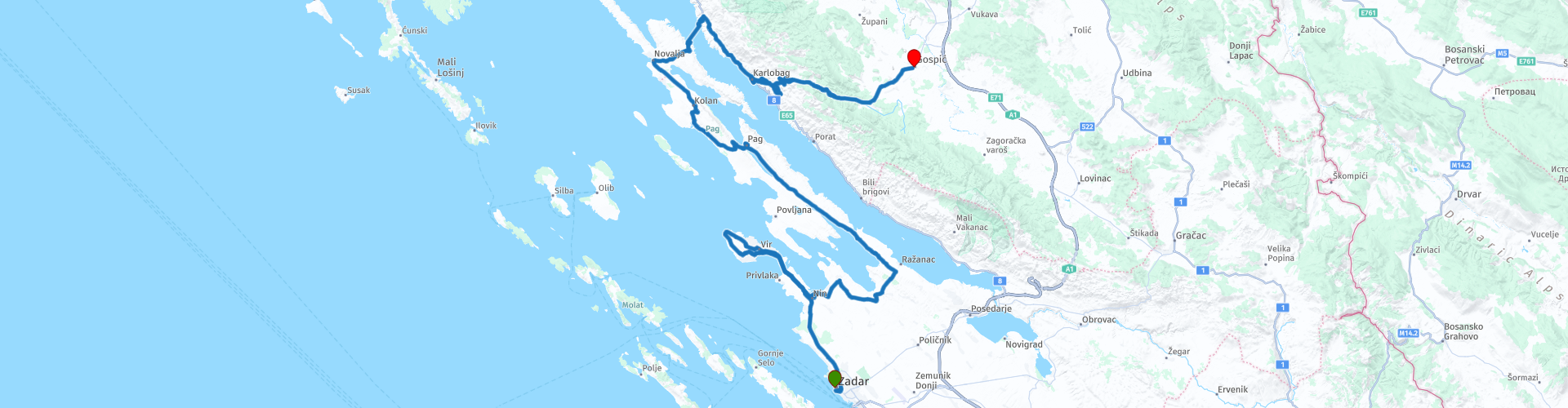
Dalmatia from Zadar

This route was brought to you by:
RouteXpert Jan Koelstra - Senior Rx
Last edit: 13-12-2025
 Route Summary
 All this promises a truly varied route. Starting from the beautiful city of Zadar, you'll travel along the Riviera with views of the islands of the Adriatic archipelago, finally concluding your journey through Croatia's largest nature park. A five-star rating for this tour is therefore a given!
 Share this route


Animation

Verdict


Duration
7h 21m

Mode of travel
Car or motorcycle

Distance
195.44 km

Countries

 RouteXpert Review
 This tour through Northern Dalmatia starts in Zadar and ends at Gospić in the Zagora, behind the Velebit Mountains on the Croatian mainland.
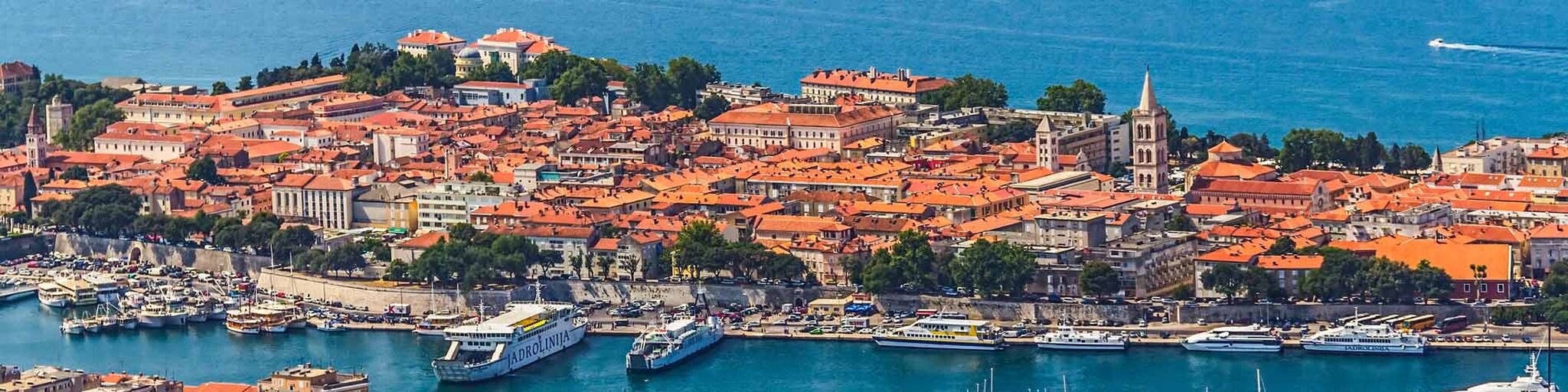
Zadar
The main city of Northern Dalmatia is Zadar, affectionately called "Croatia's Little Rome." This is thanks to its rich Roman heritage, which illuminates every corner of the city, including the Roman Forum, the Land Gate, and the Triumphal Arch by the harbor. As you stroll along Zadar's promenade, you'll always hear music. This music comes from the 70-meter-long sea organ located along the promenade. The organ consists of seven steps that create seven musical notes, with 35 organ pipes of varying lengths beneath them. This ingenious system, designed by architect Nikola Basic, has won several awards. The waves crashing into the organ create the music, which can change at any moment because the sounds are determined by the strength and direction of the waves. It's the perfect place to enjoy the sunset with music playing in the background. Next to the sea organ is the sun salutation, also designed by Nikola Basic. This circle consists of 300 glass tiles that are charged by the sun during the day. As soon as it gets dark, the lights come on and they put on a light show to the rhythm of the sea organ.
The city of Zadar has been inhabited since 1000 BC, though nothing remains of this today. However, more than a thousand years later, when the city became a Roman colony, they built the Roman Forum, which became the heart of the city's social life. At 90 meters long and 45 meters wide, it is the largest forum ever discovered in Croatia and is still remarkably well-preserved. To this day, the forum remains the heart of social life, as it is located right in the heart of the city.
St. Anastasia's Cathedral is the largest cathedral in the Dalmatia region and was built in the 12th century. The cathedral itself is magnificent and definitely worth a visit. The real highlight is the view from the cathedral's bell tower. You'll have to brave the 180 steps to the top, but once you reach the top, you'll quickly forget about that. From the top of the bell tower, you have a magnificent 360-degree view of Zadar! A very special experience is the Barkajlo: a rowboat that takes you from the old city center to the other side of Zadar. A tradition over 800 years old, run by the same family. Once on the other side, you can enjoy a beautiful view of the city from the terrace of a local café.
Vir
The island of Vir is one of the 300 islands of the Zadar archipelago. It is connected to the mainland by a bridge. The first part of the island consists of a very densely populated area, with the town of Vir as its center. The most beautiful part, with unspoiled nature, bays, and coves, lies on the north side of the island. Because it is difficult to access due to the steep red cliffs, you won't find mass tourism there.
Nin (coffee stop)
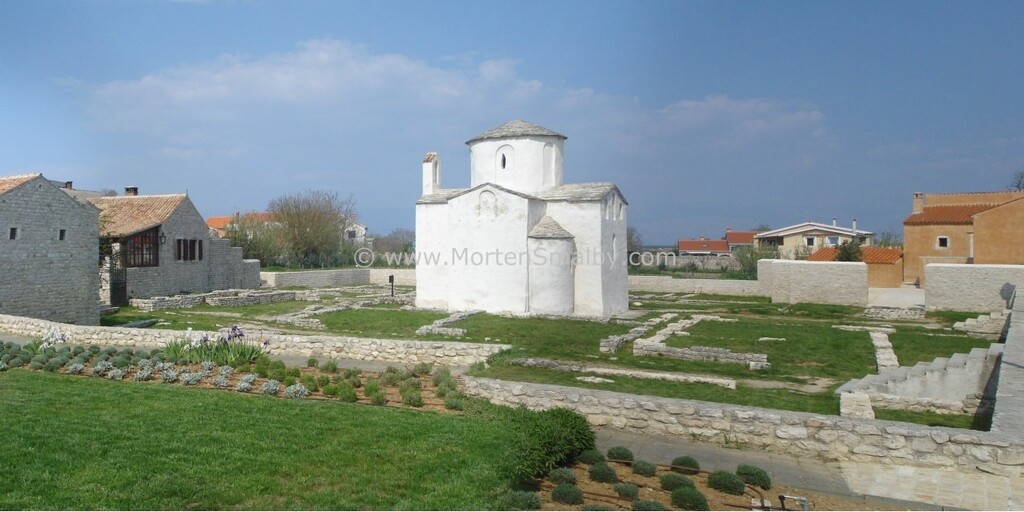
Nin is especially famous for its salt pans, which are still in use today. There's a relatively large amount to see for a town as small as Nin. Nin's picturesque town center, where cobblestone streets and centuries-old buildings still dominate, is a major attraction. The Church of the Holy Cross is sometimes called "the smallest cathedral in the world." The Church of the Holy Cross, Sveti Kriz, was built in Nin in the 9th century and, thanks to its unique design, can be used as a clock and calendar. Its location gives it a commanding position in the area and makes it one of Nin's symbols. The church was built on the remains of old houses, which are still visible today. During the reign of the Croatian kings, it served as a court chapel for the nearby ducal court.
Pag (island)
The Bura wind, which blows from the interior of the island, ensures that there is little vegetation on Pag. You drive through large, barren, white rock formations with the occasional olive tree. The island of Pag is the third-largest island in the Kvarner Bay. As soon as you arrive, you'll immediately notice the unique landscape. This wind blows a lot of salty seawater over the island, which makes the island's food so special. Pag has many salt flats, where the special Pag salt is extracted. The 30,000 sheep that live on the island ingest this salt by eating the salty grass. This gives the lamb and sheep's cheese their distinctive salty flavor. Therefore, Pag, with its vast, barren, lunar landscape dotted with shrubs and olive trees, sheep pastures with stone walls, and the bright blue Adriatic Sea, is a wonderful, photogenic holiday destination. The island is famous for its many beautiful bays and beaches; The popular Zrće beach near the town of Novalja is often mentioned as one of the most beautiful beaches on the Croatian coast.
Page (city)
The island's capital is a beautiful, old town nestled in a sheltered bay, where time seems to have stood still, especially in the historic center. During its construction in the fifteenth century, Pag was under Venetian rule, and the medieval street pattern with right angles and city gates is a reminder of this. Among the many old churches and buildings from that period, you'll now find charming squares with terraces where you can enjoy delicious food and drinks. In the narrow streets, women sit in front of their doors, making the famous Croatian lace.
Novalja (lunch stop)
The island's second city was once a quiet village, but in recent years it has blossomed into a tourist resort with a charming boulevard, marina, charming restaurants, and shops. In the center is the Church of Our Lady of the Rosary. Inside, you'll find the remains of a fourth-century floor mosaic. The underground Roman aqueduct from the first century is a reminder of Roman times and can be seen in the city museum. You can walk about 45 meters deep into the tunnel; it may look a bit spooky, but it's worth a visit!
Caska Cove
Another spot located on the northwestern side of Pag Island that will delight history and culture enthusiasts is Caska Cove. In the 4th century, a Roman city disappeared underwater after an earthquake. A few Roman houses can still be seen on land, but the seabed is perhaps even more spectacular. Here, you can still see remnants of the city, which is a popular attraction for divers.
The Prizna - Žigljen ferry line connects the Croatian coast with the island of Pag. The journey takes 20 minutes, and the ticket purchased is valid for any departure time on the day of the scheduled trip. Due to the popularity of the island of Pag and the destination of Novalja, which is only a short distance from the port of Žigljen, there are regular extra departures on this route during the summer season.
Karlobag (drink stopper)
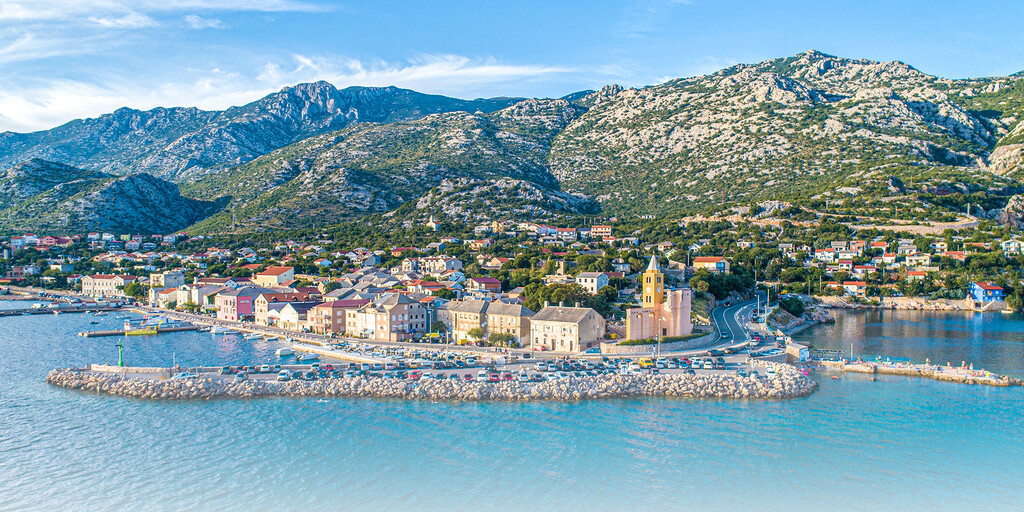
The town boasts several historical sights worth visiting, such as the 18th-century Capuchin monastery with a valuable collection of paintings, the ruins of the medieval fortress Fortica, and the magnificent Baroque Church of St. Charles Borromeo. As you stroll through Karlobag, you'll notice numerous stone wells. Before the water supply system, these wells, or cisterns, were the only source of drinking water in the area. Today, they are considered a cultural heritage site. After exploring, you can enjoy a drink on the famous sandy beach of Tatinja, located in the bay at the northern entrance to Karlobag.
Velebit Nature Park
The impressive Velebit mountain range is the longest and largest in Croatia, rich in flora and fauna, so it's no wonder it even boasts two national parks – Northern Velebit National Park and Paklenica National Park. Velebit Nature Park covers an area of approximately 2,000 km² and is the largest protected area in Croatia. Velebit also boasts strict reserves, caves, botanical gardens, forest vegetation, and habitats home to numerous endemic species, including bears and wolves. Velebit's unique character lies in its two completely different faces – mild, green, and wooded on the continental side and steep, rocky, and barren on the coastal side.
Gospic (end point)
The area is surrounded by the Velebit mountain range. A distinctive feature is the statue of the Water Lady Marta (Marta vodarica), a 19th-century sculpture in the center of Gospić in front of the cathedral. The statue of the woman atop the fountain was named "Marta" after the first woman to pour water from the fountain. The statue stands on a high stone pedestal, decorated with metal shell-shaped containers into which the water flows through metal gargoyles in the shape of a lion. The fountain and the statue were installed to commemorate the inauguration of the water supply in Gospić.
Smiljan, near Gospic, is known as the birthplace of the iconic inventor and genius Nikola Tesla, who proved Thomas Edison wrong by showing the world that alternating current (AC) was far superior to Edison's direct current (DC). Tesla, known as the "father of physics," is described as the most important scientist and inventor of modern times. A collection from his birthplace is part of the museum. The Nikola Tesla Memorial Centre is a must-see for science enthusiasts.
 Links
Links  Usage
Usage Want to download this route?
You can download the route for free without MyRoute-app account. To do so, open the route and click 'save as'. Want to edit this route?
No problem, start by opening the route. Follow the tutorial and create your personal MyRoute-app account. After registration, your trial starts automatically.  Disclaimer
Use of this GPS route is at your own expense and risk. The route has been carefully composed and checked by a MyRoute-app accredited RouteXpert for use on TomTom, Garmin and MyRoute-app Navigation.
Changes may nevertheless have occurred due to changed circumstances, road diversions or seasonal closures. We therefore recommend checking each route before use.
Preferably use the route track in your navigation system. More information about the use of MyRoute-app can be found on the website under 'Community' or 'Academy'.
Changes may nevertheless have occurred due to changed circumstances, road diversions or seasonal closures. We therefore recommend checking each route before use.
Preferably use the route track in your navigation system. More information about the use of MyRoute-app can be found on the website under 'Community' or 'Academy'.
 Nearby routes
Zadar
About this region
Zadar (US: ZAH-dar, Croatian: [zâdar] ), historically known as Zara (from Venetian and Italian, pronounced [ˈdzaːra]; see also other names), is the oldest continuously inhabited city in Croatia. It is situated on the Adriatic Sea, at the northwestern part of Ravni Kotari region. Zadar serves as the seat of Zadar County and of the wider northern Dalmatian region. The city proper covers 25 km2 (9.7 sq mi) with a population of 75,082 in 2011, making it the second-largest city of the region of Dalmatia and the fifth-largest city in the country.
Today, Zadar is a historical center of Dalmatia, Zadar County's principal political, cultural, commercial, industrial, educational, and transportation centre. Zadar is also the episcopal see of the Archdiocese of Zadar. Because of its rich heritage, Zadar is today one of the most popular Croatian tourist destinations, named "entertainment center of the Adriatic" by The Times and "Croatia's new capital of cool" by The Guardian.
UNESCO's World Heritage Site list included the fortified city of Zadar as part of the Venetian Works of Defence between the 16th and 17th centuries: Stato da Terra – Western Stato da Mar in 2017.
Read more on Wikipedia
Today, Zadar is a historical center of Dalmatia, Zadar County's principal political, cultural, commercial, industrial, educational, and transportation centre. Zadar is also the episcopal see of the Archdiocese of Zadar. Because of its rich heritage, Zadar is today one of the most popular Croatian tourist destinations, named "entertainment center of the Adriatic" by The Times and "Croatia's new capital of cool" by The Guardian.
UNESCO's World Heritage Site list included the fortified city of Zadar as part of the Venetian Works of Defence between the 16th and 17th centuries: Stato da Terra – Western Stato da Mar in 2017.
View region
 Statistics
  2
2Amount of RX reviews (Zadar)
 1122
1122Amount of visitors (Zadar)
 3
3Amount of downloads (Zadar)
 Route Collections in this region
 Dalmatia
Dalmatia. Both the coast and the interior offer many attractions. The numerous picturesque harbor towns, beautiful beaches, and azure sea define the coastline. Vast green landscapes and hills, as well as stunning nature parks, form the scenery of a tour of the Dalmatian interior. Dalmatia can be roughly divided into three main regions: Northern Dalmatia, Central Dalmatia, and Southern Dalmatia. Croatia's sun-drenched coastline stretches along the Adriatic Sea, a perfect blend of rugged nature and ancient culture. From north to south, the landscape changes from island-dotted archipelagos to dramatic cliffs.
This collection consists of 12 tours in total, five of which are in the northern region, four in central Dalmatia and three in the southern regions.
North Dalmatia: Islands and Waterfalls
The capital of this region is Zadar. This city is known for its Roman forum and the modern Sea Organ, which plays music on the waves. Off the coast lies the Kornati archipelago, a labyrinth of uninhabited islands and crystal-clear waters. Inland, the spectacular waterfalls of Krka National Park dominate, where rivers carve their way through deep gorges to the sea. The nearby city of Šibenik, with its stone cathedral, serves as the gateway to this water-rich region.
Central Dalmatia: The Beating Heart
Further south lies Split, the vibrant center of the region. The city was literally built in and around the palace of the Roman Emperor Diocletian. This is the place where modern life merges with 1,700 years of history. Off the coast lie the most popular islands: sun-drenched Hvar, known for its lavender fields and nightlife, and Brač, famous for the iconic white pebble beach Zlatni Rat. South of Split stretches the Makarska Riviera, where the massive Biokovo Mountains rise steeply from the sea.
South Dalmatia: The Pearl of the Adriatic
Southern Dalmatia has become more accessible since the opening of the Pelješac Bridge. Previously, you had to drive through Bosnia to reach Dubrovnik, among other places. The bridge provides a direct connection to the Pelješac Peninsula, from where you can continue to southern Dalmatia and its islands. The region ends in the narrow strip of the deep south. Here lies the island of Korčula, according to legend the birthplace of Marco Polo, surrounded by dense forests and vineyards. The absolute highlight is Dubrovnik, the "Pearl of the Adriatic." Surrounded by medieval fortifications and marble streets, this city offers a majestic end to the Dalmatian coast, overlooking an azure horizon.
This collection consists of 12 tours in total, five of which are in the northern region, four in central Dalmatia and three in the southern regions.
North Dalmatia: Islands and Waterfalls
The capital of this region is Zadar. This city is known for its Roman forum and the modern Sea Organ, which plays music on the waves. Off the coast lies the Kornati archipelago, a labyrinth of uninhabited islands and crystal-clear waters. Inland, the spectacular waterfalls of Krka National Park dominate, where rivers carve their way through deep gorges to the sea. The nearby city of Šibenik, with its stone cathedral, serves as the gateway to this water-rich region.
Central Dalmatia: The Beating Heart
Further south lies Split, the vibrant center of the region. The city was literally built in and around the palace of the Roman Emperor Diocletian. This is the place where modern life merges with 1,700 years of history. Off the coast lie the most popular islands: sun-drenched Hvar, known for its lavender fields and nightlife, and Brač, famous for the iconic white pebble beach Zlatni Rat. South of Split stretches the Makarska Riviera, where the massive Biokovo Mountains rise steeply from the sea.
South Dalmatia: The Pearl of the Adriatic
Southern Dalmatia has become more accessible since the opening of the Pelješac Bridge. Previously, you had to drive through Bosnia to reach Dubrovnik, among other places. The bridge provides a direct connection to the Pelješac Peninsula, from where you can continue to southern Dalmatia and its islands. The region ends in the narrow strip of the deep south. Here lies the island of Korčula, according to legend the birthplace of Marco Polo, surrounded by dense forests and vineyards. The absolute highlight is Dubrovnik, the "Pearl of the Adriatic." Surrounded by medieval fortifications and marble streets, this city offers a majestic end to the Dalmatian coast, overlooking an azure horizon.
View Route Collection