
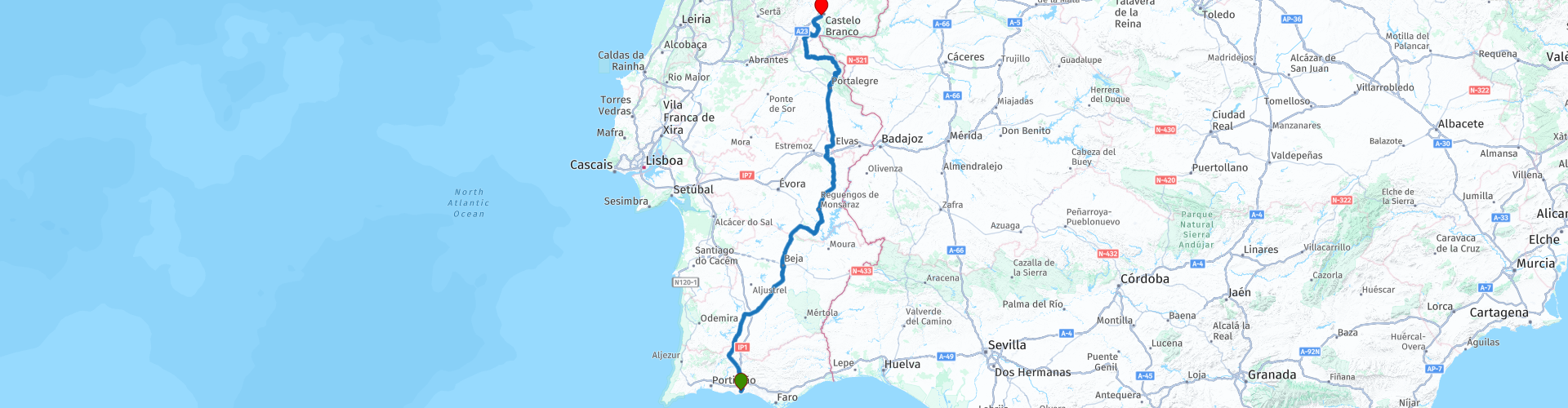
Albufeira to Castelo Branco

This route was brought to you by:
RouteXpert Jannes van Dijken
Last edit: 01-04-2025
 Route Summary
 This route goes through many historical places in Portugal, each with its own story. This is a part of Portugal that is less visited by the average tourist.
The transition from coastal area to inland area makes for a very changing landscape. That is one of the reasons I gave this route 4 stars. The roads are generally well maintained.
 Share this route


Animation

Verdict


Duration
8h 54m

Mode of travel
Car or motorcycle

Distance
444.49 km

Countries

 RouteXpert Review
 The first really big town on the route is Beja. Located in the Alentejo region of Portugal, Beja is a charming town with a rich history and a peaceful atmosphere. It is situated on a hill of about 277 meters high and offers beautiful views over the vast plains of Baixo Alentejo. The town has a fascinating past that dates back to the Bronze Age. Under Julius Caesar, Beja was given the name Pax Julia, symbolizing peace. During the Moorish era, the town became known as Baja, and these influences are still visible in the architecture.
One of the most striking sights is the Castelo de Beja, an imposing 13th-century castle with a central tower, the Torre de Menagem, built entirely of marble. From the top of the tower you can enjoy a panoramic view of the city and its surroundings.
About 60 kilometres north of Beja lies the Albufeira do Alqueva. The Albufeira do Alqueva, also known as the Grande Lago, is the largest artificial lake in Europe and is located in the Alentejo region of Portugal. The lake was created by the construction of the Barragem de Alqueva, an impressive dam on the Guadiana River. With an area of approximately 250 square kilometres and more than 1,100 kilometres of shoreline, it offers beautiful scenery and numerous recreational opportunities.
Another 60 kilometres further on, the route takes you to Vila Viçosa. Besides being a good place for lunch, this is also a place with a lot of history. Located in the Alentejo region of Portugal, Vila Viçosa is a city with a rich history and cultural significance. It is often called the "Princess of the Alentejo" due to the beauty of its historic buildings and surrounding natural beauty.
One of the most iconic sights is the Paço Ducal de Vila Viçosa, the former palace of the Dukes of Bragança. Dating back to the Renaissance, the palace has a magnificent 110-metre-long marble façade and today houses several art collections and historical artefacts.
The city is also characterised by the imposing Castelo de Vila Viçosa, a medieval castle that once served as a defensive fortress. From the castle you have a beautiful view over the city and the surrounding countryside.
Further north, after passing through the town of Portalegre, the route enters the Parque Natural da Serra de São Mamede. Located in the Alentejo region of Portugal, the Parque Natural da Serra de São Mamede is a beautiful natural area known for its varied landscape and rich biodiversity. The park covers an area of approximately 29,694 hectares and includes the highest point south of the Tagus River, the Pico de São Mamede, which rises to 1,025 metres.
The park offers a unique mix of Atlantic and Mediterranean influences, resulting in a diverse flora and fauna. You will find deciduous forests, cork oaks, and rare birds of prey such as the griffon vulture and the black kite. It is also a refuge for animals such as red deer, wild boar and genet cats.
The last part of the route begins by crossing the Rio Tejo. The Rio Tejo, also known as the Tagus, is the longest river in the Iberian Peninsula and an important geographical and cultural feature of both Spain and Portugal. The river rises in the Sierra de Albarracín in Spain and flows for approximately 1,007 kilometres before emptying into the Atlantic Ocean at Lisbon.
In Portugal, the Tagus River plays a crucial role in the life and history of the country. Its wide estuary at Lisbon forms a natural harbour that has been of great economic importance for centuries. Along the river are historic cities such as Santarém and Abrantes, known for their beautiful architecture and cultural heritage.
Castelo Branco is the end point of this route. Castelo Branco, located in the east of Portugal, is a city with a rich history and a unique charm. The name literally means "White Castle" and refers to an ancient Luso-Roman settlement called Castra Leuca. The city grew around a Templar castle built in the 13th century.
One of the highlights of Castelo Branco is the Jardim do Paço Episcopal, a beautiful Baroque garden with fountains, statues and ornate hedges. This garden is part of the former Episcopal Palace, which now houses the Museu Francisco Tavares Proença Júnior. Here you can admire, among other things, the famous colchas, silk-embroidered cotton bedspreads that are an important cultural heritage of the city.


 Links
Links  Usage
Usage Want to download this route?
You can download the route for free without MyRoute-app account. To do so, open the route and click 'save as'. Want to edit this route?
No problem, start by opening the route. Follow the tutorial and create your personal MyRoute-app account. After registration, your trial starts automatically.  Disclaimer
Use of this GPS route is at your own expense and risk. The route has been carefully composed and checked by a MyRoute-app accredited RouteXpert for use on TomTom, Garmin and MyRoute-app Navigation.
Changes may nevertheless have occurred due to changed circumstances, road diversions or seasonal closures. We therefore recommend checking each route before use.
Preferably use the route track in your navigation system. More information about the use of MyRoute-app can be found on the website under 'Community' or 'Academy'.
Changes may nevertheless have occurred due to changed circumstances, road diversions or seasonal closures. We therefore recommend checking each route before use.
Preferably use the route track in your navigation system. More information about the use of MyRoute-app can be found on the website under 'Community' or 'Academy'.
 Nearby routes
Castelo Branco
About this region
Camilo Castelo Branco, 1st Viscount of Correia Botelho (Portuguese pronunciation: [kɐˈmilu kɐʃˈtɛlu ˈbɾɐ̃ku]; 16 March 1825 – 1 June 1890), was a prolific Portuguese writer of the 19th century, having produced over 260 books (mainly novels, plays and essays). His writing is considered original in that it combines the dramatic and sentimental spirit of Romanticism with a highly personal combination of sarcasm, bitterness and dark humour. He is also celebrated for his peculiar wit and anecdotal character, as well as for his turbulent (and ultimately tragical) life.
His writing, which is centred in the local and the picturesque and is in a general sense affiliated with the Romantic tradition, is often regarded in contrast to that of Eça de Queiroz – a cosmopolitan dandy and a fervorous proponent of Realism, who was Camilo's literary contemporary in spite of being 20 years younger. In this tension between Camilo and Eça – often dubbed by critics the literary guerrilla – many have interpreted a synthesis of the two great tendencies present in the Portuguese literature of the 19th century.
Allegations that he was initiated in Freemasonry in 1846, are somewhat contradictory as there are indications that, around the same time, during the Revolution of Maria da Fonte, he fought in favor of the Miguelists as "helper to the orders of the Scottish General Reinaldo MacDonell", who was active in the revived Order of Saint Michael of the Wing precisely to combat Masonry. Similarly, much of his literature demonstrates his ideals of legitimism and as a conservative and Catholic traditionalist.
Read more on Wikipedia
His writing, which is centred in the local and the picturesque and is in a general sense affiliated with the Romantic tradition, is often regarded in contrast to that of Eça de Queiroz – a cosmopolitan dandy and a fervorous proponent of Realism, who was Camilo's literary contemporary in spite of being 20 years younger. In this tension between Camilo and Eça – often dubbed by critics the literary guerrilla – many have interpreted a synthesis of the two great tendencies present in the Portuguese literature of the 19th century.
Allegations that he was initiated in Freemasonry in 1846, are somewhat contradictory as there are indications that, around the same time, during the Revolution of Maria da Fonte, he fought in favor of the Miguelists as "helper to the orders of the Scottish General Reinaldo MacDonell", who was active in the revived Order of Saint Michael of the Wing precisely to combat Masonry. Similarly, much of his literature demonstrates his ideals of legitimism and as a conservative and Catholic traditionalist.
View region
 Statistics
  7
7Amount of RX reviews (Castelo Branco)
 27558
27558Amount of visitors (Castelo Branco)
 360
360Amount of downloads (Castelo Branco)
 Route Collections in this region
 Paradors Pousadas And Iberian Passes
This collection is an end-to-end motorcycle journey across northern Spain and Portugal, shaped deliberately to unfold over eleven days with a clear sense of progression. Each stage builds naturally on the last, carrying the rider from the Atlantic edge of northern Spain, south through Portugal’s mountain heartlands and open plains, before returning north across Spain to finish back on the Cantabrian coast.
The journey begins on the Cantabrian coast, leaving Santander behind and climbing steadily inland towards Cervera de Pisuerga. The opening day sets the tone immediately, trading sea air for rising ground and greener hills as the road threads through northern Spain’s quieter interior. It feels purposeful without being rushed, easing the rider into the rhythm of the tour.
From Cervera de Pisuerga, the route pushes deeper into the Cantabrian highlands, crossing broad upland terrain and remote border regions on the way to Bragança. The scenery becomes more expansive, the roads quieter, and the sense of travelling through less familiar Spain grows stronger as the journey approaches Portugal.
Crossing into Portugal, the character tightens again through Montesinho and the Peneda-Gerês region. Roads fold into wooded hills and granite villages, with more frequent elevation changes and a greater sense of enclosure. This is riding that rewards attention and flow rather than outright speed, and it marks a clear transition into Portugal’s mountainous north.
The route then opens into the Douro highlands, running south towards Viseu. Valleys deepen, viewpoints lengthen and the riding alternates between fast, open sections and more intimate stretches that follow the land closely. The sense of scale increases without losing the feeling of remoteness that defines this part of the journey.
Climbing into the Serra da Estrela plateau, the collection reaches one of its defining high points. Portugal’s highest mountain range delivers wide horizons, exposed passes and a feeling of space that contrasts sharply with the valleys below. This stage stands out for its elevation, light and long views, and it feels like a natural midpoint landmark in the overall journey.
Dropping south from the mountains, the route transitions into the Beiras and Alentejo, carrying the rider from high ground into warmer, more open landscapes on the way to Évora. The roads relax into longer, flowing lines, and the pace of the journey subtly changes without losing interest or intent.
From Évora to Beja, the ride settles fully into the heart of the Alentejo. Cork forests, reservoirs and historic hill towns define the scenery, while the riding becomes smoother and more measured. These stages offer breathing space within the collection, allowing the rider to absorb the scale and atmosphere of southern Portugal.
Turning back towards the Spanish border, the route climbs again through Castelo and the border ridges to Marvão. Elevation returns, views stretch out, and the landscape regains a rugged edge. The dramatic setting of Marvão feels earned, sitting high above the surrounding plains and marking a clear shift back towards frontier territory.
Crossing back into Spain, the journey continues through the serranías and frontier regions of Castile, heading for Ciudad Rodrigo. Historic borderlands, rolling terrain and quiet roads reinforce the feeling of travelling through lesser-known landscapes, with riding that remains engaging through variety rather than intensity.
From Ciudad Rodrigo to Benavente, the route crosses the Castilla y León plains. Big skies, long sightlines and subtle changes in terrain define this stage, providing contrast after the mountains while maintaining a strong sense of direction as the journey turns decisively north.
The final day carries the rider from the Meseta back to the Cantabrian coast, closing the loop at Santander. As greener hills return and the Atlantic air reappears, the transition from inland Spain back to the coast provides a fitting and satisfying conclusion, both geographically and emotionally, to the journey.
Throughout the collection, the choice of Paradors and Pousadas anchors each day in history and landscape. These are not simply places to stop, but destinations that reinforce the character of each region and give the journey a sense of occasion from start to finish.
Taken as a whole, this is a coherent and rewarding Iberian tour: varied without feeling fragmented, demanding enough to stay engaging without becoming tiring, and designed to be ridden as a complete journey rather than a series of disconnected stages. It is best suited to riders who value flow, scenery and progression, and who appreciate the satisfaction of a route that unfolds naturally over time.
The journey begins on the Cantabrian coast, leaving Santander behind and climbing steadily inland towards Cervera de Pisuerga. The opening day sets the tone immediately, trading sea air for rising ground and greener hills as the road threads through northern Spain’s quieter interior. It feels purposeful without being rushed, easing the rider into the rhythm of the tour.
From Cervera de Pisuerga, the route pushes deeper into the Cantabrian highlands, crossing broad upland terrain and remote border regions on the way to Bragança. The scenery becomes more expansive, the roads quieter, and the sense of travelling through less familiar Spain grows stronger as the journey approaches Portugal.
Crossing into Portugal, the character tightens again through Montesinho and the Peneda-Gerês region. Roads fold into wooded hills and granite villages, with more frequent elevation changes and a greater sense of enclosure. This is riding that rewards attention and flow rather than outright speed, and it marks a clear transition into Portugal’s mountainous north.
The route then opens into the Douro highlands, running south towards Viseu. Valleys deepen, viewpoints lengthen and the riding alternates between fast, open sections and more intimate stretches that follow the land closely. The sense of scale increases without losing the feeling of remoteness that defines this part of the journey.
Climbing into the Serra da Estrela plateau, the collection reaches one of its defining high points. Portugal’s highest mountain range delivers wide horizons, exposed passes and a feeling of space that contrasts sharply with the valleys below. This stage stands out for its elevation, light and long views, and it feels like a natural midpoint landmark in the overall journey.
Dropping south from the mountains, the route transitions into the Beiras and Alentejo, carrying the rider from high ground into warmer, more open landscapes on the way to Évora. The roads relax into longer, flowing lines, and the pace of the journey subtly changes without losing interest or intent.
From Évora to Beja, the ride settles fully into the heart of the Alentejo. Cork forests, reservoirs and historic hill towns define the scenery, while the riding becomes smoother and more measured. These stages offer breathing space within the collection, allowing the rider to absorb the scale and atmosphere of southern Portugal.
Turning back towards the Spanish border, the route climbs again through Castelo and the border ridges to Marvão. Elevation returns, views stretch out, and the landscape regains a rugged edge. The dramatic setting of Marvão feels earned, sitting high above the surrounding plains and marking a clear shift back towards frontier territory.
Crossing back into Spain, the journey continues through the serranías and frontier regions of Castile, heading for Ciudad Rodrigo. Historic borderlands, rolling terrain and quiet roads reinforce the feeling of travelling through lesser-known landscapes, with riding that remains engaging through variety rather than intensity.
From Ciudad Rodrigo to Benavente, the route crosses the Castilla y León plains. Big skies, long sightlines and subtle changes in terrain define this stage, providing contrast after the mountains while maintaining a strong sense of direction as the journey turns decisively north.
The final day carries the rider from the Meseta back to the Cantabrian coast, closing the loop at Santander. As greener hills return and the Atlantic air reappears, the transition from inland Spain back to the coast provides a fitting and satisfying conclusion, both geographically and emotionally, to the journey.
Throughout the collection, the choice of Paradors and Pousadas anchors each day in history and landscape. These are not simply places to stop, but destinations that reinforce the character of each region and give the journey a sense of occasion from start to finish.
Taken as a whole, this is a coherent and rewarding Iberian tour: varied without feeling fragmented, demanding enough to stay engaging without becoming tiring, and designed to be ridden as a complete journey rather than a series of disconnected stages. It is best suited to riders who value flow, scenery and progression, and who appreciate the satisfaction of a route that unfolds naturally over time.
View Route Collection