
JW Corbett WMA East Gate Explore

This route was brought to you by:
RouteXpert William Edward Henry
Last edit: 02-07-2025
 Route Summary
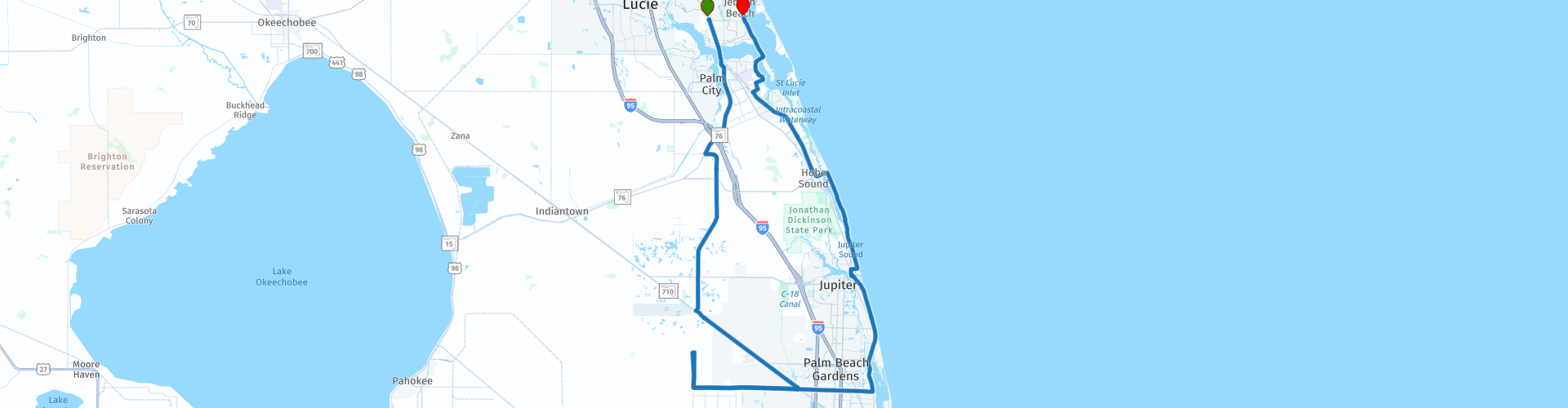
 This route has three legs or components, each of which differs considerably from the others.
The first portion of the route takes you from Jensen Beach, through Stuart, then inland and further south past farms and forests to the east entrance of the Wildlife Management Area (WMA).
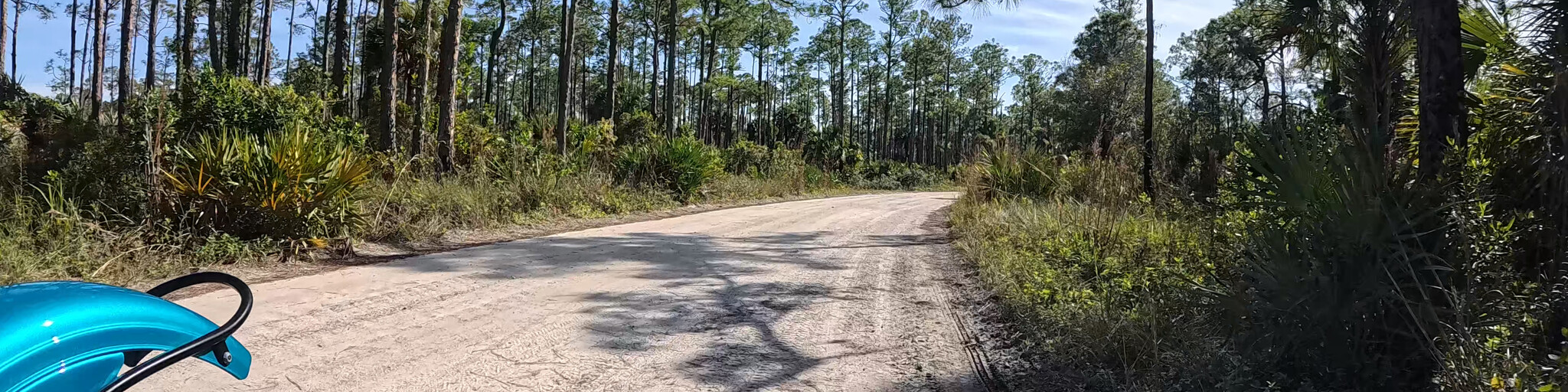
Then, as an introduction to the delights of J.W. Corbett WMA, we test your riding skills on twenty miles of unpaved unimproved road replete with spacious potholes.
The more adventurous could even try their skills on one of the many unimproved roads or trails within the WMA. Please be sure to check the latest information regarding restrictions on the WMA web site to determine availability.
After a rigorous, bone-jarring, and teeth rattling ride within Corbett WMA, you will ride smooth slow-speed roads through one of the wealthiest neighbourhoods in the country, close by the delightful Square Grouper tiki bar, past the historic Jupiter Lighthouse (worth a visit), relax at Hobe Sound beach, and finish at a waterside restaurant for suitable refreshment.
The route will not appeal to everyone, but for those who crave a little rough-road adventure it is well suited. A dual-sport, trail bike, or other adventure type motorcycle will be most suitable. Note: all vehicles using the WMA road must be "street legal" and licensed.
For those willing to endure the rigours of the WMA, this route is a delightful challenge. I rate it as four stars for that alone.
 Share this route


Animation

Verdict


Duration
4h 42m

Mode of travel
Car or motorcycle

Distance
167.28 km

Countries

 RouteXpert Review
 The route takes you to the east entrance of the WMA after which you must find your way within the WMA to explore the roads and trails before returning to the east entrance where your GPS system should again follow the route's (gpx file) waypoints. A map of the area is available and can be found via the J.W. Corbett link attached to this review.
Note that other than the "main" road on this route, there are a number of genuine off-road / overland trails within the WMA. Depending on the season and weather, some or all of these trails may be closed or impassable due to WMA regulations or flooding. Be sure to verify regulations and conditions on the Florida Fish and Wildlife Conservation Commission web site.
If you wish to avoid the rough-road section of the route, then skip the WMA's east entrance waypoint and continue east towards the coast.
Also note, cell / mobile phone signals are not strong within the WMA.
And, this is a "Wildlife" area. There have been recorded instances of attacks by 'gators and other critters. Take care.
We start this route at a Wawa gas station in Jensen Beach. Fuel as well as water, sandwiches, and other snacks are available at the Wawa. It is suggested that you should take at least some bottled water on this ride. A short distance into the route another fuel stop is noted for those who neglected to fill up at the Wawa.
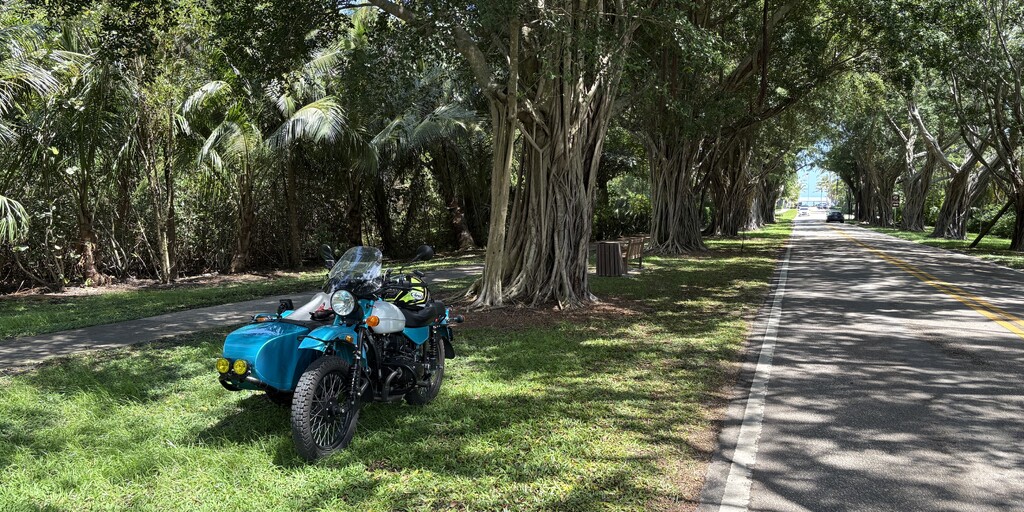
After proceeding through the small-town urban landscape and traffic of Jensen Beach and Stuart, we are soon following two-lane blacktop roads bordered by cattle ranches, old fields, and forest. This portion of the route will lead you to the east entrance of the Corbett WMA. It is a straightforward easy ride with little traffic. A good section to slow down and enjoy the rural old-Florida scenery.
After arriving at the WMA's east entrance, you may be required to pay a fee to enter the area. It's a good spot to stop, gather your thoughts, take a bio break, drink some water, and get ready to explore the overland routes of the WMA.
As noted above, the HERE mapping system does not contain the roads and trails within the WMA. Hence, route waypoints have not been positioned for this portion of the route.
CAUTION: the internal roads and trails of the WMA have many blind curves and entrances. Although traffic is very light, it's always possible to encounter pickup trucks, overland SUV's, swamp buggies, other vehicles, or wildlife on this narrow unimproved road. Proceed with care.
Similarly, after your ride through the WMA, the east entrance is again a good spot to stop for a few minutes before proceeding further east to the urban jungle of Palm Beach Gardens (PBG). After running the gauntlet of the zany traffic in PBG, you will find yourself on narrow but quiet roads near the Atlantic shore.
From North Palm Beach, we now turn and head north along the Atlantic Coast. At times, the ocean will be visible as will the Atlantic Intra-Coastal Waterway (ICW) as you head towards Jupiter Inlet. The "Square Grouper" is a waterside outdoor tiki bar / restaurant located just south of Jupiter Inlet. With a remarkably relaxed atmosphere, good food, and typical tropical beverages, one can easily spend far too much time here.
If you have time, a stop at the historic Jupiter Lighthouse and its associated park is well worth a visit. The panoramic view from the lighthouse is well worth climbing the 105 steps to the top.
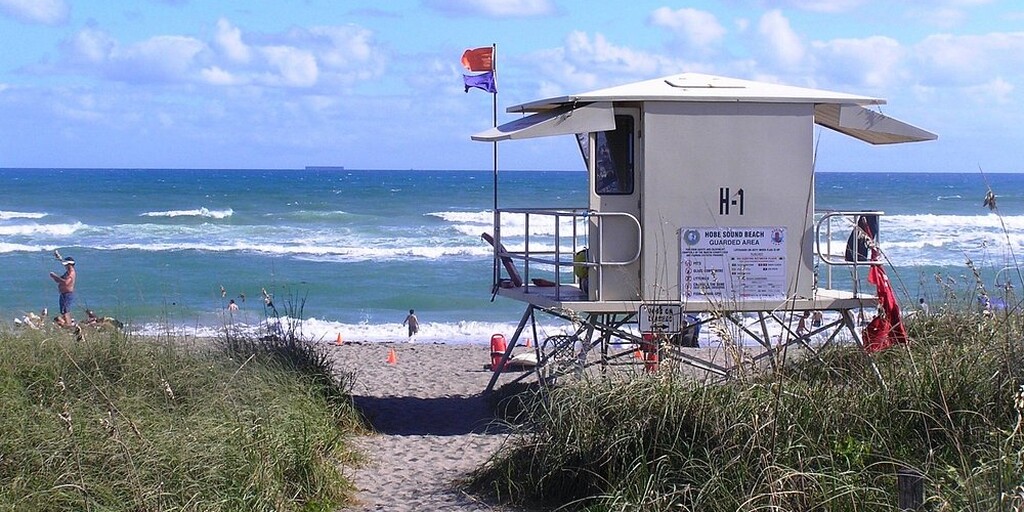
A little further north, we have an opportunity for a beach side break at the Hobe Sound beach. There are public washrooms here if needed. Be aware, in pleasant weather, the parking lot is often full.
Continuing north, we pass through Port Salerno with its many waterside attractions on Manatee Pocket as we proceed on our way back through the town of Stuart. In Stuart, we pass the Martin County Airport, Witham Field, before reaching our finish at Conchy Joe's where ample refreshment awaits as a reward for your successful outing.
 Links
Links  Usage
Usage Want to download this route?
You can download the route for free without MyRoute-app account. To do so, open the route and click 'save as'. Want to edit this route?
No problem, start by opening the route. Follow the tutorial and create your personal MyRoute-app account. After registration, your trial starts automatically.  Disclaimer
Use of this GPS route is at your own expense and risk. The route has been carefully composed and checked by a MyRoute-app accredited RouteXpert for use on TomTom, Garmin and MyRoute-app Navigation.
Changes may nevertheless have occurred due to changed circumstances, road diversions or seasonal closures. We therefore recommend checking each route before use.
Preferably use the route track in your navigation system. More information about the use of MyRoute-app can be found on the website under 'Community' or 'Academy'.
Changes may nevertheless have occurred due to changed circumstances, road diversions or seasonal closures. We therefore recommend checking each route before use.
Preferably use the route track in your navigation system. More information about the use of MyRoute-app can be found on the website under 'Community' or 'Academy'.
 Nearby routes
Florida
About this region
Florida is a state located in the Southeastern region of the United States. Florida is bordered to the west by the Gulf of Mexico, to the northwest by Alabama, to the north by Georgia, to the east by the Bahamas and Atlantic Ocean, and to the south by the Straits of Florida and Cuba; it is the only state that borders both the Gulf of Mexico and the Atlantic Ocean. Spanning 65,758 square miles, Florida ranks 22nd in area among the 50 states, and with a population of over 21 million, is the third-most populous. The state capital is Tallahassee and the most populous city is Jacksonville. The Miami metropolitan area, with a population of almost 6.2 million, is the most populous urban area in Florida and the seventh-most populous in the United States; other urban conurbations with over one million people are Tampa Bay, Orlando, and Jacksonville.
Various Native American groups have inhabited Florida for at least 14,000 years. In 1513, Spanish explorer Juan Ponce de León became the first known European to make landfall, calling the region La Florida ([la floˈɾiða] for its lush greenery and the Easter season (Pascua Florida in Spanish). Florida subsequently became the first area in the continental U.S. to be permanently settled by Europeans, with the Spanish colony of St. Augustine, founded in 1565, being the oldest continuously inhabited city. Florida was repeatedly contested by Spain and Great Britain, before being ceded to the U.S. in 1819; it was admitted as the 27th state on March 3, 1845. Florida was the principal location of the Seminole Wars (1816–1858), the longest and most extensive of the Indian Wars in U.S. history. The state seceded from the Union on January 10, 1861, becoming one of the seven original Confederate States. After the Civil War, Florida was restored to the Union on June 25, 1868.
Since the mid-20th century, Florida has experienced rapid demographic and economic growth. Its $1.0 trillion economy is the fourth-largest of any U.S. state and the 16th-largest in the world; the main sectors are tourism, hospitality, agriculture, real estate, and transportation. Florida is world-renowned for its beach resorts, amusement parks, warm and sunny climate, and nautical recreation; attractions such as Walt Disney World, the Kennedy Space Center, and Miami Beach draw tens of millions of visitors annually. Florida is a popular destination for retirees, seasonal vacationers, and both domestic and international migrants; it hosts nine out of the ten fastest-growing communities in the U.S. The state's close proximity to the ocean has shaped its culture, identity, and daily life; its colonial history and successive waves of migration are reflected in African, European, Indigenous, Latino, and Asian influences. Florida has attracted or inspired writers such as Marjorie Kinnan Rawlings, Ernest Hemingway and Tennessee Williams, and continues to attract celebrities and athletes, particularly in golf, tennis, auto racing, and water sports.
About two-thirds of Florida occupies a peninsula between the Gulf of Mexico and the Atlantic Ocean. It has the longest coastline in the contiguous United States, spanning approximately 1,350 miles (2,170 km), not including its many barrier islands. Florida has 4,510 islands that are ten acres (4 ha) or larger in area, the second highest number after Alaska. Much of the state is at or near sea level, and is characterized by sedimentary soil. Florida is the flattest state in the country, with the lowest high point of any U.S. state, at just 345 feet (105 meters). Lake Okeechobee is its largest freshwater lake, and the second-largest located entirely within the contiguous 48 states. Several beaches in Florida have turquoise and emerald-colored coastal waters.
Florida's climate varies from subtropical in the north to tropical in the south. It is the only state besides Hawaii to have a tropical climate, and is the only continental state with both a tropical climate (at the lower tip of the peninsula) and a coral reef. Consequently, Florida has several unique ecosystems, most notably Everglades National Park, the largest tropical wilderness in the U.S. and among the largest in the Americas. Unique wildlife include the American alligator, American crocodile, American flamingo, Roseate spoonbill, Florida panther, bottlenose dolphin, and manatee. The Florida Reef is the only living coral barrier reef in the continental United States, and the third-largest coral barrier reef system in the world (after the Great Barrier Reef and Belize Barrier Reef).
Florida's large population and economy give it considerable influence in national politics; since the late 20th century the state has been a major battleground in presidential elections, most notably in 2000. Miami, along with Orlando and Tampa, is recognized as a global city.
Read more on Wikipedia
Various Native American groups have inhabited Florida for at least 14,000 years. In 1513, Spanish explorer Juan Ponce de León became the first known European to make landfall, calling the region La Florida ([la floˈɾiða] for its lush greenery and the Easter season (Pascua Florida in Spanish). Florida subsequently became the first area in the continental U.S. to be permanently settled by Europeans, with the Spanish colony of St. Augustine, founded in 1565, being the oldest continuously inhabited city. Florida was repeatedly contested by Spain and Great Britain, before being ceded to the U.S. in 1819; it was admitted as the 27th state on March 3, 1845. Florida was the principal location of the Seminole Wars (1816–1858), the longest and most extensive of the Indian Wars in U.S. history. The state seceded from the Union on January 10, 1861, becoming one of the seven original Confederate States. After the Civil War, Florida was restored to the Union on June 25, 1868.
Since the mid-20th century, Florida has experienced rapid demographic and economic growth. Its $1.0 trillion economy is the fourth-largest of any U.S. state and the 16th-largest in the world; the main sectors are tourism, hospitality, agriculture, real estate, and transportation. Florida is world-renowned for its beach resorts, amusement parks, warm and sunny climate, and nautical recreation; attractions such as Walt Disney World, the Kennedy Space Center, and Miami Beach draw tens of millions of visitors annually. Florida is a popular destination for retirees, seasonal vacationers, and both domestic and international migrants; it hosts nine out of the ten fastest-growing communities in the U.S. The state's close proximity to the ocean has shaped its culture, identity, and daily life; its colonial history and successive waves of migration are reflected in African, European, Indigenous, Latino, and Asian influences. Florida has attracted or inspired writers such as Marjorie Kinnan Rawlings, Ernest Hemingway and Tennessee Williams, and continues to attract celebrities and athletes, particularly in golf, tennis, auto racing, and water sports.
About two-thirds of Florida occupies a peninsula between the Gulf of Mexico and the Atlantic Ocean. It has the longest coastline in the contiguous United States, spanning approximately 1,350 miles (2,170 km), not including its many barrier islands. Florida has 4,510 islands that are ten acres (4 ha) or larger in area, the second highest number after Alaska. Much of the state is at or near sea level, and is characterized by sedimentary soil. Florida is the flattest state in the country, with the lowest high point of any U.S. state, at just 345 feet (105 meters). Lake Okeechobee is its largest freshwater lake, and the second-largest located entirely within the contiguous 48 states. Several beaches in Florida have turquoise and emerald-colored coastal waters.
Florida's climate varies from subtropical in the north to tropical in the south. It is the only state besides Hawaii to have a tropical climate, and is the only continental state with both a tropical climate (at the lower tip of the peninsula) and a coral reef. Consequently, Florida has several unique ecosystems, most notably Everglades National Park, the largest tropical wilderness in the U.S. and among the largest in the Americas. Unique wildlife include the American alligator, American crocodile, American flamingo, Roseate spoonbill, Florida panther, bottlenose dolphin, and manatee. The Florida Reef is the only living coral barrier reef in the continental United States, and the third-largest coral barrier reef system in the world (after the Great Barrier Reef and Belize Barrier Reef).
Florida's large population and economy give it considerable influence in national politics; since the late 20th century the state has been a major battleground in presidential elections, most notably in 2000. Miami, along with Orlando and Tampa, is recognized as a global city.
View region
 Statistics
  20
20Amount of RX reviews (Florida)
 15247
15247Amount of visitors (Florida)
 214
214Amount of downloads (Florida)
 Route Collections in this region
 Coast to Coast Across the USA
14 Days across the USA
Start the trip at Daytona Pier on the Atlantic Coast.
Through 14 days you will visit New Orleans, Memphis, Tulsa, Colorado Springs, Las Vegas and Los Angeles. See the sights of Monument and Death Valley, the Hoover Dam. Ride across 12 US States for 4267 miles of adventure before ending the trip on Santa Monica Pier, Los Angeles on the Pacific Coast
Start the trip at Daytona Pier on the Atlantic Coast.
Through 14 days you will visit New Orleans, Memphis, Tulsa, Colorado Springs, Las Vegas and Los Angeles. See the sights of Monument and Death Valley, the Hoover Dam. Ride across 12 US States for 4267 miles of adventure before ending the trip on Santa Monica Pier, Los Angeles on the Pacific Coast
View Route Collection
Ultimate USA road trip part 04
Michel van Hagen challenged me to follow the Roadtrip of Dr. Randy Olsen as a basis to create the Ultimate USA Road Trip for the MyRoute app RouteXpert Library. I took up that challenge and started in February 2022.
The scientist Dr. Randy Olsen, who became known for using his knowledge of algorithms to find 'Waldo' in the well-known American 'Where's Waldo' book series, has been challenged by Tracy Staedter, from Discovery News, to use the same algorithm to create the perfect Road Trip by creating the US, which will visit almost every state in the US. Alaska and Hawaii are not included in this Road Trip due to their geographical location.
The following three requirements formed the basis of the route: In all 48 countries there must be at least one stop at famous points, monuments, historical sites, national parks, etc. I have added additional interesting points, beautiful tours and routes.
After more than 26 months, the job is finished and, with a lot of support from Nick Carthew, I have created 129 routes that run through the 48 states of the USA and part of Canada. This is the fourth collection that takes you from Waco in ten days through Texas, Arkansas, Mississippi, Louisiana and Alabama to Cocao Beach in Florida.
The scientist Dr. Randy Olsen, who became known for using his knowledge of algorithms to find 'Waldo' in the well-known American 'Where's Waldo' book series, has been challenged by Tracy Staedter, from Discovery News, to use the same algorithm to create the perfect Road Trip by creating the US, which will visit almost every state in the US. Alaska and Hawaii are not included in this Road Trip due to their geographical location.
The following three requirements formed the basis of the route: In all 48 countries there must be at least one stop at famous points, monuments, historical sites, national parks, etc. I have added additional interesting points, beautiful tours and routes.
After more than 26 months, the job is finished and, with a lot of support from Nick Carthew, I have created 129 routes that run through the 48 states of the USA and part of Canada. This is the fourth collection that takes you from Waco in ten days through Texas, Arkansas, Mississippi, Louisiana and Alabama to Cocao Beach in Florida.
View Route Collection