
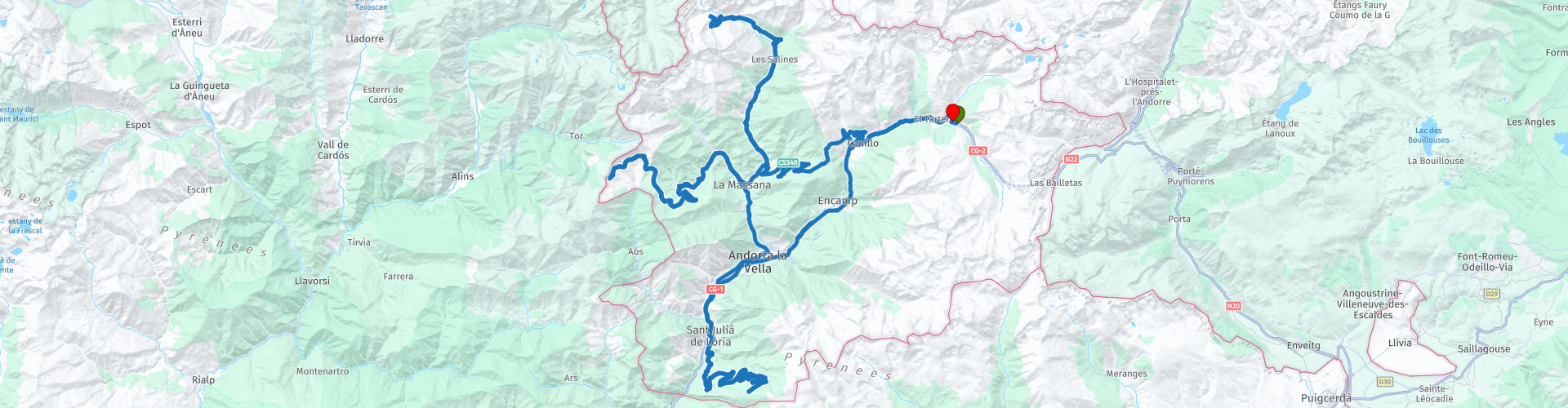
AD Soldeu Andorra la Vella Soldeu 170km

This route was brought to you by:
RouteXpert Johan Baars (RouteXpert)
Last edit: 26-11-2019
 Route Summary
  Share this route


Animation

Verdict


Duration
4h 52m

Mode of travel
Car or motorcycle

Distance
169.91 km

Countries


 RouteXpert Review
 We traverse Andorra in all directions.
So we will visit the northern, western and southern point.
Often these are high plains and mountains where it can be very inhospitable in the winter.
Of course we start in Soldeu the most easterly point of Andorra.
Watch out for mostly loose running horses that you see in front of you in an unclear hairpin bend.
Because of this stray cattle, it is usually swinging around the excrement that the roads are full of.


 Usage
Usage Want to download this route?
You can download the route for free without MyRoute-app account. To do so, open the route and click 'save as'. Want to edit this route?
No problem, start by opening the route. Follow the tutorial and create your personal MyRoute-app account. After registration, your trial starts automatically.  Disclaimer
Use of this GPS route is at your own expense and risk. The route has been carefully composed and checked by a MyRoute-app accredited RouteXpert for use on TomTom, Garmin and MyRoute-app Navigation.
Changes may nevertheless have occurred due to changed circumstances, road diversions or seasonal closures. We therefore recommend checking each route before use.
Preferably use the route track in your navigation system. More information about the use of MyRoute-app can be found on the website under 'Community' or 'Academy'.
Changes may nevertheless have occurred due to changed circumstances, road diversions or seasonal closures. We therefore recommend checking each route before use.
Preferably use the route track in your navigation system. More information about the use of MyRoute-app can be found on the website under 'Community' or 'Academy'.
 Nearby routes
Catalonia
About this region
Catalonia (; Catalan: Catalunya [kətəˈluɲə, kataˈluɲa]; Aranese Occitan: Catalonha [kataˈluɲa]; Spanish: Cataluña [kataˈluɲa]) is an autonomous community in the northeastern corner of Spain, designated as a nationality by its Statute of Autonomy.Catalonia consists of four provinces: Barcelona, Girona, Lleida, and Tarragona. The capital and largest city, Barcelona is the second-most populated municipality in Spain and the fifth-most populous urban area in the European Union. It comprises most of the former Principality of Catalonia (with the remainder Roussillon now part of France's Pyrénées-Orientales). It is bordered by France (Occitanie) and Andorra to the north, the Mediterranean Sea to the east, and the Spanish autonomous communities of Aragon to the west and Valencia to the south. The official languages are Catalan, Spanish, and the Aranese dialect of Occitan.In the late 8th century, various counties across the eastern Pyrenees were established by the Frankish kingdom as a defensive barrier against Muslim invasions. In the 10th century the County of Barcelona became progressively independent. In 1137, Barcelona and the Kingdom of Aragon were united by marriage under the Crown of Aragon. Within the Crown, the Catalan counties adopted a common polity, the Principality of Catalonia, developing its own institutional system, such as Courts, Generalitat and constitutions, becoming the base for the Crown's Mediterranean trade and expansionism. In the later Middle Ages, Catalan literature flourished. In 1469, the king of Aragon and the queen of Castile were married and ruled their realms together, retaining all of their distinct institutions and legislation.
During the Franco-Spanish War (1635–1659), Catalonia revolted (1640–1652) against a large and burdensome presence of the royal army, being briefly proclaimed a republic under French protection, until it was largely reconquered by the Spanish army. By the Treaty of the Pyrenees (1659), the northern parts of Catalonia, mostly the Roussillon, were ceded to France. During the War of the Spanish Succession (1701–1714), the Crown of Aragon sided against the Bourbon Philip V of Spain; following Catalan defeat on 11 September 1714, Philip V imposed a unifying administration across Spain, enacting the Nueva Planta decrees which, like in the other realms of the Crown of Aragon, suppressed the Catalan institutions and rights. This led to the eclipse of Catalan as a language of government and literature, replaced by Spanish. Throughout the 18th century, Catalonia experienced economic growth.
In the 19th century, Catalonia was severely affected by the Napoleonic and Carlist Wars. In the second third of the century, it experienced industrialisation. As wealth from the industrial expansion grew, it saw a cultural renaissance coupled with incipient nationalism while several workers movements appeared. With the establishment of the Second Spanish Republic (1931–1939), the Generalitat was restored as a Catalan autonomous government. After the Spanish Civil War, the Francoist dictatorship enacted repressive measures, abolishing Catalan self-government and banning the official use of the Catalan language. After a period of autarky, from the late 1950s through to the 1970s Catalonia saw rapid economic growth, drawing many workers from across Spain, making Barcelona one of Europe's largest industrial metropolitan areas and turning Catalonia into a major tourist destination. During the Spanish transition to democracy (1975–1982), Catalonia regained self-government and is now one of the most economically dynamic communities of Spain.
Since the 2010s there has been growing support for Catalan independence. On 27 October 2017, the Catalan Parliament unilaterally declared independence following a disputed referendum. The Spanish Senate voted in favour of enforcing direct rule by removing the Catalan government and calling a snap regional election. The Spanish Supreme Court imprisoned seven former ministers of the Catalan government on charges of rebellion and misuse of public funds, while several others—including then-President Carles Puigdemont—fled to other European countries.
Read more on Wikipedia
During the Franco-Spanish War (1635–1659), Catalonia revolted (1640–1652) against a large and burdensome presence of the royal army, being briefly proclaimed a republic under French protection, until it was largely reconquered by the Spanish army. By the Treaty of the Pyrenees (1659), the northern parts of Catalonia, mostly the Roussillon, were ceded to France. During the War of the Spanish Succession (1701–1714), the Crown of Aragon sided against the Bourbon Philip V of Spain; following Catalan defeat on 11 September 1714, Philip V imposed a unifying administration across Spain, enacting the Nueva Planta decrees which, like in the other realms of the Crown of Aragon, suppressed the Catalan institutions and rights. This led to the eclipse of Catalan as a language of government and literature, replaced by Spanish. Throughout the 18th century, Catalonia experienced economic growth.
In the 19th century, Catalonia was severely affected by the Napoleonic and Carlist Wars. In the second third of the century, it experienced industrialisation. As wealth from the industrial expansion grew, it saw a cultural renaissance coupled with incipient nationalism while several workers movements appeared. With the establishment of the Second Spanish Republic (1931–1939), the Generalitat was restored as a Catalan autonomous government. After the Spanish Civil War, the Francoist dictatorship enacted repressive measures, abolishing Catalan self-government and banning the official use of the Catalan language. After a period of autarky, from the late 1950s through to the 1970s Catalonia saw rapid economic growth, drawing many workers from across Spain, making Barcelona one of Europe's largest industrial metropolitan areas and turning Catalonia into a major tourist destination. During the Spanish transition to democracy (1975–1982), Catalonia regained self-government and is now one of the most economically dynamic communities of Spain.
Since the 2010s there has been growing support for Catalan independence. On 27 October 2017, the Catalan Parliament unilaterally declared independence following a disputed referendum. The Spanish Senate voted in favour of enforcing direct rule by removing the Catalan government and calling a snap regional election. The Spanish Supreme Court imprisoned seven former ministers of the Catalan government on charges of rebellion and misuse of public funds, while several others—including then-President Carles Puigdemont—fled to other European countries.
View region
 Statistics
  47
47Amount of RX reviews (Catalonia)
 28280
28280Amount of visitors (Catalonia)
 2848
2848Amount of downloads (Catalonia)
 Route Collections in this region
 7 day roundtrip from Girona to Catalonia Andorra and the Pyrenees
The Pyrenees stretch for more than 450 kilometers from the Bay of Biscay in the west to the Cap de Creus on the Mediterranean. The mountain range, with peaks of more than 3000 meters, forms a natural barrier that cuts off the Iberian Peninsula from the rest of Europe. The main ridge of the mountain range also largely forms the state border between France and Spain, while the microstate Andorra lies between these two countries.
Bordering the Pyrenees is Catalonia, the hinterland of Barcelona. No wonder many new models of motorcycles are introduced to the press in Catalonia. There are many great ways to test the new models there. An additional advantage is that it is very quiet! You would almost say 'too quiet' because there is a danger that at some point you will use the entire width of the road, under the guise of 'you won't see oncoming traffic here'.... But let's keep it safe and stay on the right side of the center line.
These seven routes of this collection pass through these beautiful areas. Each and every one of these routes where especially the sides of the tires have a hard time. Whether on the gentle slopes in Catalonia or on the balcony roads in the Gorges in the French Pyrenees, make sure they're excited, because you can bet it's going to be exciting!
A few sights are discussed in the review for each route. These often tell something about the history of the area in which you drive. Fun facts, quite educational. There are also places where you can refuel and where you can drink coffee and/or have lunch. You are completely free to visit these places, you can of course also determine your own points of interest.
But the main thing you probably traveled to this area for is simply driving. And as mentioned above, you are in a true motorcycle paradise where the steering is fantastic!
Each route ends at a hotel. It is of course not an obligation to use these hotels, you can always find another place to stay in the area, that decision is up to you. My experience, however, is that they are all simple but good hotels for a very reasonable price. They are known and can be booked at booking.com.
The routes of these collections:
R01 - Girona to Sant Julia de Loria, 269km
R02 - Sant Julia de Loria to Pierrefitte Nestalas, 290km
R03 - Pierrefitte Nestalas to Barbastro, 291km
R04 - Barbastro to Puig Reig, 266km
R05 - Puig Reig to Figueres, 268km
R06 - Figueres to Quillan, 243km
R07 - Quillan to Gironam, 286km
Have fun driving these routes!
Bordering the Pyrenees is Catalonia, the hinterland of Barcelona. No wonder many new models of motorcycles are introduced to the press in Catalonia. There are many great ways to test the new models there. An additional advantage is that it is very quiet! You would almost say 'too quiet' because there is a danger that at some point you will use the entire width of the road, under the guise of 'you won't see oncoming traffic here'.... But let's keep it safe and stay on the right side of the center line.
These seven routes of this collection pass through these beautiful areas. Each and every one of these routes where especially the sides of the tires have a hard time. Whether on the gentle slopes in Catalonia or on the balcony roads in the Gorges in the French Pyrenees, make sure they're excited, because you can bet it's going to be exciting!
A few sights are discussed in the review for each route. These often tell something about the history of the area in which you drive. Fun facts, quite educational. There are also places where you can refuel and where you can drink coffee and/or have lunch. You are completely free to visit these places, you can of course also determine your own points of interest.
But the main thing you probably traveled to this area for is simply driving. And as mentioned above, you are in a true motorcycle paradise where the steering is fantastic!
Each route ends at a hotel. It is of course not an obligation to use these hotels, you can always find another place to stay in the area, that decision is up to you. My experience, however, is that they are all simple but good hotels for a very reasonable price. They are known and can be booked at booking.com.
The routes of these collections:
R01 - Girona to Sant Julia de Loria, 269km
R02 - Sant Julia de Loria to Pierrefitte Nestalas, 290km
R03 - Pierrefitte Nestalas to Barbastro, 291km
R04 - Barbastro to Puig Reig, 266km
R05 - Puig Reig to Figueres, 268km
R06 - Figueres to Quillan, 243km
R07 - Quillan to Gironam, 286km
Have fun driving these routes!
View Route Collection
5 day tour from the Spanish Pyrenees through Andorra and across France to The Alps
A 5 day tour with 5 routes that link up and take you from the Spanish foothills of the Pyrenees, through the Principality of Andorra and across France to The Alps.
Starting from La Seu d'Urgell, known as the gateway to Andorra this 5 day tour seeks out the most exciting and scenic roads for you to travel on. Some of the highlights include:
Andorra and the highest paved road in the Pyrenees at 2408m.
The Col de Pailheres at 2001m with 24 hairpin bends.
The Gorges de l'Aude, Gorges de Saint Georges and Gorges de Galamus all in the French Pyrenees.
The beautiful medieval walled city of Carcassonne.
Minerve is a well-preserved medieval village nested on a rocky outcrop and surrounded by a network of cliffs, natural bridges and canyons.
The spectacular Millau Viaduct, one of the world's tallest bridges, standing at an impressive 343 meters.
The beautiful Gorges du Tarn and Ardèche Gorges.
Pont-en-Royans, a charming and picturesque village in Vercors Regional Nature Park whose old houses overhang the Bourne river.
Combe Laval, frequently recognised as the most magnificent of all French balcony roads.
And then it is hairpin bend after hairpin bend as you travel from Grenoble to Chambery with perhaps the most spectacular being the Lacets du Montvernier with it's series of 17 tight hairpin bends climbing 277m in just 3.4 km.
This is a tour that you'll never forget.
Starting from La Seu d'Urgell, known as the gateway to Andorra this 5 day tour seeks out the most exciting and scenic roads for you to travel on. Some of the highlights include:
Andorra and the highest paved road in the Pyrenees at 2408m.
The Col de Pailheres at 2001m with 24 hairpin bends.
The Gorges de l'Aude, Gorges de Saint Georges and Gorges de Galamus all in the French Pyrenees.
The beautiful medieval walled city of Carcassonne.
Minerve is a well-preserved medieval village nested on a rocky outcrop and surrounded by a network of cliffs, natural bridges and canyons.
The spectacular Millau Viaduct, one of the world's tallest bridges, standing at an impressive 343 meters.
The beautiful Gorges du Tarn and Ardèche Gorges.
Pont-en-Royans, a charming and picturesque village in Vercors Regional Nature Park whose old houses overhang the Bourne river.
Combe Laval, frequently recognised as the most magnificent of all French balcony roads.
And then it is hairpin bend after hairpin bend as you travel from Grenoble to Chambery with perhaps the most spectacular being the Lacets du Montvernier with it's series of 17 tight hairpin bends climbing 277m in just 3.4 km.
This is a tour that you'll never forget.
View Route Collection