
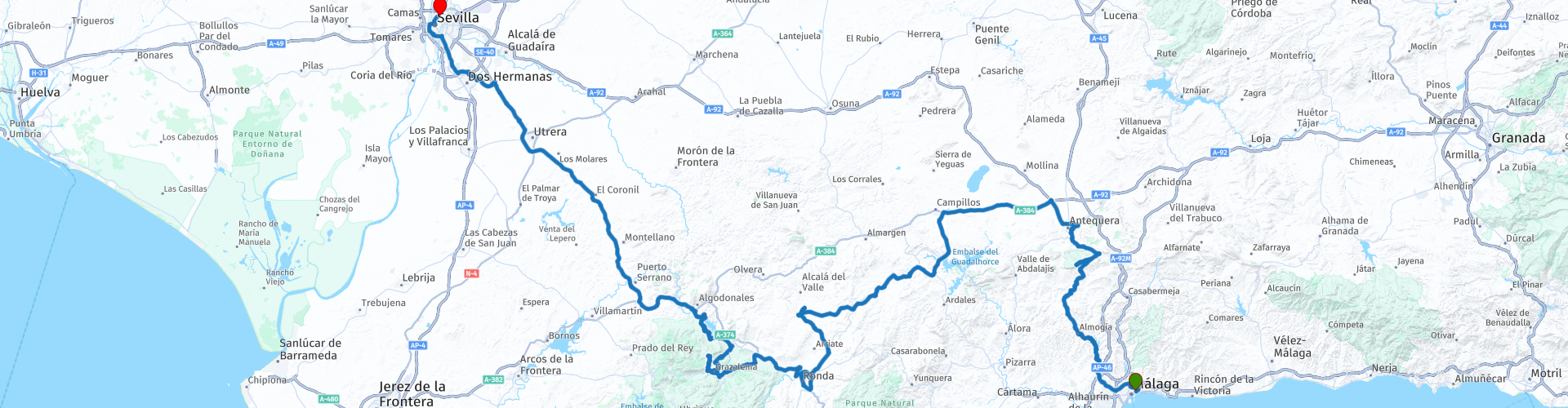
D01 Malaga to Sevilla

This route was brought to you by:
RouteXpert Albert van den Elsen-RX
Last edit: 30-10-2025
 Route Summary
 In Antequera, you step into history. You'll wander past prehistoric dolmens, Moorish walls, and tranquil squares that whisper of ancient stories. The route to Ronda winds through rugged mountain terrain, with panoramas and hairpin bends that will make your heart dance with excitement. And then Ronda itself—a city that captivates with its deep gorge and iconic bridge, perfect for a romantic stopover.
Via Grazalema, you climb to a breathtaking mountain pass: here lies Andalusia at your feet, vast and unspoiled. Zahara de la Sierra appears like a postcard above a turquoise reservoir, a painting you won't soon forget.
The final kilometers glide through peaceful valleys towards Seville. A sultry evening full of southern magic awaits—among palaces, squares, and the pulsating heartbeat of Andalusia.
Southern Spain at its finest: a route full of rhythm, ruggedness, and romance. From mountain passes to Moorish squares—every kilometer is pure Andalusian fire. Another route that deserves a five-star rating.
Start: Malaga - Hotel Parador-de Málaga
End: Seville - Hotel EXE Sevilla Macarena
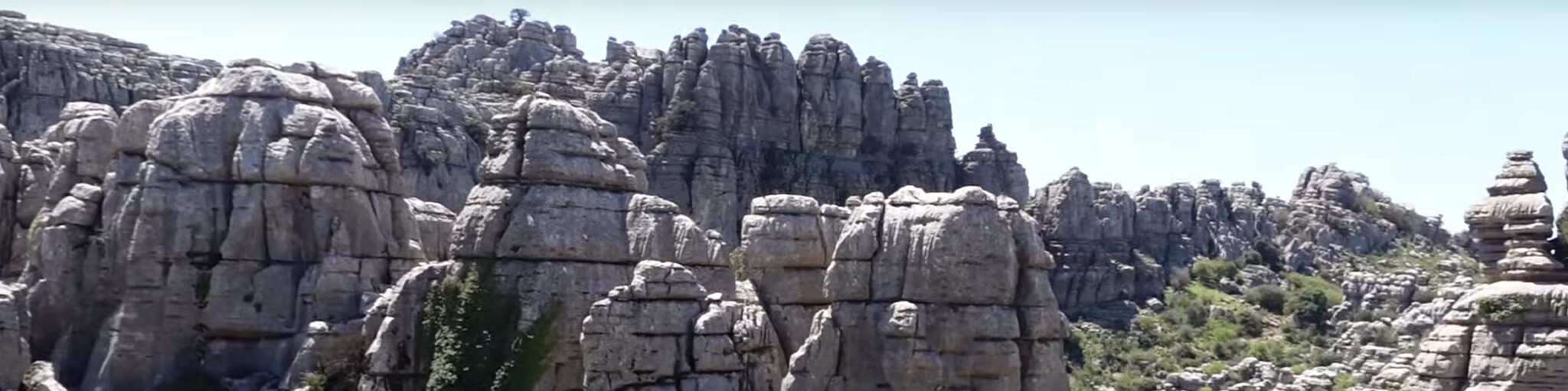
The Torcal de Antequera
Entrance costs are: €22 (2025)
 Share this route


Animation

Verdict


Duration
9h 43m

Mode of travel
Car or motorcycle

Distance
335.27 km

Countries

 RouteXpert Review
 This route is no ordinary ride—it's a narrative journey through the heart of southern Spain. You'll follow in the footsteps of explorers, knights, farmers, and poets. The names along your route capture the imagination: Ronda, Zahara de la Sierra, Antequera, Dos Hermanas, Seville. Every village, every bend, every ridge carries a story. You'll smell the aroma of olive trees in the valleys of Villanueva de la Concepción, experience the silence among the rocks of El Torcal, and hear the echo of flamenco in the alleys of Ronda. And you? You are the traveler who brings this route to life—with an open mind, curiosity, and a heart that beats for adventure.
As you leave Málaga, the world begins to open up. The city, with its Roman theater, Moorish Alcazaba, and Mediterranean flair, slowly fades into your mirrors. Here begins your journey—not just through the landscape, but through time.
Driving through the 'la Concepción' area from Amogia to Villanueva, you will be accompanied by olive groves, almond trees, limestone hills and Mediterranean scrub.
But first you pass the 'Embalse de Casasola' reservoir, which was built for water supply and flood protection, fed by the Campanillas River.
A river that rises in the Sierra de Alcaparaín near the village of Casarabonela.
And then Almogía, the gateway to the interior, nestled in the heart of the Guadalhorce Valley. You continue to Villanueva de la Concepción, where the mountains begin to rise. The road is technical but flowing—a delight for any motorcyclist. In the distance, you see El Torcal de Antequera looming: a surreal karst landscape, shaped by millions of years of erosion. The rock formations resemble petrified waves, sentinels of stone. This is also your next stop. There, you'll dismount your bike and take your time to enjoy this spectacle and take stunning photos.
What is now El Torcal de Antequera was once a still seabed, bathed in sunlight and lapped by the rhythm of the tides. Wind, frost, and time did the rest, creating a karst landscape that is among the most spectacular in Europe.
After this stop the tour continues to Antequera: crossroads of civilizations.
The descent to Antequera is panoramic. The city sits like a pearl in the valley, surrounded by history. In the city itself, you'll find Baroque churches, Roman baths, and the Dolmens of Menga and Viera, passage tombs (similar to hunebedden).
Towards Campillos and Cañete la Real the landscape changes again.
As the road quietens, you drive through a rural area where the scent of olives and sunflowers greets you. Campillos is the gatekeeper of the region, a place where the history of agriculture and nature intersect. This is not a place of towering monuments, but of a rare and fragile natural heritage: the lakes.
This is the domain of the Lagunas de Campillos Nature Reserve. A unique, salt-rich wetland consisting of lagoons such as Dulce, Salada, and Redonda. Along the way, you'll pass the Teba River, dried up by prolonged drought, climate change, and water regulation through reservoirs such as the Embalse de Guadalteba.
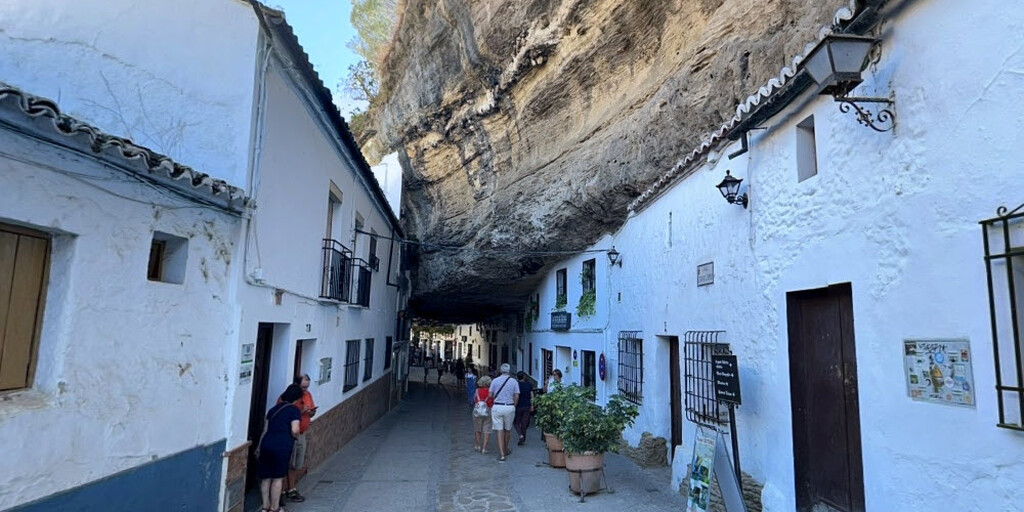
And then, suddenly, further on, a gorge. Setenil de las Bodegas, a village that seems to have been built into the mountain. Houses built under rocks, cafes tucked away in the shade.
Undoubtedly one of the most spectacular and unique "white villages" (Pueblos Blancos) in Andalusia. If you want to see this wonder, take your time and turn off to this village. Otherwise, continue on to your next stop, Ronda: the queen of the mountain towns.
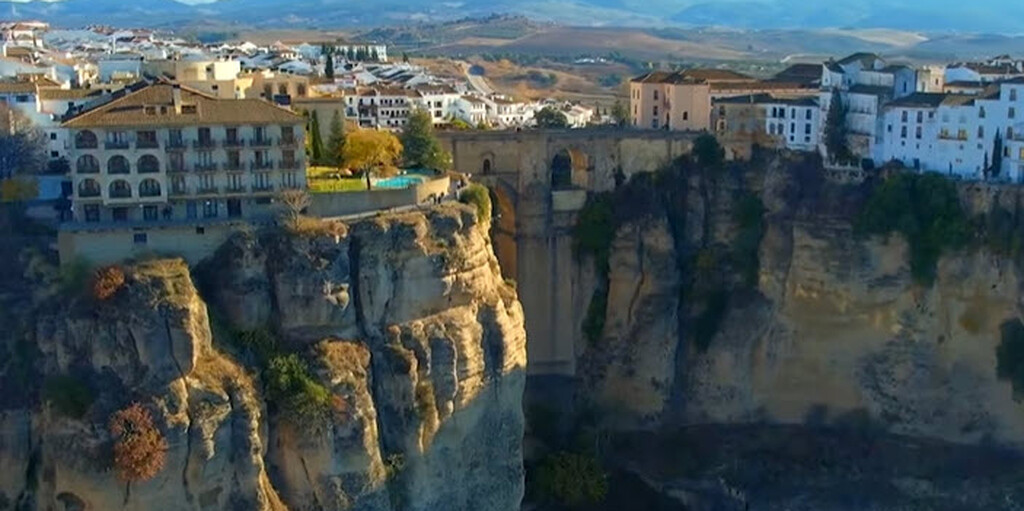
The road to Ronda is an ode to motorcycling. You ride through the Sierra de las Nieves, where the curves follow one another in rapid succession. Ronda itself is a city of drama and beauty. Built on a rocky plateau, split by a dizzying gorge. You ride over the Puente Nuevo bridge, 120 meters above the chasm.
An echo of romance, of struggle, of pride. You stroll through the old neighborhoods, taste Ibérico jamón, and look out over the mountains you've just crossed.
After Ronda, one of the most beautiful stretches of the route awaits, the road to Grazalema. This road is a dream—smooth asphalt, hairpin bends, and a backdrop of pine forests, limestone peaks, and grazing mountain goats. You then stop for an espresso, and the silence is palpable.
The descent to Zahara de la Sierra is equally spectacular. You can see the village from afar, like a white jewel on a hilltop, with the turquoise reservoir beyond. You park in the public motorcycle-friendly lot and hike up to the castle. The view is breathtaking: you see the road you came from winding through the landscape like a silver thread. Zahara was once a Moorish fortress, strategically situated among the mountains. Today, it is a place of peace, beauty, and remembrance.
After Zahara, the scenery shifts. The mountains give way to rolling hills and fertile plains. Via Algodonales and El Coronil, you drive through agricultural land where the scent of earth and oil fills your helmet. The road leads you further east, but soon you veer off onto the road heading south.
Here, the landscape changes. The mountains recede, the horizon opens up. You drive past fields of olive trees, ancient stone walls, and the occasional abandoned cortijo where the silence is palpable.
Only the rhythm of the asphalt and the birdsong on the side of the road are your companions. You pass through small hamlets, where life still revolves around the land and the seasons.
Then, after a winding descent, you meet the road leading to Montellano and El Coronil. The scenery takes on a different character, becoming softer and the hills rounder. The colors shift from rocky gray to the gold of cornfields.
In the distance looms the silhouette of the Castillo de las Aguzaderas, a medieval fortress that once guarded the border between kingdoms with an emerging story of struggle, merging and Andalusian identity.
Your next stop is Utrera, a historic city in Andalusia, known as one of the cradles of flamenco. In the old town, you'll find Gothic churches, a medieval castle, and lively squares full of local atmosphere. Just outside the city lie lagoons and nature reserves that offer tranquility and biodiversity.
And then, at Dos Hermanas, you feel the proximity of Seville: the traffic becomes busier, the buildings denser. Seville, a vibrant capital of Andalusia, imbued with Moorish, Christian, and Jewish influences.
You drive into Seville, the sun high above the Macarena city walls. One last fuel stop, and then you see your hotel just past the Basílica de la Macarena: stately, with a view of the basilica. You steer the bike towards the entrance, the gate opens, and you descend into the underground garage of the Hotel Exe Sevilla Macarena. Safely parked, cool, and ready to explore the city.
Time for rest. For food, a good drink, and the afterglow of a journey that will resonate long after—until the next ride arrives.
 Links
Links  Usage
Usage Want to download this route?
You can download the route for free without MyRoute-app account. To do so, open the route and click 'save as'. Want to edit this route?
No problem, start by opening the route. Follow the tutorial and create your personal MyRoute-app account. After registration, your trial starts automatically.  Disclaimer
Use of this GPS route is at your own expense and risk. The route has been carefully composed and checked by a MyRoute-app accredited RouteXpert for use on TomTom, Garmin and MyRoute-app Navigation.
Changes may nevertheless have occurred due to changed circumstances, road diversions or seasonal closures. We therefore recommend checking each route before use.
Preferably use the route track in your navigation system. More information about the use of MyRoute-app can be found on the website under 'Community' or 'Academy'.
Changes may nevertheless have occurred due to changed circumstances, road diversions or seasonal closures. We therefore recommend checking each route before use.
Preferably use the route track in your navigation system. More information about the use of MyRoute-app can be found on the website under 'Community' or 'Academy'.
 Nearby routes
Andalusia
About this region
Andalusia (UK: , US: ; Spanish: Andalucía [andaluˈθi.a]) is the southernmost autonomous community in Peninsular Spain. It is the most populous and the second largest autonomous community in the country. It is officially recognised as a "historical nationality". The territory is divided into eight provinces: Almería, Cádiz, Córdoba, Granada, Huelva, Jaén, Málaga, and Seville. Its capital city is Seville. The seat of the High Court of Justice of Andalusia is located in the city of Granada.
Andalusia is located in the south of the Iberian peninsula, in southwestern Europe, immediately south of the autonomous communities of Extremadura and Castilla-La Mancha; west of the autonomous community of Murcia and the Mediterranean Sea; east of Portugal and the Atlantic Ocean; and north of the Mediterranean Sea and the Strait of Gibraltar. Andalusia is the only European region with both Mediterranean and Atlantic coastlines. The small British overseas territory of Gibraltar shares a three-quarter-mile land border with the Andalusian portion of the province of Cádiz at the eastern end of the Strait of Gibraltar.
The main mountain ranges of Andalusia are the Sierra Morena and the Baetic System, consisting of the Subbaetic and Penibaetic Mountains, separated by the Intrabaetic Basin. In the north, the Sierra Morena separates Andalusia from the plains of Extremadura and Castile–La Mancha on Spain's Meseta Central. To the south the geographic subregion of Upper Andalusia lies mostly within the Baetic System, while Lower Andalusia is in the Baetic Depression of the valley of the Guadalquivir.The name "Andalusia" is derived from the Arabic word Al-Andalus (الأندلس). The toponym al-Andalus is first attested by inscriptions on coins minted in 716 by the new Muslim government of Iberia. These coins, called dinars, were inscribed in both Latin and Arabic. The etymology of the name "al-Andalus" has traditionally been derived from the name of the Vandals. Since the 1980s, a number of proposals have challenged this contention. Halm, in 1989, derived the name from a Gothic term, *landahlauts,
and in 2002, Bossong suggested its derivation from a pre-Roman substrate. The region's history and culture have been influenced by the Tartessos, Iberians, Phoenicians, Carthaginians, Greeks, Romans, Vandals, Visigoths, Byzantines, Berbers of North Africa, Jews, Romani, Arab Umayyads, and Moors. During the Islamic Golden Age, Cordoba surpassed Constantinople to be Europe's biggest city, and became the capital of Al Andalus and a prominent center of education and learning in the world, producing numerous philosophers and scientists. The Castilian and other Christian North Iberian nationalities reconquered and settled the area in the latter phases of the Reconquista.
Andalusia has historically been an agricultural region, compared to the rest of Spain and the rest of Europe. Still, the growth of the community in the sectors of industry and services was above average in Spain and higher than many communities in the Eurozone. The region has a rich culture and a strong Spanish identity. Many cultural phenomena that are seen internationally as distinctively Spanish are largely or entirely Andalusian in origin. These include flamenco and, to a lesser extent, bullfighting and Hispano-Moorish architectural styles, both of which are also prevalent in some other regions of Spain.
Andalusia's hinterland is the hottest area of Europe, with cities like Córdoba and Seville averaging above 36 °C (97 °F) in summer high temperatures. Late evening temperatures can sometimes stay around 35 °C (95 °F) until close to midnight and daytime highs of over 40 °C (104 °F) are common. Seville also has the highest average annual temperature in mainland Spain and mainland Europe (19.2 °C, 66.6 °F), closely followed by Almería (19.1 °C, 66.4 °F).
Read more on Wikipedia
Andalusia is located in the south of the Iberian peninsula, in southwestern Europe, immediately south of the autonomous communities of Extremadura and Castilla-La Mancha; west of the autonomous community of Murcia and the Mediterranean Sea; east of Portugal and the Atlantic Ocean; and north of the Mediterranean Sea and the Strait of Gibraltar. Andalusia is the only European region with both Mediterranean and Atlantic coastlines. The small British overseas territory of Gibraltar shares a three-quarter-mile land border with the Andalusian portion of the province of Cádiz at the eastern end of the Strait of Gibraltar.
The main mountain ranges of Andalusia are the Sierra Morena and the Baetic System, consisting of the Subbaetic and Penibaetic Mountains, separated by the Intrabaetic Basin. In the north, the Sierra Morena separates Andalusia from the plains of Extremadura and Castile–La Mancha on Spain's Meseta Central. To the south the geographic subregion of Upper Andalusia lies mostly within the Baetic System, while Lower Andalusia is in the Baetic Depression of the valley of the Guadalquivir.The name "Andalusia" is derived from the Arabic word Al-Andalus (الأندلس). The toponym al-Andalus is first attested by inscriptions on coins minted in 716 by the new Muslim government of Iberia. These coins, called dinars, were inscribed in both Latin and Arabic. The etymology of the name "al-Andalus" has traditionally been derived from the name of the Vandals. Since the 1980s, a number of proposals have challenged this contention. Halm, in 1989, derived the name from a Gothic term, *landahlauts,
and in 2002, Bossong suggested its derivation from a pre-Roman substrate. The region's history and culture have been influenced by the Tartessos, Iberians, Phoenicians, Carthaginians, Greeks, Romans, Vandals, Visigoths, Byzantines, Berbers of North Africa, Jews, Romani, Arab Umayyads, and Moors. During the Islamic Golden Age, Cordoba surpassed Constantinople to be Europe's biggest city, and became the capital of Al Andalus and a prominent center of education and learning in the world, producing numerous philosophers and scientists. The Castilian and other Christian North Iberian nationalities reconquered and settled the area in the latter phases of the Reconquista.
Andalusia has historically been an agricultural region, compared to the rest of Spain and the rest of Europe. Still, the growth of the community in the sectors of industry and services was above average in Spain and higher than many communities in the Eurozone. The region has a rich culture and a strong Spanish identity. Many cultural phenomena that are seen internationally as distinctively Spanish are largely or entirely Andalusian in origin. These include flamenco and, to a lesser extent, bullfighting and Hispano-Moorish architectural styles, both of which are also prevalent in some other regions of Spain.
Andalusia's hinterland is the hottest area of Europe, with cities like Córdoba and Seville averaging above 36 °C (97 °F) in summer high temperatures. Late evening temperatures can sometimes stay around 35 °C (95 °F) until close to midnight and daytime highs of over 40 °C (104 °F) are common. Seville also has the highest average annual temperature in mainland Spain and mainland Europe (19.2 °C, 66.6 °F), closely followed by Almería (19.1 °C, 66.4 °F).
View region
 Statistics
  12
12Amount of RX reviews (Andalusia)
 21635
21635Amount of visitors (Andalusia)
 340
340Amount of downloads (Andalusia)
 Route Collections in this region
 A 4 day tour in Spain from Bilbao to Cartagena
With a starting point just south of Bilbao, this 1,300 km tour is easy to connect to from the French border or Santander. The tour travels through some of Spain's most spectacular landscapes and visits among other things, the windmills of La Mancha, made famous in the books by Miguel de Cervantes and his character Don Quixote. The end of this 4 day tour is at Cartagena on the Mediterranean's Costa Cálida, a wonderful city that's alive with culture, history and gastronomy.
View Route Collection
Discovering the villages of Huelva
This tour consists of three routes for three days, but you can do them interchangeably if you prefer due to the proximity of the three routes. Huelva is an area to explore, beautiful in its landscapes and nature and the best thing is its Iberian pork gastronomy and on these routes you can experience and enjoy it all.
View Route Collection