
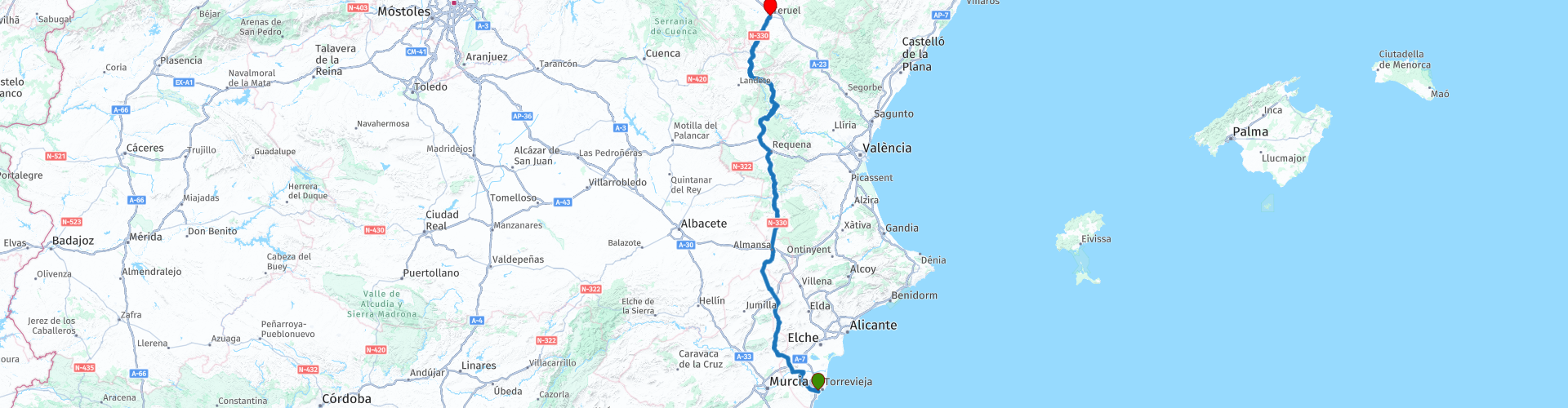
Torrevieja to Teruel

This route was brought to you by:
RouteXpert Nick Carthew - (MRA Master)
Last edit: 18-08-2025
 Route Summary
  Share this route


Animation

Verdict


Duration
7h 42m

Mode of travel
Car or motorcycle

Distance
377.36 km

Countries

 RouteXpert Review
 Embalse de la Pedrera is a large reservoir located in the province of Alicante. It serves as an important water source for irrigation in the region, supporting local agriculture and it plays a crucial role in water management for the area.
You now head into the open countryside with long distance views of small mountain ranges ahead, and when you pass these, there is another range, and another and another. The road surface is very good and there are some fast sweeping bends that will put a smile on any motorcyclists face.
You will enter the Special Protection Zone for Birds, Yecla Steppes.
The endless landscape of the vast northern plains of the Yecla area constitutes a valuable refuge for some bird species that are threatened throughout Europe. Birds such as great bustard, little bustard, sandgrouse, stone curlew, lesser kestrels and harriers all depend on this type of landscape.
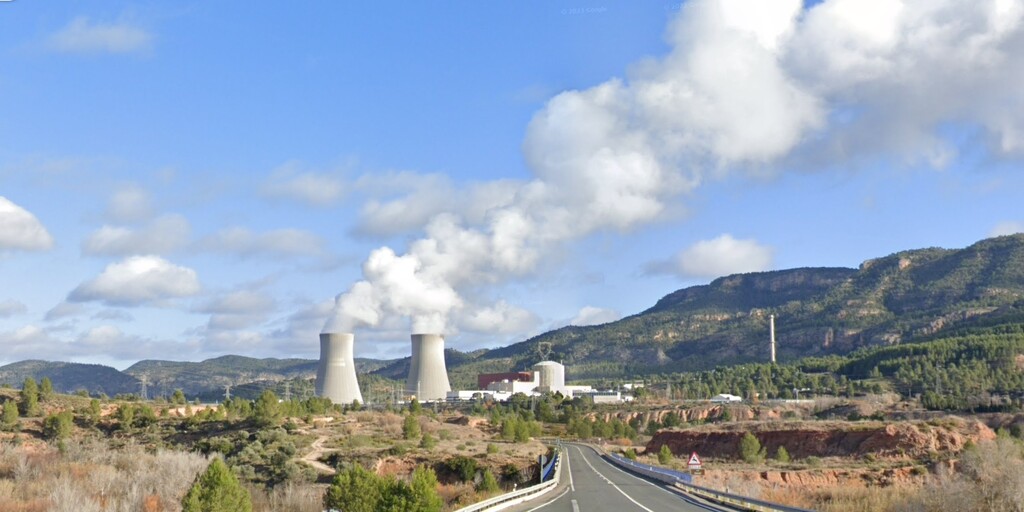
Then as a complete contrast to the natural countryside that surrounds you, you'll come across the Cofrentes Nuclear Power Plant, built on the right bank of the Júcar river, which provides water for cooling. Steam rising from the cooling towers can be seen from miles around. The reactor has Spain's highest net capacity capable of producing 1,064 Megawatts of electricity.
I have suggested a fuel and lunch stop at El Pontón. The La Brassa restaurant is next door to the gas station and they welcome motorcyclists.
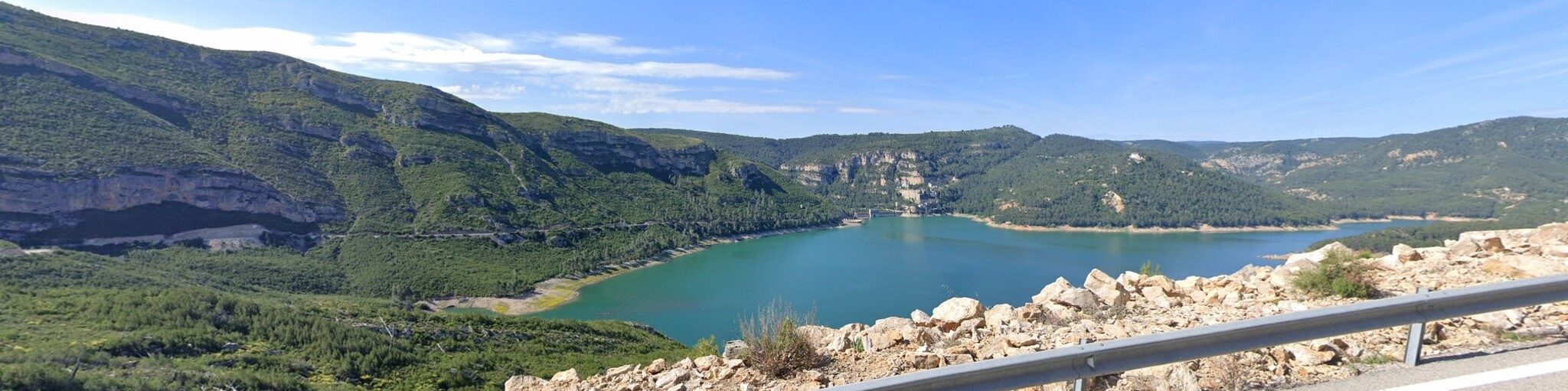
After lunch the route takes a smaller road and heads towards the magnificent Benagéber reservoir. The road is very twisty and has several hairpin bends. There is an opportunity to take pictures on the dam and anyone with a loud exhaust will appreciate the tunnel!
This enormous reservoir is fed by the Rio Turia which we will meet up with again at the Santa Cruz de Moya bridge and follow its path, with more hairpins all the way to the hotel at Teruel.
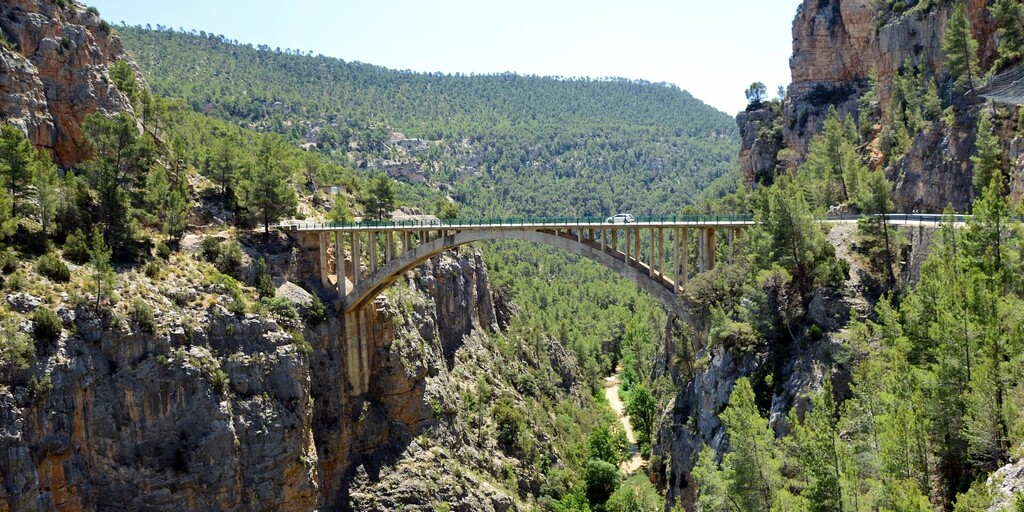
The Santa Cruz de Moya bridge crosses over the Turia River at a spectacular canyon. The bridge consists of an iron arch with four trusses joined together, with a cement formwork . The length of the arch (width of the Turia canyon) is 85 metres and the height is 100 metres above the river bed. Although the structure of the bridge is made of iron, it is completely covered in cement, so that the metal is not visible at all. After crossing the canyon there are no safe places to stop for a photo, but I would certainly try to!
The route ends at the Hotel Isabel de Segura which has 3*** and is very comfortable with secure parking. We stayed here in May 2019, see the link below.
I will also add that the barmaid was very generous with her brandy measures!
Enjoy
 Links
Links  Usage
Usage Want to download this route?
You can download the route for free without MyRoute-app account. To do so, open the route and click 'save as'. Want to edit this route?
No problem, start by opening the route. Follow the tutorial and create your personal MyRoute-app account. After registration, your trial starts automatically.  Disclaimer
Use of this GPS route is at your own expense and risk. The route has been carefully composed and checked by a MyRoute-app accredited RouteXpert for use on TomTom, Garmin and MyRoute-app Navigation.
Changes may nevertheless have occurred due to changed circumstances, road diversions or seasonal closures. We therefore recommend checking each route before use.
Preferably use the route track in your navigation system. More information about the use of MyRoute-app can be found on the website under 'Community' or 'Academy'.
Changes may nevertheless have occurred due to changed circumstances, road diversions or seasonal closures. We therefore recommend checking each route before use.
Preferably use the route track in your navigation system. More information about the use of MyRoute-app can be found on the website under 'Community' or 'Academy'.
 Nearby routes
Murcia
About this region
The Region of Murcia (, US also ; Spanish: Región de Murcia [reˈxjon de ˈmuɾθja]), is an autonomous community of Spain located in the southeast part of the Iberian Peninsula, on the Mediterranean coast. The region is centered on a historical region of the same name in what is now southeastern Spain. It is heir to the ancient Kingdom of Murcia, which traditionally included, as a bi-provincial region, the provinces of Albacete and Murcia. During the transition to democracy (la Transición), Albacete became part of Castilla–La Mancha. The region is 11,313 km2 (4,368 sq mi) in area and had a population of 1,511,251 as at the start of 2020. About one-third of its population lives in the capital, Murcia. At 2,014 m (6,608 ft), the region's highest point is Los Obispos Peak in the Massif of Revolcadores.The region is bordered by Andalusia (the provinces of Almería and Granada), Castile La Mancha (the province of Albacete, which until 1980 was a part of Murcia), the Valencian Community (province of Alicante), and the Mediterranean Sea. The autonomous community is a single province. The city of Murcia is the capital of the region and the seat of the regional government, but the legislature, known as the Regional Assembly of Murcia, is located in Cartagena. The region is subdivided into municipalities.The region is among Europe's largest producers of fruits, vegetables, and flowers, with important vineyards in the municipalities of Jumilla, Bullas, and Yecla that produce wines of Denominación de origen. It also has an important tourism sector concentrated on its Mediterranean coastline, which features the Mar Menor saltwater lagoon. Industries include the petrochemical and energy sector (centered in Cartagena) and food production. Because of Murcia's warm climate, the region's long growing season is suitable for agriculture; however, rainfall is low. As a result, in addition to the water needed for crops, there are increasing pressures related to the booming tourist industry. Water is supplied by the Segura River and, since the 1970s, by the Tagus-Segura Water Transfer, a major civil-engineering project that brings water from the Tagus River into the Segura under environmental and sustainability restraints.
Notable features of the region's extensive cultural heritage include 72 cave art ensembles, which are part of the rock art of the Iberian Mediterranean Basin, a World Heritage Site. Other culturally significant features include the Council of Wise Men of the plain of Murcia and the tamboradas (drumming processions) of Moratalla and Mula, which were declared intangible cultural heritage by UNESCO. The region is also the home of Caravaca de la Cruz, a holy city in the Catholic Church that celebrates the Perpetual Jubilee every seven years in the Santuario de la Vera Cruz.
Read more on Wikipedia
Notable features of the region's extensive cultural heritage include 72 cave art ensembles, which are part of the rock art of the Iberian Mediterranean Basin, a World Heritage Site. Other culturally significant features include the Council of Wise Men of the plain of Murcia and the tamboradas (drumming processions) of Moratalla and Mula, which were declared intangible cultural heritage by UNESCO. The region is also the home of Caravaca de la Cruz, a holy city in the Catholic Church that celebrates the Perpetual Jubilee every seven years in the Santuario de la Vera Cruz.
View region
 Statistics
  4
4Amount of RX reviews (Murcia)
 15753
15753Amount of visitors (Murcia)
 242
242Amount of downloads (Murcia)
 Route Collections in this region
 A 4 day tour in Spain from Bilbao to Cartagena
With a starting point just south of Bilbao, this 1,300 km tour is easy to connect to from the French border or Santander. The tour travels through some of Spain's most spectacular landscapes and visits among other things, the windmills of La Mancha, made famous in the books by Miguel de Cervantes and his character Don Quixote. The end of this 4 day tour is at Cartagena on the Mediterranean's Costa Cálida, a wonderful city that's alive with culture, history and gastronomy.
View Route Collection
Hasta la Vista
"Hasta la vista" is a Spanish expression that literally translates to "until we see you." It's used as a farewell greeting and means something like "see you later," "see you later," or "farewell." The routes under the Hasta la Vista umbrella all have in common that they head towards the Spanish sun, and along the way you'll encounter (almost) forgotten sights, refreshing your memories and reviving the joy of it all.
This collection consists of 16 routes that all share one thing in common: they all face south, heading towards the sunny south and then all the way to the Costa del Sol. The first route begins in the northernmost tip of the cool Netherlands near Moddergat, and the last route ends in the sunny south of Spain near Almeria.
This collection consists of 16 routes that all share one thing in common: they all face south, heading towards the sunny south and then all the way to the Costa del Sol. The first route begins in the northernmost tip of the cool Netherlands near Moddergat, and the last route ends in the sunny south of Spain near Almeria.
View Route Collection