
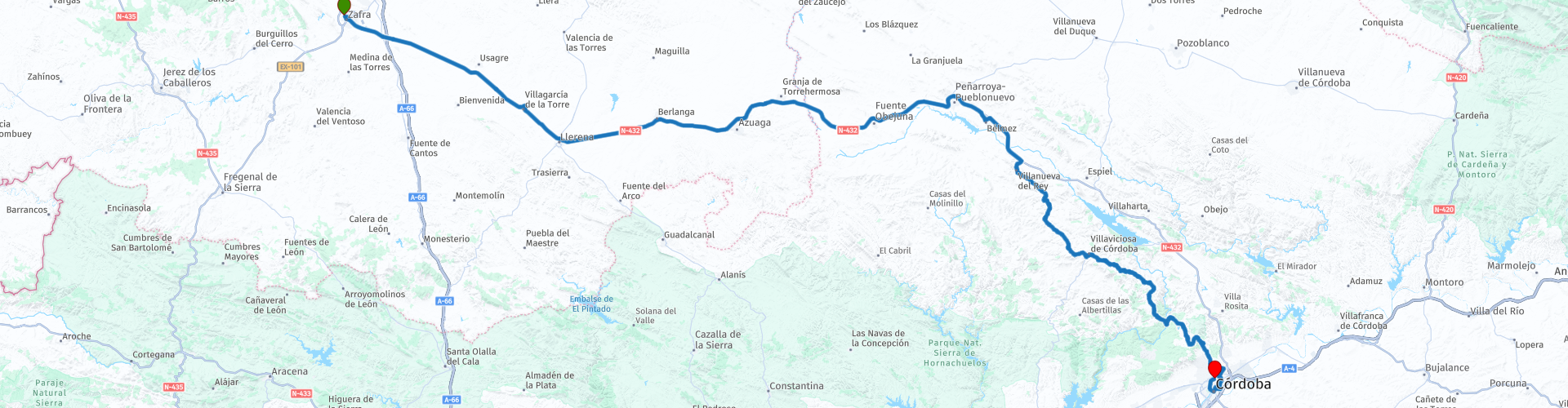
D06 Zafra to Cordoba

This route was brought to you by:
RouteXpert Albert van den Elsen-RX
Last edit: 04-02-2026
 Route Summary
 As you travel further, a world of ancient castles and villages unfolds where time seems to have stood still. Vast plains breathe the scent of Mediterranean vegetation, while the winding roads of the Sierra Morena take you through a landscape that reveals itself layer by layer. Every bend, every slope, every horizon offers a new panorama—a reminder of how impressive and resilient nature can be. And then, after a day of history, nature, and the pure joy of driving, Cordoba appears… a city where cultures have intersected for centuries, where stones whisper, and where time becomes almost tangible.
It's inevitable. This ride, shaped by beauty and story, once again earns its well-deserved five stars.
Start: Zafra, Hotel La Muralla
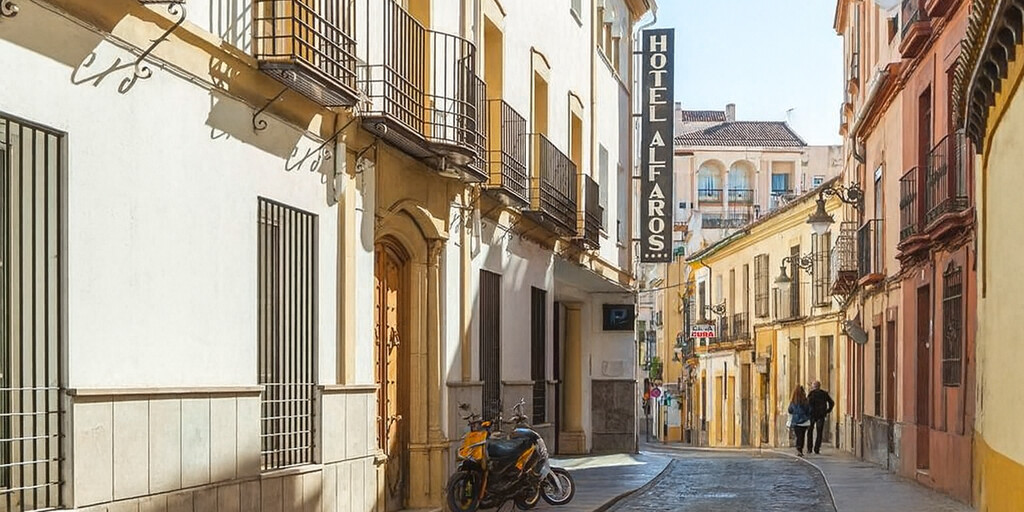
End: Cordoba: Hotel Alfaros
 Share this route


Animation

Verdict


Duration
4h 54m

Mode of travel
Car or motorcycle

Distance
214.86 km

Countries

 RouteXpert Review
 When the engine revs, the sound doesn't disturb the silence, but rather adds to it. A low, warm hum blends with the soft murmur of a city that has witnessed the departure of so many generations of travelers. Above it all towers the Alcázar de los Duques, a fifteenth-century fortress that stands like an imperturbable sentinel over the city. Its stones have witnessed wars, famines, festivals, market days—and now your departure.
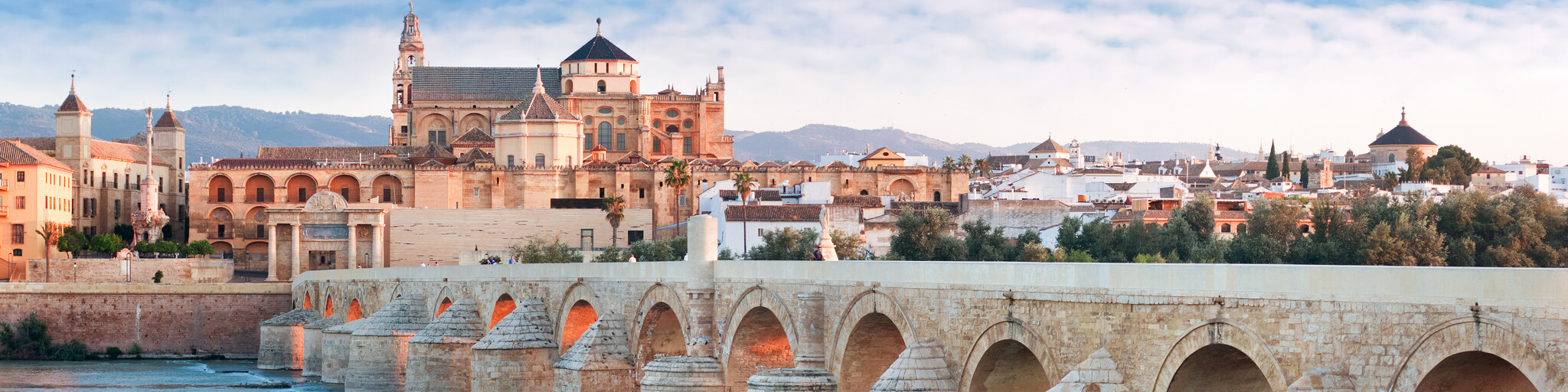
It's one of those moments when the horizon not only beckons, but practically grabs you by the scruff of the neck as you drive towards your final destination: the unforgettable Córdoba between the striped arches of the Mezquita.
As soon as you leave the city behind, a landscape unfolds that doesn't impose itself, but slowly reveals itself. The road stretches like a ribbon through a region where the horizon always seems a little further than you think. This is the land of Extremadura: rugged, vast, and shaped by centuries of wind, sun, and human perseverance. Usagre appears as a dot on the edge of the landscape. A settlement that, like so many villages here, bears a long history without boasting about it.
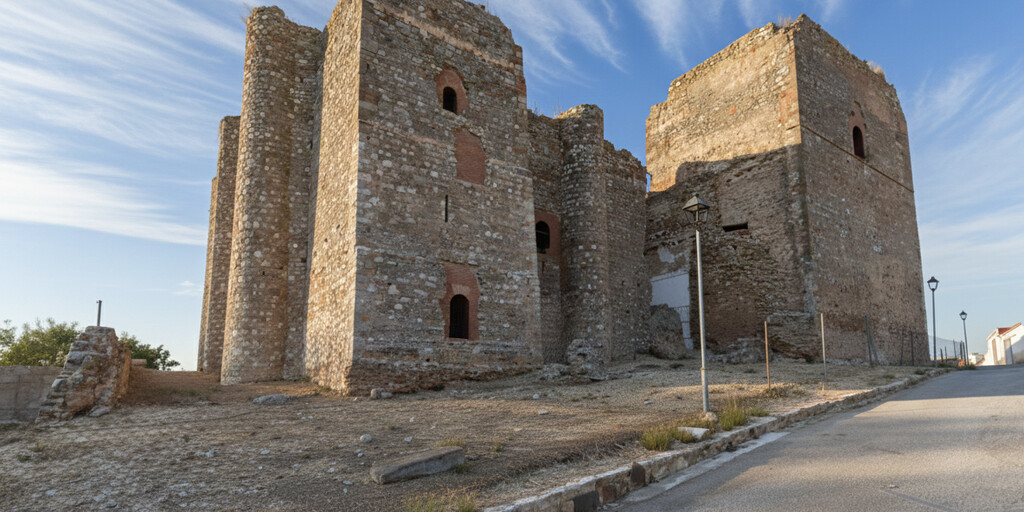
Shortly after, follows Villagarcía de la Torre, where the ruins of a fifteenth-century castle still dominate the skyline. The Homenaje Tower, weathered by time and weather, stands as a silent witness to a time when this region was a frontier—a place where cultures met, clashed, and ultimately intermingled. The Mudéjar church towers that rise above the village are a reminder of the centuries-long presence of the Moors. Their architecture, with its brick patterns and elegant lines, almost seems to whisper of a time when religions and cultures coexisted here, sometimes in harmony, sometimes in tension.
Between Llerena and Azuaga, a landscape unfolds that, as if aware of its own importance, is part of an internationally recognised nature reserve.
Here, in this Key Biodiversity Area, the land breathes an age-old harmony between man and nature.
Before you stretches a mosaic of open, golden plains that glow like liquid amber in the sun. They are gently interrupted by the traditional Spanish dehesa: vast meadows where sturdy holm oaks stand like sentinels over the land.
On the horizon rise low ridges, not imposing, but subtle enough to guide the eye and define the rhythm of this serene landscape.
It is a land where every breeze, every shadow, every contour tells a story — a place where nature still reigns supreme.
As you pass Granja de Torrehermosa, the terrain begins to undulate. It's a subtle change, but one you feel in the bike, in your body, and in the air. You're approaching the province of Córdoba, where the landscape is dominated by vast oak forests, olive groves, and the characteristic Iberian pig farm. This is the home of the famous Ibérico jamón, a product that is not only a delicacy but also a symbol of a centuries-old agricultural tradition.
The vegetation is typically Mediterranean: drought-resistant, hardy, yet surprisingly diverse. Here, nature has learned to survive in conditions that would be inhospitable to others. And yet, within this apparent austerity lies an enormous wealth.
At Romero Torres restaurant, a well-deserved coffee break awaits. The silence of the countryside, the soft hum of insects, the slow rhythm of the day—it all makes a perfect backdrop for a short break.
The route then leads to Belmez, where an impressive castle ruin towers high above the landscape. Built between the thirteenth and fifteenth centuries, the Castell de Belmez stands on a limestone outcrop that was already used by the Romans as a lookout point. From here, the Guadiato Valley stretches out like a living painting. The Arcos de Entrada a Belmez mark the entrance to the town, like gatekeepers who have welcomed travelers for centuries.
After Belmez, you leave the main road and head deeper inland, towards Villanueva de Rey. The world becomes quieter, more rugged, and the road winds through a landscape that gains ever more altitude. Shortly after, you reach Las Jaras, a residential area and nature reserve in the heart of the Sierra Morena. Here, everything changes. The air becomes fresher. The vegetation becomes denser. Holm oaks, cork oaks, and pines form a green carpet that stretches across the hills. The cistus rose—the jara—exudes a spicy scent characteristic of this area. It is a place where nature and humanity coexist in a fragile balance.
For motorcyclists, this is paradise: winding roads, perfect asphalt, and views that unfold like a slow-moving panorama. Here, you don't just feel the engine beneath you—you feel it working in harmony with the landscape.
And then the approach to a city steeped in history. As you leave the mountains, the landscape changes again. The rugged heights give way to the orderly valleys of the Guadalquivir.
The air warms, the colors soften. And then, like an old friend you see approaching from afar, Cordoba appears.
A city that was once the intellectual center of the world. A city where Muslims, Jews, and Christians together created a culture far ahead of its time. A city that still breathes rhythms older than most civilizations. A quick fuel stop to prepare for the next day, and then a quick visit to the ancient Roman bridge, Puente de Miraflores, before docking at your hotel.
Your hotel, Andalusian in style, offers a safe haven. An underground garage for your motorcycle, a swimming pool that beckons after a long day—these are little luxuries every traveler appreciates. Take your time, because in this city, you'll find many encounters with time.
Just a few steps away stand twelve Roman columns, silent sentinels from a time when Córdoba was part of an empire that spanned three continents. They seem almost unearthly, as if they sprang from the ground overnight. A ten-minute walk away awaits the Mezquita—an architectural marvel, a symbol of cultural intertwining. The Jewish Quarter, the synagogue, the Calleja de las Flores, the flower-filled patios—these are places where time seems to flow not linearly, but circularly. Everything returns, everything endures.
As evening falls and the city slowly settles, you feel the tiredness in your muscles—but also the satisfaction. You haven't just driven a route. You've traversed a landscape that lives, breathes, and tells stories to those willing to listen.
And as you settle down with a cool refreshment, you know this day will resonate with you for a long time to come. Tomorrow awaits a new stage, a new landscape, a new story. But for now, you can rest, knowing that you've experienced something special today.
 Links
Links  Usage
Usage Want to download this route?
You can download the route for free without MyRoute-app account. To do so, open the route and click 'save as'. Want to edit this route?
No problem, start by opening the route. Follow the tutorial and create your personal MyRoute-app account. After registration, your trial starts automatically.  Disclaimer
Use of this GPS route is at your own expense and risk. The route has been carefully composed and checked by a MyRoute-app accredited RouteXpert for use on TomTom, Garmin and MyRoute-app Navigation.
Changes may nevertheless have occurred due to changed circumstances, road diversions or seasonal closures. We therefore recommend checking each route before use.
Preferably use the route track in your navigation system. More information about the use of MyRoute-app can be found on the website under 'Community' or 'Academy'.
Changes may nevertheless have occurred due to changed circumstances, road diversions or seasonal closures. We therefore recommend checking each route before use.
Preferably use the route track in your navigation system. More information about the use of MyRoute-app can be found on the website under 'Community' or 'Academy'.
 Nearby routes
Andalusia
About this region
Andalusia (UK: , US: ; Spanish: Andalucía [andaluˈθi.a]) is the southernmost autonomous community in Peninsular Spain. It is the most populous and the second largest autonomous community in the country. It is officially recognised as a "historical nationality". The territory is divided into eight provinces: Almería, Cádiz, Córdoba, Granada, Huelva, Jaén, Málaga, and Seville. Its capital city is Seville. The seat of the High Court of Justice of Andalusia is located in the city of Granada.
Andalusia is located in the south of the Iberian peninsula, in southwestern Europe, immediately south of the autonomous communities of Extremadura and Castilla-La Mancha; west of the autonomous community of Murcia and the Mediterranean Sea; east of Portugal and the Atlantic Ocean; and north of the Mediterranean Sea and the Strait of Gibraltar. Andalusia is the only European region with both Mediterranean and Atlantic coastlines. The small British overseas territory of Gibraltar shares a three-quarter-mile land border with the Andalusian portion of the province of Cádiz at the eastern end of the Strait of Gibraltar.
The main mountain ranges of Andalusia are the Sierra Morena and the Baetic System, consisting of the Subbaetic and Penibaetic Mountains, separated by the Intrabaetic Basin. In the north, the Sierra Morena separates Andalusia from the plains of Extremadura and Castile–La Mancha on Spain's Meseta Central. To the south the geographic subregion of Upper Andalusia lies mostly within the Baetic System, while Lower Andalusia is in the Baetic Depression of the valley of the Guadalquivir.The name "Andalusia" is derived from the Arabic word Al-Andalus (الأندلس). The toponym al-Andalus is first attested by inscriptions on coins minted in 716 by the new Muslim government of Iberia. These coins, called dinars, were inscribed in both Latin and Arabic. The etymology of the name "al-Andalus" has traditionally been derived from the name of the Vandals. Since the 1980s, a number of proposals have challenged this contention. Halm, in 1989, derived the name from a Gothic term, *landahlauts,
and in 2002, Bossong suggested its derivation from a pre-Roman substrate. The region's history and culture have been influenced by the Tartessos, Iberians, Phoenicians, Carthaginians, Greeks, Romans, Vandals, Visigoths, Byzantines, Berbers of North Africa, Jews, Romani, Arab Umayyads, and Moors. During the Islamic Golden Age, Cordoba surpassed Constantinople to be Europe's biggest city, and became the capital of Al Andalus and a prominent center of education and learning in the world, producing numerous philosophers and scientists. The Castilian and other Christian North Iberian nationalities reconquered and settled the area in the latter phases of the Reconquista.
Andalusia has historically been an agricultural region, compared to the rest of Spain and the rest of Europe. Still, the growth of the community in the sectors of industry and services was above average in Spain and higher than many communities in the Eurozone. The region has a rich culture and a strong Spanish identity. Many cultural phenomena that are seen internationally as distinctively Spanish are largely or entirely Andalusian in origin. These include flamenco and, to a lesser extent, bullfighting and Hispano-Moorish architectural styles, both of which are also prevalent in some other regions of Spain.
Andalusia's hinterland is the hottest area of Europe, with cities like Córdoba and Seville averaging above 36 °C (97 °F) in summer high temperatures. Late evening temperatures can sometimes stay around 35 °C (95 °F) until close to midnight and daytime highs of over 40 °C (104 °F) are common. Seville also has the highest average annual temperature in mainland Spain and mainland Europe (19.2 °C, 66.6 °F), closely followed by Almería (19.1 °C, 66.4 °F).
Read more on Wikipedia
Andalusia is located in the south of the Iberian peninsula, in southwestern Europe, immediately south of the autonomous communities of Extremadura and Castilla-La Mancha; west of the autonomous community of Murcia and the Mediterranean Sea; east of Portugal and the Atlantic Ocean; and north of the Mediterranean Sea and the Strait of Gibraltar. Andalusia is the only European region with both Mediterranean and Atlantic coastlines. The small British overseas territory of Gibraltar shares a three-quarter-mile land border with the Andalusian portion of the province of Cádiz at the eastern end of the Strait of Gibraltar.
The main mountain ranges of Andalusia are the Sierra Morena and the Baetic System, consisting of the Subbaetic and Penibaetic Mountains, separated by the Intrabaetic Basin. In the north, the Sierra Morena separates Andalusia from the plains of Extremadura and Castile–La Mancha on Spain's Meseta Central. To the south the geographic subregion of Upper Andalusia lies mostly within the Baetic System, while Lower Andalusia is in the Baetic Depression of the valley of the Guadalquivir.The name "Andalusia" is derived from the Arabic word Al-Andalus (الأندلس). The toponym al-Andalus is first attested by inscriptions on coins minted in 716 by the new Muslim government of Iberia. These coins, called dinars, were inscribed in both Latin and Arabic. The etymology of the name "al-Andalus" has traditionally been derived from the name of the Vandals. Since the 1980s, a number of proposals have challenged this contention. Halm, in 1989, derived the name from a Gothic term, *landahlauts,
and in 2002, Bossong suggested its derivation from a pre-Roman substrate. The region's history and culture have been influenced by the Tartessos, Iberians, Phoenicians, Carthaginians, Greeks, Romans, Vandals, Visigoths, Byzantines, Berbers of North Africa, Jews, Romani, Arab Umayyads, and Moors. During the Islamic Golden Age, Cordoba surpassed Constantinople to be Europe's biggest city, and became the capital of Al Andalus and a prominent center of education and learning in the world, producing numerous philosophers and scientists. The Castilian and other Christian North Iberian nationalities reconquered and settled the area in the latter phases of the Reconquista.
Andalusia has historically been an agricultural region, compared to the rest of Spain and the rest of Europe. Still, the growth of the community in the sectors of industry and services was above average in Spain and higher than many communities in the Eurozone. The region has a rich culture and a strong Spanish identity. Many cultural phenomena that are seen internationally as distinctively Spanish are largely or entirely Andalusian in origin. These include flamenco and, to a lesser extent, bullfighting and Hispano-Moorish architectural styles, both of which are also prevalent in some other regions of Spain.
Andalusia's hinterland is the hottest area of Europe, with cities like Córdoba and Seville averaging above 36 °C (97 °F) in summer high temperatures. Late evening temperatures can sometimes stay around 35 °C (95 °F) until close to midnight and daytime highs of over 40 °C (104 °F) are common. Seville also has the highest average annual temperature in mainland Spain and mainland Europe (19.2 °C, 66.6 °F), closely followed by Almería (19.1 °C, 66.4 °F).
View region
 Statistics
  20
20Amount of RX reviews (Andalusia)
 25170
25170Amount of visitors (Andalusia)
 506
506Amount of downloads (Andalusia)
 Route Collections in this region
 A 4 day tour in Spain from Bilbao to Cartagena
With a starting point just south of Bilbao, this 1,300 km tour is easy to connect to from the French border or Santander. The tour travels through some of Spain's most spectacular landscapes and visits among other things, the windmills of La Mancha, made famous in the books by Miguel de Cervantes and his character Don Quixote. The end of this 4 day tour is at Cartagena on the Mediterranean's Costa Cálida, a wonderful city that's alive with culture, history and gastronomy.
View Route Collection
Discovering the villages of Huelva
This tour consists of three routes for three days, but you can do them interchangeably if you prefer due to the proximity of the three routes. Huelva is an area to explore, beautiful in its landscapes and nature and the best thing is its Iberian pork gastronomy and on these routes you can experience and enjoy it all.
View Route Collection