
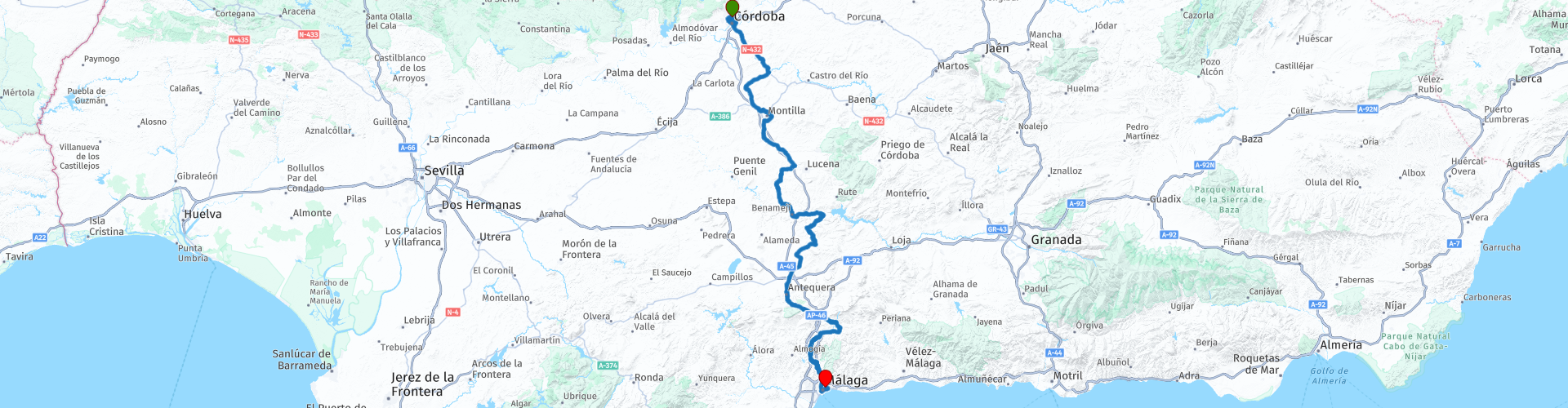
D07 Cordoba to Malaga

This route was brought to you by:
RouteXpert Albert van den Elsen-RX
Last edit: 07-02-2026
 Route Summary
 You glide through Montilla and Aguilar like a silent visitor, past hills and villages that have watched undisturbed for centuries. Then the Axarquía pulls you upward, where the air is filled with thyme and rosemary, and the mountains close in a protective embrace.
And then… the descent. Bend after bend, the world opens up again, and on the horizon, the Mediterranean Sea begins to shimmer like a slowly revealed promise.
At the top of Gibralfaro, you finally stand still. The city below you, the sea before you—breathing, eternal. A moment not just seen, but deeply felt. A journey that carries you long after the engine has been turned off.
This ride undoubtedly deserves another five stars—for reasons that are both rational and emotional. This is one of those journeys that isn't just beautiful, it feels beautiful.
Start: Hotel Marcia Alfaros, Cordoba
End: Hotel Parador-de Málaga Gibralfaro, Malaga
 Share this route


Animation

Verdict


Duration
7h 25m

Mode of travel
Car or motorcycle

Distance
240.91 km

Countries

 RouteXpert Review
 You're standing on the outskirts of Córdoba, a city that for centuries has been the center of ideas, exchange, and civilization. The air is warm, almost palpable, and carries the echoes of Romans, Moors, kings, and travelers. With a gentle breeze in your hair, you set course for Málaga—a journey measured not simply in kilometers, but in experiences that intertwine like threads into an Andalusian tapestry.
You leave Calle Alfaros behind you, a street where the past feels close, as if ancient voices still whisper from the walls. You glide past the Plaza de Toros de Los Califas, where the bullring still hosts events that breathe both tradition and modern culture. Then comes a short crossing: the Río Guadalquivir, which you leave behind you via the ancient Puento Romano. The river flows imperturbably—a silent, flowing memory bank of Andalusia.
Then the landscape opens up, as if a curtain is slowly being drawn back. The urban noise fades away; someone seems to have gently muted the world's sounds. The interior unfolds towards Fernán Núñez, where the asphalt winds like a modern ribbon between hills that seem to have breathed the same rhythm for centuries.
Here lies the Campiña—a wide, open plain that undulates like a green sea. Cortijos, traditional farmhouses, shine like white dots among the silvery-green olive trees. The sky is a blue so deep and intense that your eyes almost have to adjust to it. In the scorching summer sun, currents of heat dance above the earth, and the scent of dry grass mingles with the robust, earthy aromas of olives.
In the distance, Fernán Núñez rises. The Palacio Ducal, an eighteenth-century neoclassical palace, is in the midst of restoration and will once again shine like the crowning glory of the valley in 2026. It is a reminder of how human ambition engages in dialogue with a landscape that effortlessly defies the ravages of time. A short visit is enough to immerse yourself in the history that has settled here like sediment.
The route leads you further south, into the hills. The Castillo de Montilla appears on the horizon—birthplace of the legendary "El Gran Capitán." From its weathered walls, a panorama of farmland and fields unfolds, where even an eighteenth-century granary still stands steadfastly.
Leaving Montilla behind, the landscape changes again. An ocean of vineyards stretches endlessly, bathed in sunlight. Here, the famed Pedro Ximénez grape ripens, shimmering and dark, nourished by the almost white albariza soil that reflects the sunlight as if the earth itself were a lantern. The geometric patterns of olive groves pass by like a living mosaic. Aguilar de la Frontera towers above it all—stately, with Moorish echoes still softly resonating.
The route follows the slopes of the Sierra Norte, where the air becomes slightly cooler and the contours of the land become firmer and more rugged. In Monturque, Restaurant El Cañuelo awaits, where the aroma of freshly brewed coffee briefly fills the landscape.
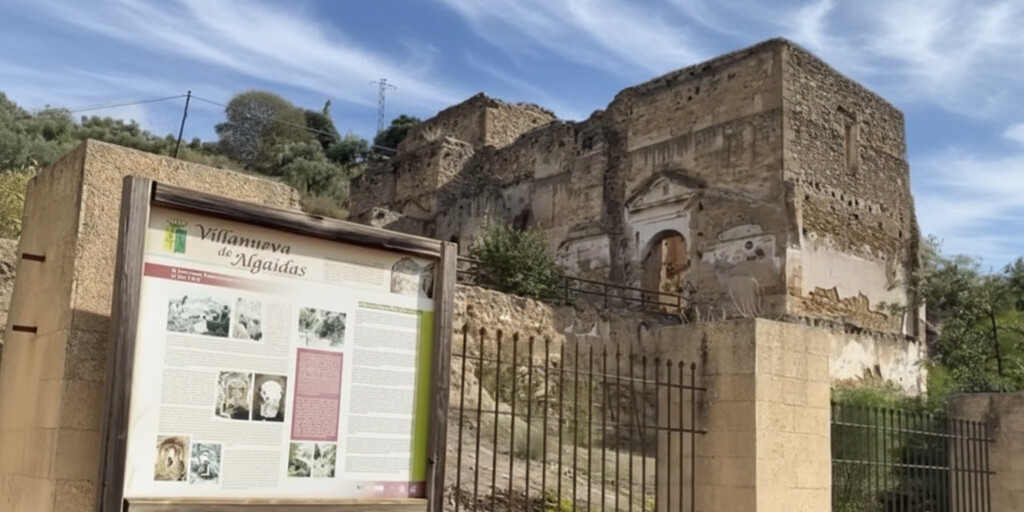
Then comes the transition to Antequera, passing through villages each whispering their own story. Cuevas de San Marcos with its magnificent Cueva de Belda, carved high into the limestone. Villanueva de Algaidas, where prehistory blends with modern art through Miguel Berrocal. And just outside the village rests the Convento de Nuestra Señora de la Consolación—half weathered, half chiseled into the stone, entirely majestic.
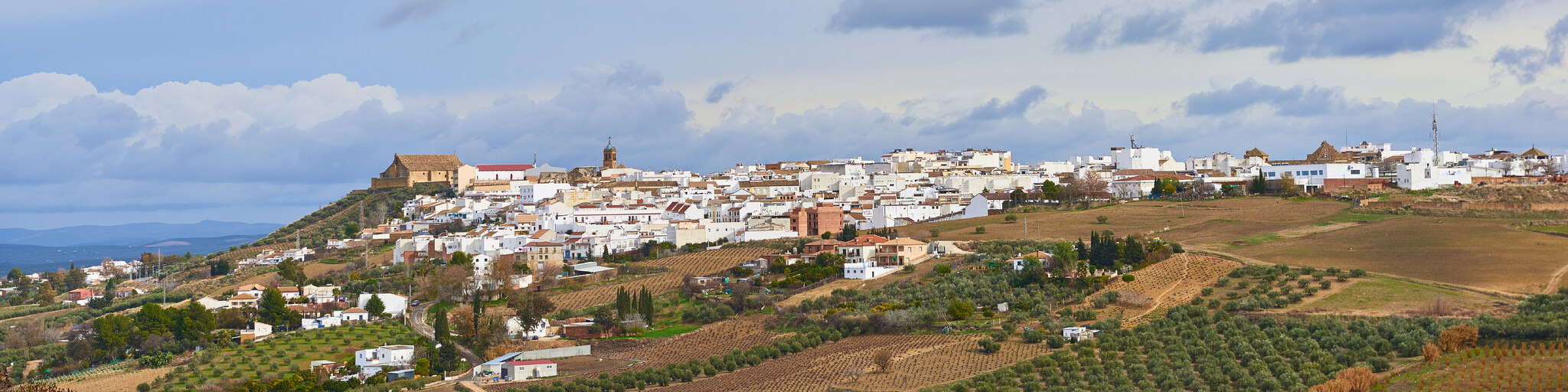
A little further on is Villanueva de Algaidas.
A peaceful village nestled in the Andalusian landscape. Here, the surroundings reveal subtle traces of defenses from a distant past. On the summit of the hill, the Villeta, rest the remains of a fortified site. Silent and watchful, its rough sandstone walls follow the natural contours. Stacked without mortar, they are made of small, irregularly shaped stones.
Simply built, but with a clear purpose.
Even if you don't stop here, you can't miss it. From the road, the hill stands out against the horizon. A modest, yet significant remnant of human adaptability.
When Antequera embraces you with its lively squares and fragrant restaurants, you'll find a welcome break. At Restaurant Leila in Plaza San Sebastián, Mediterranean and Moroccan flavors blend effortlessly.
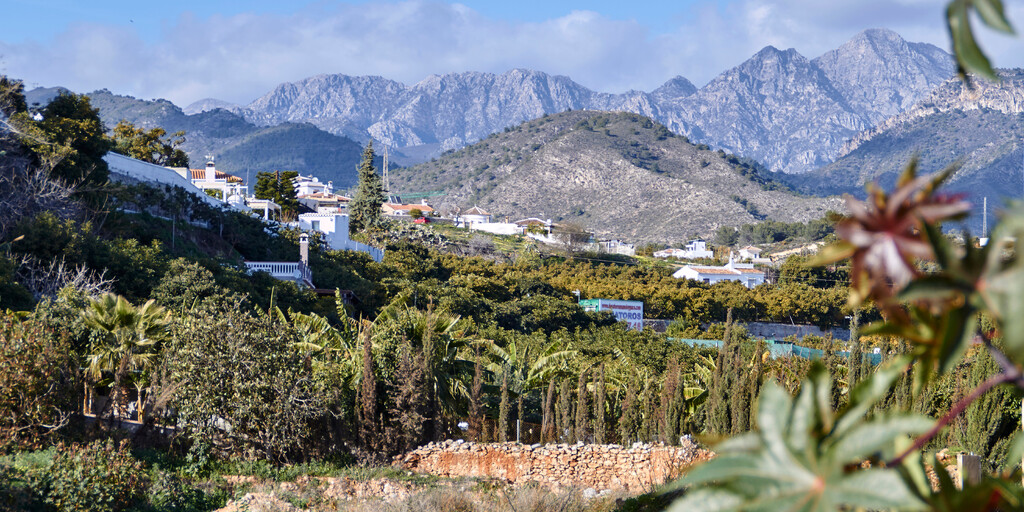
After lunch, you turn east. The road follows the contours of the mountains and takes you deeper into the Axarquía. Then, on to Colmenar—the "Gateway to the Axarquía."
The scent of thyme and rosemary hangs heavy in the air; the village's honey tradition fills the valley with sweet undertones, and the artistry of artisanal sausages.
As the peaks of the Montes de Málaga rise before you, Casabermeja finally appears. Its houses stand out white and bright against the reddish-brown earth—as if the village itself were a brushstroke on the Andalusian canvas.
Then comes the moment the journey holds its breath. The road begins to wind like a silver serpent through the mountains, each bend a new revelation. You descend from sun-baked peaks to the first whisper of the Mediterranean: salty, warm, infinite.
The light softens to a golden hue, and the air takes on a humid warmth that heralds the coast. Gliding into Málaga along the lush Paseo del Parque, it feels as if the city is opening its arms—green, vibrant, alive.
But your destination awaits higher up. The road climbs, becomes quieter, narrower. And then, on the hilltop, the Parador de Málaga Gibralfaro appears.
The panorama that unfolds there is almost otherworldly: the harbor glitters like liquid metal, the city spreads out at your feet like a living carpet, and the sea — eternally breathing — forms the horizon of the world that now lies behind you.
You turn off the engine. The pool water embraces you like a cooling, weightless silence. The heat of the day slips away, as the journey itself slowly fades into memory.
This is not a simple ending.
This is an echo—a deep, lingering breath of a journey that will stay with you long after, a last ray of sunshine on the skin before night falls softly over Andalusia.
 Links
Links  Usage
Usage Want to download this route?
You can download the route for free without MyRoute-app account. To do so, open the route and click 'save as'. Want to edit this route?
No problem, start by opening the route. Follow the tutorial and create your personal MyRoute-app account. After registration, your trial starts automatically.  Disclaimer
Use of this GPS route is at your own expense and risk. The route has been carefully composed and checked by a MyRoute-app accredited RouteXpert for use on TomTom, Garmin and MyRoute-app Navigation.
Changes may nevertheless have occurred due to changed circumstances, road diversions or seasonal closures. We therefore recommend checking each route before use.
Preferably use the route track in your navigation system. More information about the use of MyRoute-app can be found on the website under 'Community' or 'Academy'.
Changes may nevertheless have occurred due to changed circumstances, road diversions or seasonal closures. We therefore recommend checking each route before use.
Preferably use the route track in your navigation system. More information about the use of MyRoute-app can be found on the website under 'Community' or 'Academy'.
 Nearby routes
Andalusia
About this region
Andalusia (UK: , US: ; Spanish: Andalucía [andaluˈθi.a]) is the southernmost autonomous community in Peninsular Spain. It is the most populous and the second largest autonomous community in the country. It is officially recognised as a "historical nationality". The territory is divided into eight provinces: Almería, Cádiz, Córdoba, Granada, Huelva, Jaén, Málaga, and Seville. Its capital city is Seville. The seat of the High Court of Justice of Andalusia is located in the city of Granada.
Andalusia is located in the south of the Iberian peninsula, in southwestern Europe, immediately south of the autonomous communities of Extremadura and Castilla-La Mancha; west of the autonomous community of Murcia and the Mediterranean Sea; east of Portugal and the Atlantic Ocean; and north of the Mediterranean Sea and the Strait of Gibraltar. Andalusia is the only European region with both Mediterranean and Atlantic coastlines. The small British overseas territory of Gibraltar shares a three-quarter-mile land border with the Andalusian portion of the province of Cádiz at the eastern end of the Strait of Gibraltar.
The main mountain ranges of Andalusia are the Sierra Morena and the Baetic System, consisting of the Subbaetic and Penibaetic Mountains, separated by the Intrabaetic Basin. In the north, the Sierra Morena separates Andalusia from the plains of Extremadura and Castile–La Mancha on Spain's Meseta Central. To the south the geographic subregion of Upper Andalusia lies mostly within the Baetic System, while Lower Andalusia is in the Baetic Depression of the valley of the Guadalquivir.The name "Andalusia" is derived from the Arabic word Al-Andalus (الأندلس). The toponym al-Andalus is first attested by inscriptions on coins minted in 716 by the new Muslim government of Iberia. These coins, called dinars, were inscribed in both Latin and Arabic. The etymology of the name "al-Andalus" has traditionally been derived from the name of the Vandals. Since the 1980s, a number of proposals have challenged this contention. Halm, in 1989, derived the name from a Gothic term, *landahlauts,
and in 2002, Bossong suggested its derivation from a pre-Roman substrate. The region's history and culture have been influenced by the Tartessos, Iberians, Phoenicians, Carthaginians, Greeks, Romans, Vandals, Visigoths, Byzantines, Berbers of North Africa, Jews, Romani, Arab Umayyads, and Moors. During the Islamic Golden Age, Cordoba surpassed Constantinople to be Europe's biggest city, and became the capital of Al Andalus and a prominent center of education and learning in the world, producing numerous philosophers and scientists. The Castilian and other Christian North Iberian nationalities reconquered and settled the area in the latter phases of the Reconquista.
Andalusia has historically been an agricultural region, compared to the rest of Spain and the rest of Europe. Still, the growth of the community in the sectors of industry and services was above average in Spain and higher than many communities in the Eurozone. The region has a rich culture and a strong Spanish identity. Many cultural phenomena that are seen internationally as distinctively Spanish are largely or entirely Andalusian in origin. These include flamenco and, to a lesser extent, bullfighting and Hispano-Moorish architectural styles, both of which are also prevalent in some other regions of Spain.
Andalusia's hinterland is the hottest area of Europe, with cities like Córdoba and Seville averaging above 36 °C (97 °F) in summer high temperatures. Late evening temperatures can sometimes stay around 35 °C (95 °F) until close to midnight and daytime highs of over 40 °C (104 °F) are common. Seville also has the highest average annual temperature in mainland Spain and mainland Europe (19.2 °C, 66.6 °F), closely followed by Almería (19.1 °C, 66.4 °F).
Read more on Wikipedia
Andalusia is located in the south of the Iberian peninsula, in southwestern Europe, immediately south of the autonomous communities of Extremadura and Castilla-La Mancha; west of the autonomous community of Murcia and the Mediterranean Sea; east of Portugal and the Atlantic Ocean; and north of the Mediterranean Sea and the Strait of Gibraltar. Andalusia is the only European region with both Mediterranean and Atlantic coastlines. The small British overseas territory of Gibraltar shares a three-quarter-mile land border with the Andalusian portion of the province of Cádiz at the eastern end of the Strait of Gibraltar.
The main mountain ranges of Andalusia are the Sierra Morena and the Baetic System, consisting of the Subbaetic and Penibaetic Mountains, separated by the Intrabaetic Basin. In the north, the Sierra Morena separates Andalusia from the plains of Extremadura and Castile–La Mancha on Spain's Meseta Central. To the south the geographic subregion of Upper Andalusia lies mostly within the Baetic System, while Lower Andalusia is in the Baetic Depression of the valley of the Guadalquivir.The name "Andalusia" is derived from the Arabic word Al-Andalus (الأندلس). The toponym al-Andalus is first attested by inscriptions on coins minted in 716 by the new Muslim government of Iberia. These coins, called dinars, were inscribed in both Latin and Arabic. The etymology of the name "al-Andalus" has traditionally been derived from the name of the Vandals. Since the 1980s, a number of proposals have challenged this contention. Halm, in 1989, derived the name from a Gothic term, *landahlauts,
and in 2002, Bossong suggested its derivation from a pre-Roman substrate. The region's history and culture have been influenced by the Tartessos, Iberians, Phoenicians, Carthaginians, Greeks, Romans, Vandals, Visigoths, Byzantines, Berbers of North Africa, Jews, Romani, Arab Umayyads, and Moors. During the Islamic Golden Age, Cordoba surpassed Constantinople to be Europe's biggest city, and became the capital of Al Andalus and a prominent center of education and learning in the world, producing numerous philosophers and scientists. The Castilian and other Christian North Iberian nationalities reconquered and settled the area in the latter phases of the Reconquista.
Andalusia has historically been an agricultural region, compared to the rest of Spain and the rest of Europe. Still, the growth of the community in the sectors of industry and services was above average in Spain and higher than many communities in the Eurozone. The region has a rich culture and a strong Spanish identity. Many cultural phenomena that are seen internationally as distinctively Spanish are largely or entirely Andalusian in origin. These include flamenco and, to a lesser extent, bullfighting and Hispano-Moorish architectural styles, both of which are also prevalent in some other regions of Spain.
Andalusia's hinterland is the hottest area of Europe, with cities like Córdoba and Seville averaging above 36 °C (97 °F) in summer high temperatures. Late evening temperatures can sometimes stay around 35 °C (95 °F) until close to midnight and daytime highs of over 40 °C (104 °F) are common. Seville also has the highest average annual temperature in mainland Spain and mainland Europe (19.2 °C, 66.6 °F), closely followed by Almería (19.1 °C, 66.4 °F).
View region
 Statistics
  20
20Amount of RX reviews (Andalusia)
 25170
25170Amount of visitors (Andalusia)
 506
506Amount of downloads (Andalusia)
 Route Collections in this region
 A 4 day tour in Spain from Bilbao to Cartagena
With a starting point just south of Bilbao, this 1,300 km tour is easy to connect to from the French border or Santander. The tour travels through some of Spain's most spectacular landscapes and visits among other things, the windmills of La Mancha, made famous in the books by Miguel de Cervantes and his character Don Quixote. The end of this 4 day tour is at Cartagena on the Mediterranean's Costa Cálida, a wonderful city that's alive with culture, history and gastronomy.
View Route Collection
Discovering the villages of Huelva
This tour consists of three routes for three days, but you can do them interchangeably if you prefer due to the proximity of the three routes. Huelva is an area to explore, beautiful in its landscapes and nature and the best thing is its Iberian pork gastronomy and on these routes you can experience and enjoy it all.
View Route Collection