
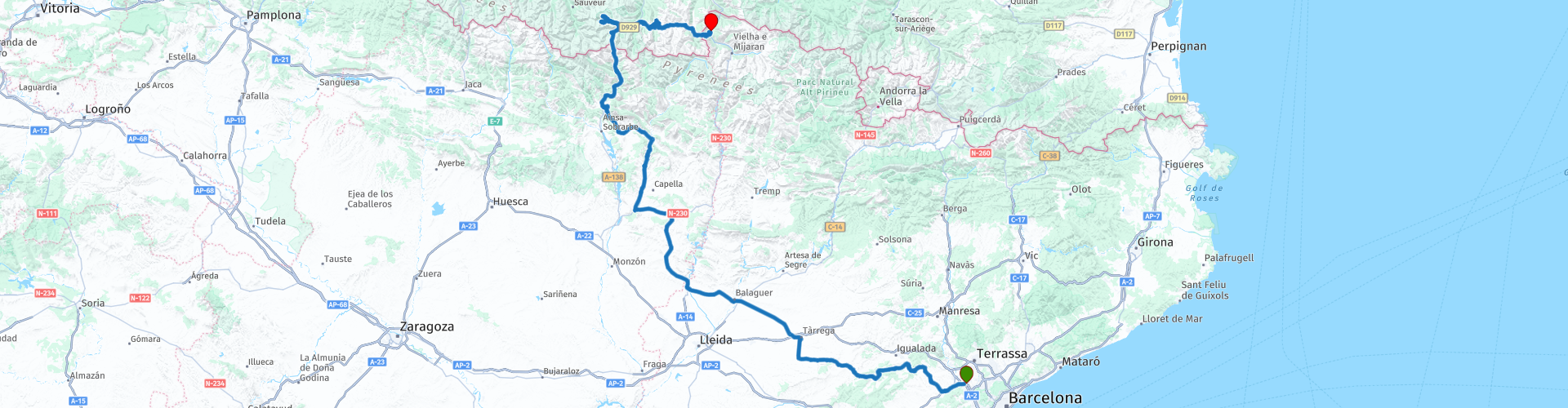
01 Barcelona to Bossost via the lakes of Neouvielle

This route was brought to you by:
RouteXpert Jordi Honrubia MRA-RouteXpert
Last edit: 03-12-2025
 Route Summary
 Variety of roads: secondary roads, technically attractive mountain stretches.
Because of its continuous points of interest that allow for photographic and gastronomic stops.
A good balance between driving and leisure for a long and full day.
 Share this route


Animation

Verdict


Duration
12h 52m

Mode of travel
Car or motorcycle

Distance
447.85 km

Countries


 RouteXpert Review
 The one-day route that connects Barcelona with Bossòst is a journey as intense as it is unforgettable, a long journey of more than twelve hours, in which the landscapes change continuously and the asphalt guides the traveler from the urban environment of the big city to the high mountains of the central Pyrenees.
It's a day that demands getting up early, preparation, and a desire to absorb every kilometer, because its 446.71 km encompass historic roads, medieval villages, large reservoirs, an international tunnel, and above all, some of the most impressive mountain lakes in Europe.
The route begins in Barcelona, leaving behind its frenetic pace as the first light of dawn accompanies the ascent into the heart of Catalonia. After passing through Martorell, the secondary roads lead to Sant Llorenç d'Hortons and Piera, where the landscape begins to turn more rural. Cultivated fields, scattered farmhouses, and the scent of vineyards herald the arrival in a more tranquil, intimate Catalonia, one that hints at something special about to begin.
Capellades soon appears, one of the first highlights of the day. This town, strategically located between ravines and plateaus, has been known since the 17th century for its papermaking tradition. Today, the Molí-Museu Paperer (Paper Mill Museum), housed in a former mill dating back to 1714, is still preserved—one of the oldest and most emblematic papermaking centers in Spain. Although the route continues without much stopping, knowing that you're traveling alongside a living piece of Catalan industrial history adds an unexpected cultural touch.
As the road gently curves inland, the landscape opens up as you approach Santa Coloma de Queralt. This medieval village stands like a postcard from the past: walls, towers, and streets that still retain their historical essence. Continuing west means venturing into increasingly agricultural territory, where Guimerà appears as a medieval jewel perched atop a hill. Its silhouette of terraced stone houses, crowned by the watchtower, is a perfect reminder of why this route is not simply a journey, but a sensory one.
Reaching the Lleida plains gives way to gentler kilometers, allowing for a smooth ride and saving time. In Anglesola, the aroma of traditional breakfasts beckons you to stop at a typical bar to enjoy a plate of fried eggs with bacon and white beans, a hearty and flavorful classic that provides the energy needed to tackle the most demanding part of the day.
Resuming the journey, the road continues north, skirting villages and fields until reaching Barbens, Castelló de Farfanya, and Estopiñán, leaving the province of Lleida behind and gradually entering the province of Huesca. The geographical transition is quite noticeable: the vast fields begin to break up, hills rise, and the horizon narrows between mountains.
The next notable stop is Benabarre, where you'll find a service station and a bar, perfect for resting and refueling before tackling the climb to Bielsa. This break is important because from here the road becomes more winding, narrower in some sections, and above all, wilder in terms of scenery. The hillsides rise on both sides as the route stretches north through forests and gorges.
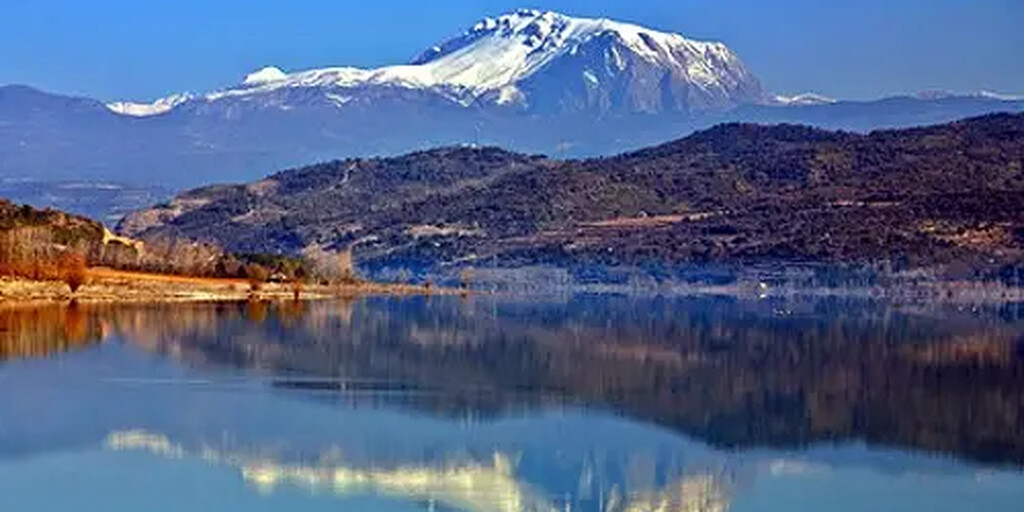
Shortly after, the traveler arrives at one of the most photogenic spots on the first mountain stretch: the Barasona Reservoir. The route suggests a stop at a place known as "Playa el Torico," with its grassy area by the water and a pier offering sweeping views of the vast reservoir. The deep blue water reflects the mountains that rise in the distance, and it's easy to lose yourself in the vast expanse of this Aragonese landscape. It's the perfect place to take a deep breath, stretch your legs, and enjoy one of the first great visual moments of the day.
Back on the asphalt, the route passes through Graus and continues between rocky walls and dense forests until reaching the medieval bridge of Besians, a 12th or 13th-century structure that many believe to be Roman but which belongs to the Middle Ages. Crossing it or simply admiring it from the road is like opening an ancient book: the weathered stones, the perfect arch over the Ésera River, and the sound of the water create a scene that seems frozen in time.
After leaving Besians, the road narrows even further as the vegetation becomes denser. The climb towards Bielsa marks the beginning of one of the most exciting sections of the journey. In Bielsa, located deep in the Aragonese Pyrenees, it's highly recommended to stop for a light meal or at least a drink, as the next stretch demands attention, skill, and enjoyment: the entrance to the Bielsa–Aragnouet International Tunnel.
This 3,070-meter tunnel cuts through the mountains at a high altitude, connecting Spain and France. Its Spanish entrance is at 1,664 meters, while the French exit is at 1,821 meters. Crossing it is a symbolic experience: after traversing its dark and damp interior, the world on the other side changes completely. Suddenly, the French landscape opens up: a steep valley, with alpine roots, surrounded by high peaks, granite walls, and dense forests. The air seems fresher, the light brighter, the vegetation greener.
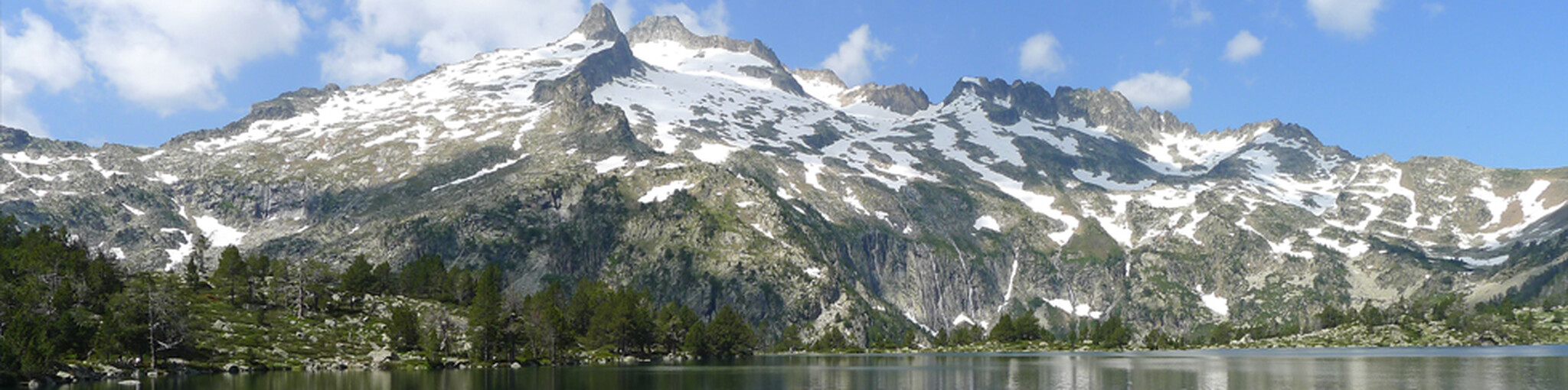
Here begins the most breathtaking natural spectacle of the day. The road climbs towards the Néouvielle massif, a protected treasure within the Pyrenees National Park. This area is famous for its more than 70 glacial lakes; a picture-postcard scene straight out of the Alps, yet with an unmistakable Pyrenean character. The first significant lake is Lac d'Aubert, at an altitude of 2,148 meters. Fed by small glaciers and surrounded by alpine meadows, its deep blue color contrasts with the gray granite and the dark green of the black pines, the tallest in Europe. The small dam that slightly raises the lake's level adds a human touch to a landscape dominated by nature.
Nearby lies Lac d'Aumar, at 2,192 meters, even more surrounded by meadows and peat bogs. Its beauty lies in its serenity: still waters reflecting the sky, high-altitude meadows where life is limited to hardy grasses and small alpine flowers. Between the two lakes, the traveler feels the immensity of the mountains and the purity of the cold air descending from the peaks.
A little further down the mountain, you'll find Lac d'Oredon, a historic reservoir built in the 19th century to regulate water flow to the forest and support shipbuilding on the Atlantic coast. With its large stone dam and wooded surroundings, it offers a more enclosed, intimate landscape, perfect for a photograph with deep shadows and silvery light reflecting off the water.
Finally, the route reaches the section leading to Cap de Long, perhaps the most spectacular lake on the journey. It's a large reservoir created between 1950 and 1954 in the heart of the massif, surrounded by towering granite walls that rise abruptly from the water. The feeling upon arrival is breathtaking: an imposing, powerful landscape that makes the traveler feel very small in the face of nature's might.
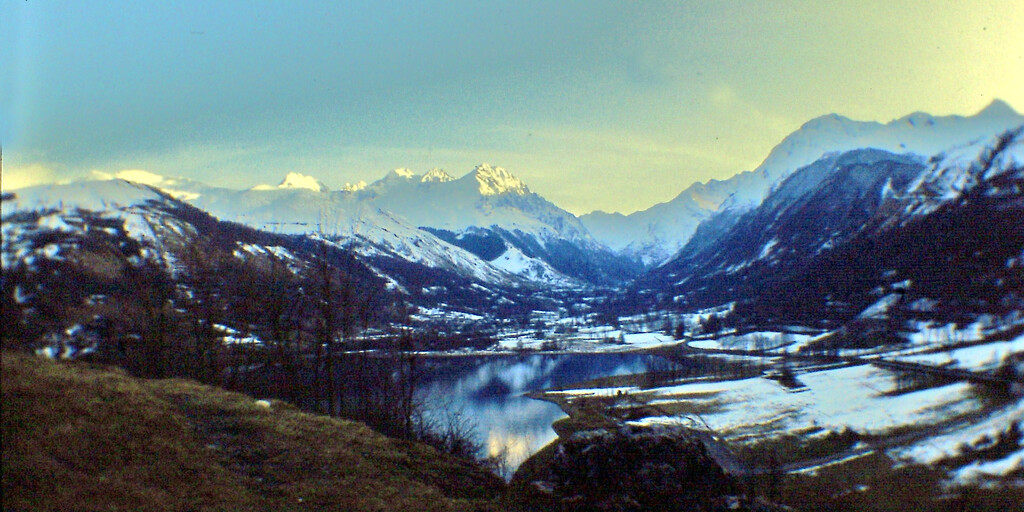
After experiencing some of the most memorable landscapes of the French Pyrenees, the route begins an equally beautiful descent towards Vielle-Aure, Azet, Génos, and Loudenvielle, where the lovely Génos-Loudenvielle lake is located. The roads wind through pastures, forests, alpine chalets, and natural viewpoints that invite you to stop again and again. It might seem that the day has already offered its full spectacle, but one of the most symbolic moments is yet to come: passing through Bagnères-de-Luchon and climbing towards the Col du Portillón.
Bagnères-de-Luchon is a spa town with elegant architecture and a very pleasant atmosphere. Riding through it on a motorbike is a visual delight, and its Belle Époque style contrasts sharply with the rustic charm of the villages before it. After leaving it behind, the ascent to the Portillón begins, a narrow, leafy road steeped in sporting history. Near the summit is the viewpoint where the monument dedicated to the Spanish cyclists who have won the Tour de France stands. From this point, a magnificent view opens up over the valleys that connect France and Spain.
Finally, the descent down the Spanish side of the Portillón pass leads to the Aran Valley, with its stone houses and slate roofs, until reaching Bossòst, the day's final destination. This village, nestled along the banks of the Garona River, is the perfect place to relax after such a long day. Its welcoming atmosphere, traditional restaurants, and the serenity of the surrounding mountains provide the ideal end to a day that will be hard to forget.
This one-day route manages to condense the very best of the Pyrenees' adventurous spirit into just a few hours: exhilarating roads, breathtaking landscapes, border crossings, medieval villages, authentic cuisine, and a collection of alpine lakes that make this trip a truly unique experience. It's demanding, yes, but the kind of tiredness it leaves you with is the good kind, the kind that comes with a smile as the day draws to a close and you think: "Today has been an extraordinary day."
 Links
Links  Usage
Usage Want to download this route?
You can download the route for free without MyRoute-app account. To do so, open the route and click 'save as'. Want to edit this route?
No problem, start by opening the route. Follow the tutorial and create your personal MyRoute-app account. After registration, your trial starts automatically.  Disclaimer
Use of this GPS route is at your own expense and risk. The route has been carefully composed and checked by a MyRoute-app accredited RouteXpert for use on TomTom, Garmin and MyRoute-app Navigation.
Changes may nevertheless have occurred due to changed circumstances, road diversions or seasonal closures. We therefore recommend checking each route before use.
Preferably use the route track in your navigation system. More information about the use of MyRoute-app can be found on the website under 'Community' or 'Academy'.
Changes may nevertheless have occurred due to changed circumstances, road diversions or seasonal closures. We therefore recommend checking each route before use.
Preferably use the route track in your navigation system. More information about the use of MyRoute-app can be found on the website under 'Community' or 'Academy'.
 Nearby routes
Aragon
About this region
Aragon ( or , Spanish and Aragonese: Aragón [aɾaˈɣon], Catalan: Aragó [əɾəˈɣo]) is an autonomous community in Spain, coextensive with the medieval Kingdom of Aragon. In northeastern Spain, the Aragonese autonomous community comprises three provinces (from north to south): Huesca, Zaragoza, and Teruel. Its capital is Zaragoza. The current Statute of Autonomy declares Aragon a historic nationality of Spain.
Covering an area of 47720 km2 (18420 sq mi), the region's terrain ranges diversely from permanent glaciers to verdant valleys, rich pasture lands and orchards, through to the arid steppe plains of the central lowlands. Aragon is home to many rivers—most notably, the river Ebro, Spain's largest river in volume, which runs west–east across the entire region through the province of Zaragoza. It is also home to the highest mountains of the Pyrenees.
As of January 2020, the population of Aragon was 1329391, with over half of it living in its capital city, Zaragoza. During the same year, the economy of Aragon generated a GDP of €34687 million, which represents 3.1% of Spain's national GDP, and is currently 6th in per capita production behind Madrid, Basque Country, Navarre, Catalonia and La Rioja.In addition to its three provinces, Aragon is subdivided into 33 comarcas or counties. All comarcas of Aragon have a rich geopolitical and cultural history from its pre-Roman, Celtic and Roman days, four centuries of Islamic rule as Marca Superior of Al-Andalus or kingdom (or taifa) of Saraqusta, as lands that once belonged to the Frankish Marca Hispanica, counties that later formed the Kingdom of Aragon, and eventually the Crown of Aragon.
Read more on Wikipedia
Covering an area of 47720 km2 (18420 sq mi), the region's terrain ranges diversely from permanent glaciers to verdant valleys, rich pasture lands and orchards, through to the arid steppe plains of the central lowlands. Aragon is home to many rivers—most notably, the river Ebro, Spain's largest river in volume, which runs west–east across the entire region through the province of Zaragoza. It is also home to the highest mountains of the Pyrenees.
As of January 2020, the population of Aragon was 1329391, with over half of it living in its capital city, Zaragoza. During the same year, the economy of Aragon generated a GDP of €34687 million, which represents 3.1% of Spain's national GDP, and is currently 6th in per capita production behind Madrid, Basque Country, Navarre, Catalonia and La Rioja.In addition to its three provinces, Aragon is subdivided into 33 comarcas or counties. All comarcas of Aragon have a rich geopolitical and cultural history from its pre-Roman, Celtic and Roman days, four centuries of Islamic rule as Marca Superior of Al-Andalus or kingdom (or taifa) of Saraqusta, as lands that once belonged to the Frankish Marca Hispanica, counties that later formed the Kingdom of Aragon, and eventually the Crown of Aragon.
View region
 Statistics
  38
38Amount of RX reviews (Aragon)
 14078
14078Amount of visitors (Aragon)
 2415
2415Amount of downloads (Aragon)
 Route Collections in this region
 7 day roundtrip from Girona to Catalonia Andorra and the Pyrenees
The Pyrenees stretch for more than 450 kilometers from the Bay of Biscay in the west to the Cap de Creus on the Mediterranean. The mountain range, with peaks of more than 3000 meters, forms a natural barrier that cuts off the Iberian Peninsula from the rest of Europe. The main ridge of the mountain range also largely forms the state border between France and Spain, while the microstate Andorra lies between these two countries.
Bordering the Pyrenees is Catalonia, the hinterland of Barcelona. No wonder many new models of motorcycles are introduced to the press in Catalonia. There are many great ways to test the new models there. An additional advantage is that it is very quiet! You would almost say 'too quiet' because there is a danger that at some point you will use the entire width of the road, under the guise of 'you won't see oncoming traffic here'.... But let's keep it safe and stay on the right side of the center line.
These seven routes of this collection pass through these beautiful areas. Each and every one of these routes where especially the sides of the tires have a hard time. Whether on the gentle slopes in Catalonia or on the balcony roads in the Gorges in the French Pyrenees, make sure they're excited, because you can bet it's going to be exciting!
A few sights are discussed in the review for each route. These often tell something about the history of the area in which you drive. Fun facts, quite educational. There are also places where you can refuel and where you can drink coffee and/or have lunch. You are completely free to visit these places, you can of course also determine your own points of interest.
But the main thing you probably traveled to this area for is simply driving. And as mentioned above, you are in a true motorcycle paradise where the steering is fantastic!
Each route ends at a hotel. It is of course not an obligation to use these hotels, you can always find another place to stay in the area, that decision is up to you. My experience, however, is that they are all simple but good hotels for a very reasonable price. They are known and can be booked at booking.com.
The routes of these collections:
R01 - Girona to Sant Julia de Loria, 269km
R02 - Sant Julia de Loria to Pierrefitte Nestalas, 290km
R03 - Pierrefitte Nestalas to Barbastro, 291km
R04 - Barbastro to Puig Reig, 266km
R05 - Puig Reig to Figueres, 268km
R06 - Figueres to Quillan, 243km
R07 - Quillan to Gironam, 286km
Have fun driving these routes!
Bordering the Pyrenees is Catalonia, the hinterland of Barcelona. No wonder many new models of motorcycles are introduced to the press in Catalonia. There are many great ways to test the new models there. An additional advantage is that it is very quiet! You would almost say 'too quiet' because there is a danger that at some point you will use the entire width of the road, under the guise of 'you won't see oncoming traffic here'.... But let's keep it safe and stay on the right side of the center line.
These seven routes of this collection pass through these beautiful areas. Each and every one of these routes where especially the sides of the tires have a hard time. Whether on the gentle slopes in Catalonia or on the balcony roads in the Gorges in the French Pyrenees, make sure they're excited, because you can bet it's going to be exciting!
A few sights are discussed in the review for each route. These often tell something about the history of the area in which you drive. Fun facts, quite educational. There are also places where you can refuel and where you can drink coffee and/or have lunch. You are completely free to visit these places, you can of course also determine your own points of interest.
But the main thing you probably traveled to this area for is simply driving. And as mentioned above, you are in a true motorcycle paradise where the steering is fantastic!
Each route ends at a hotel. It is of course not an obligation to use these hotels, you can always find another place to stay in the area, that decision is up to you. My experience, however, is that they are all simple but good hotels for a very reasonable price. They are known and can be booked at booking.com.
The routes of these collections:
R01 - Girona to Sant Julia de Loria, 269km
R02 - Sant Julia de Loria to Pierrefitte Nestalas, 290km
R03 - Pierrefitte Nestalas to Barbastro, 291km
R04 - Barbastro to Puig Reig, 266km
R05 - Puig Reig to Figueres, 268km
R06 - Figueres to Quillan, 243km
R07 - Quillan to Gironam, 286km
Have fun driving these routes!
View Route Collection
A 5-day tour from Peniscola visiting Toledo Merida Avila Segovia Siquenza Barcelona
A 5-route, 5-day tour of Peniscola, Aranjuez, Toledo, Consuegra, Molinos, Merida, Avila, Segovia, seguiranza and Barcelona, taking in these sites will immerse you in the rich history and culture of Spain. From stunning medieval fortresses to charming windmill villages, you will pass through picturesque roads enjoying the exquisite local cuisine and natural beauty that each place has to offer. It will be an unforgettable experience full of discoveries and unforgettable moments. Definitely a trip worth taking!
View Route Collection