
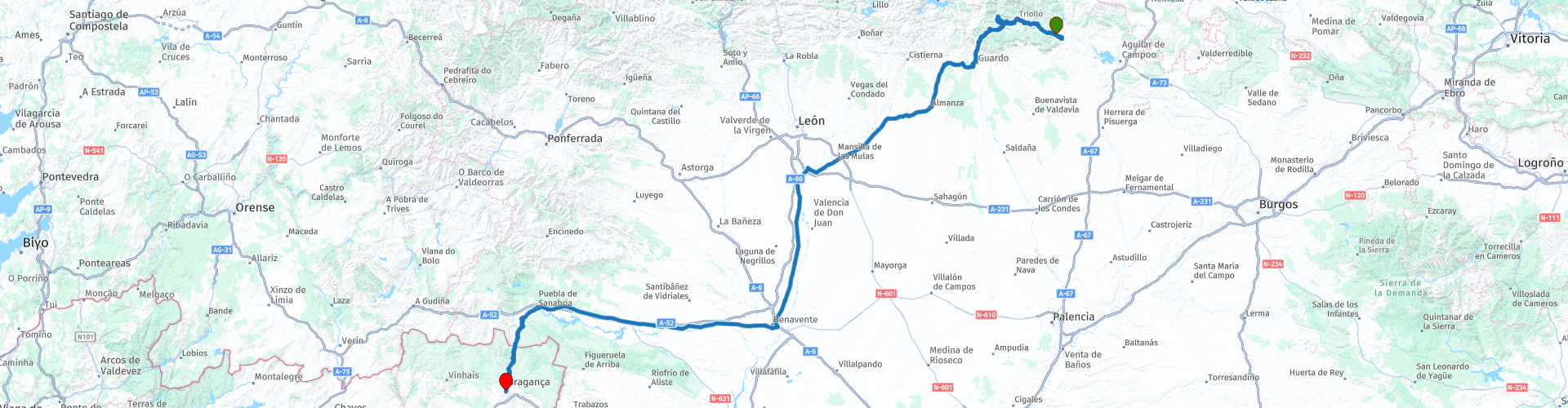
Cantabrian Highlands Cervera de Pisuerga to Braganca

This route was brought to you by:
RouteXpert CorsaroG
Last edit: 10-12-2025
 Route Summary
 The middle of the day moves out of the tight mountains and across the interior plateau. After the run down the Esla valley, a mid-morning coffee in the small village of Quintana de Rueda breaks up the straighter section, then the old main roads across León and Zamora let you cover ground without stress. A classic roadside restaurant at Rionegro del Puente, well regarded for game and mushroom dishes from the Sierra de la Culebra, gives you a proper sit-down lunch right on your line before the terrain begins to rise again towards Sanabria.
The final third has a strong sense of story. You climb into Puebla de Sanabria, whose stone houses and fifteenth-century castle of the Counts of Benavente dominate a hill above the river, then pick up a cross-border road that riders praise for its rural, riverside and twisty character with very light traffic as it crosses into Montesinho highlands. A short climb at the end brings you to the Pousada de Bragança on its hillside perch above the town, with balconies and a restaurant looking over the castle and surrounding hills, giving a clear feeling of arrival at the close of a substantial but balanced day.
There are no tolls and only a brief, deliberate motorway hop around Benavente. The mid-section is more about flow than drama, but the quality of the Pantanos start, the double mirador opening and the Sanabria–Montesinho finale comfortably justify a four-star rating.
Star Rating: ★★★★
 Share this route


Animation

Verdict


Duration
7h 14m

Mode of travel
Car or motorcycle

Distance
327.06 km

Countries


 RouteXpert Review
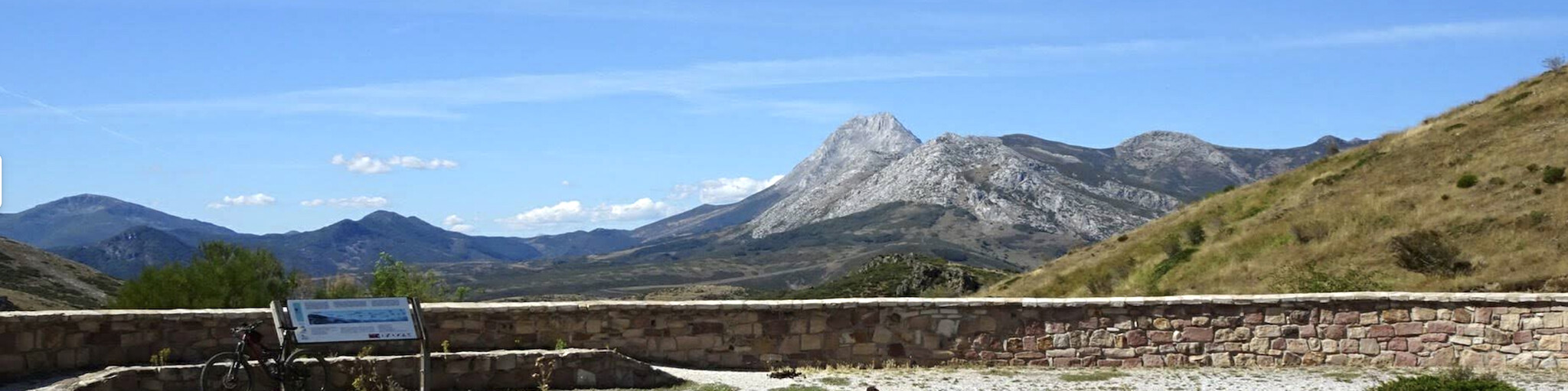
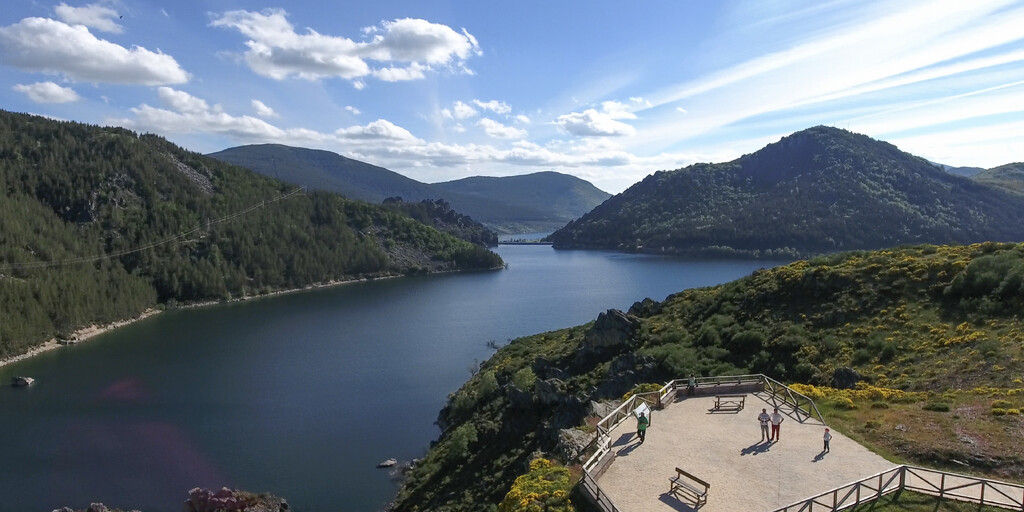
 Alto de la Varga is the first natural pause. The circular mirador on the ridge has proper parking and an open panorama over the Montaña Palentina, with peaks like Espigüete and the deep valleys falling away on both sides. A short stop here sets the tone for the day: high, airy, with a feeling of crossing a watershed. A little later, the viewpoint above Alba de los Cardaños offers a more intimate angle over the Camporredondo reservoir and dam, picked out in cycling and tourism material as a classic balcony on this road. Taken together, the two stops give you strong visual anchors before the landscape opens.
Once you leave the tight valleys and dams behind, the character shifts. The hills soften, the horizon widens and the road network gradually funnels you towards the Esla valley and the old north–south corridors. Here the riding is less intense but still satisfying: long straights, gentle curves and wide views across cereal fields and farm country. A mid-morning pause at La Plaza in Quintana de Rueda works well, exactly when most riders are ready to get off the bike. It’s a small café-bar in a quiet village, with the advantage that you can usually park right outside and keep the bikes in sight while you reset after the mountain section.
After that, the old main roads do their job. With the motorways carrying the bulk of the traffic, the parallel routes you use feel like older arteries gone semi-rural – still wide and reasonably surfaced, but much calmer than their history suggests. Near Benavente you make a short, intentional hop on the motorway to dodge the densest junctions, then peel back off for the westbound leg. This keeps the urban drag to a minimum and sets you up neatly for lunch at El Empalme. The restaurant is more than just a handy stop: food writers pick it out as a destination roadside place famed for dishes based on local game, mushrooms and seasonal produce from the Sierra de la Culebra. For the rider, the big car park and easy in-and-out access matter just as much.
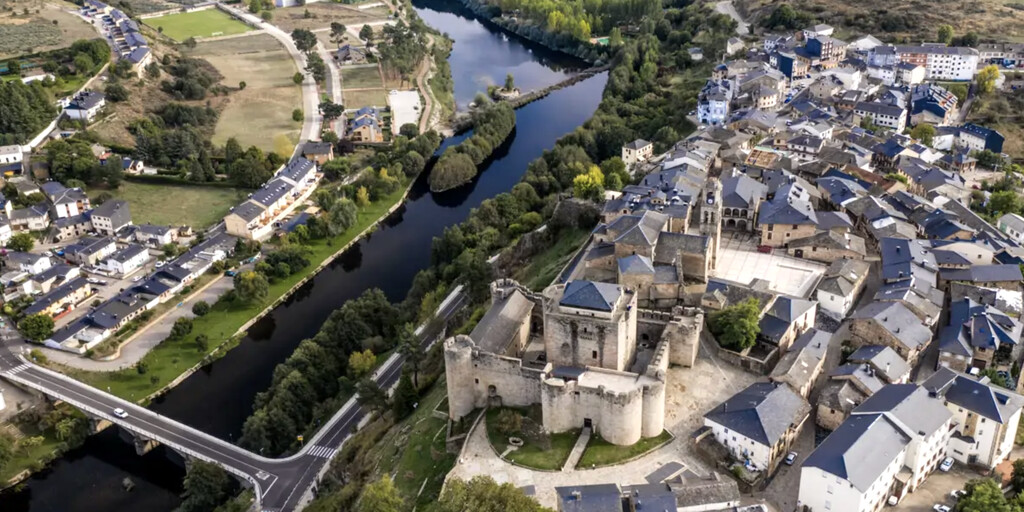
From Rionegro onwards the day begins to wind up again. The terrain gains height and tree cover, and by the time you reach Puebla de Sanabria the mood has shifted from plains back to hill country. The town itself, with its stone houses and fifteenth-century castle of the Counts of Benavente, is widely recommended in travel pieces as a place worth exploring on foot, and a quick walk up to the castle area gives a different, more historic flavour before the final twisty run.
The cross-border road from Sanabria towards Bragança is the clear riding highlight of the afternoon. Motorcycle-focused sites and route descriptions repeatedly call out this corridor for its rural, riverside and mountainous character, its smooth surface and the surprisingly low traffic since the motorway took the heavy flows. On the Portuguese side you enter Montesinho highlands, a protected area of forest, pastures and small stone villages, which adds a sense of remoteness even as the tarmac remains generally good. It’s the kind of road where you can run a steady, relaxed pace and still feel fully involved.
As you roll down towards Bragança the castle and old town come into view, and the short final climb to the Pousada feels like a natural full stop. Hotel and review sources highlight the panoramic views over the city and medieval castle, the balconies and the restaurant facing the town, and from the rider’s perspective that all translates into a satisfying finish: bikes parked up, gear off, and the day’s journey laid out below you as you sit with a drink or head down to explore the old town on foot.
This day is best from late spring to early autumn, when the high Montaña Palentina and the border hills into Montesinho are clear of snow and ice; in winter and early spring expect frost and lingering patches on shaded corners, especially near the reservoirs and on the cross-border section. The opening mountain road rewards smooth, unhurried riding – watch for livestock and slow local traffic enjoying the views. The central plains can feel hot and exposed in summer, so keep yourself hydrated. The final stretch towards Bragança is generally quiet and flowing but can carry gravel or debris after heavy rain; keep a little margin in blind bends and treat Puebla de Sanabria and Bragança themselves as slow, camera-out zones with pedestrians, tight junctions and the odd awkwardly parked car.
 Links
Links  Usage
Usage Want to download this route?
You can download the route for free without MyRoute-app account. To do so, open the route and click 'save as'. Want to edit this route?
No problem, start by opening the route. Follow the tutorial and create your personal MyRoute-app account. After registration, your trial starts automatically.  Disclaimer
Use of this GPS route is at your own expense and risk. The route has been carefully composed and checked by a MyRoute-app accredited RouteXpert for use on TomTom, Garmin and MyRoute-app Navigation.
Changes may nevertheless have occurred due to changed circumstances, road diversions or seasonal closures. We therefore recommend checking each route before use.
Preferably use the route track in your navigation system. More information about the use of MyRoute-app can be found on the website under 'Community' or 'Academy'.
Changes may nevertheless have occurred due to changed circumstances, road diversions or seasonal closures. We therefore recommend checking each route before use.
Preferably use the route track in your navigation system. More information about the use of MyRoute-app can be found on the website under 'Community' or 'Academy'.
 Nearby routes
Braganca
About this region
Bragança may refer to:
Read more on Wikipedia
View region
 Statistics
  6
6Amount of RX reviews (Braganca)
 22524
22524Amount of visitors (Braganca)
 387
387Amount of downloads (Braganca)
 Route Collections in this region
 Paradors Pousadas And Iberian Passes
This collection is an end-to-end motorcycle journey across northern Spain and Portugal, shaped deliberately to unfold over eleven days with a clear sense of progression. Each stage builds naturally on the last, carrying the rider from the Atlantic edge of northern Spain, south through Portugal’s mountain heartlands and open plains, before returning north across Spain to finish back on the Cantabrian coast.
The journey begins on the Cantabrian coast, leaving Santander behind and climbing steadily inland towards Cervera de Pisuerga. The opening day sets the tone immediately, trading sea air for rising ground and greener hills as the road threads through northern Spain’s quieter interior. It feels purposeful without being rushed, easing the rider into the rhythm of the tour.
From Cervera de Pisuerga, the route pushes deeper into the Cantabrian highlands, crossing broad upland terrain and remote border regions on the way to Bragança. The scenery becomes more expansive, the roads quieter, and the sense of travelling through less familiar Spain grows stronger as the journey approaches Portugal.
Crossing into Portugal, the character tightens again through Montesinho and the Peneda-Gerês region. Roads fold into wooded hills and granite villages, with more frequent elevation changes and a greater sense of enclosure. This is riding that rewards attention and flow rather than outright speed, and it marks a clear transition into Portugal’s mountainous north.
The route then opens into the Douro highlands, running south towards Viseu. Valleys deepen, viewpoints lengthen and the riding alternates between fast, open sections and more intimate stretches that follow the land closely. The sense of scale increases without losing the feeling of remoteness that defines this part of the journey.
Climbing into the Serra da Estrela plateau, the collection reaches one of its defining high points. Portugal’s highest mountain range delivers wide horizons, exposed passes and a feeling of space that contrasts sharply with the valleys below. This stage stands out for its elevation, light and long views, and it feels like a natural midpoint landmark in the overall journey.
Dropping south from the mountains, the route transitions into the Beiras and Alentejo, carrying the rider from high ground into warmer, more open landscapes on the way to Évora. The roads relax into longer, flowing lines, and the pace of the journey subtly changes without losing interest or intent.
From Évora to Beja, the ride settles fully into the heart of the Alentejo. Cork forests, reservoirs and historic hill towns define the scenery, while the riding becomes smoother and more measured. These stages offer breathing space within the collection, allowing the rider to absorb the scale and atmosphere of southern Portugal.
Turning back towards the Spanish border, the route climbs again through Castelo and the border ridges to Marvão. Elevation returns, views stretch out, and the landscape regains a rugged edge. The dramatic setting of Marvão feels earned, sitting high above the surrounding plains and marking a clear shift back towards frontier territory.
Crossing back into Spain, the journey continues through the serranías and frontier regions of Castile, heading for Ciudad Rodrigo. Historic borderlands, rolling terrain and quiet roads reinforce the feeling of travelling through lesser-known landscapes, with riding that remains engaging through variety rather than intensity.
From Ciudad Rodrigo to Benavente, the route crosses the Castilla y León plains. Big skies, long sightlines and subtle changes in terrain define this stage, providing contrast after the mountains while maintaining a strong sense of direction as the journey turns decisively north.
The final day carries the rider from the Meseta back to the Cantabrian coast, closing the loop at Santander. As greener hills return and the Atlantic air reappears, the transition from inland Spain back to the coast provides a fitting and satisfying conclusion, both geographically and emotionally, to the journey.
Throughout the collection, the choice of Paradors and Pousadas anchors each day in history and landscape. These are not simply places to stop, but destinations that reinforce the character of each region and give the journey a sense of occasion from start to finish.
Taken as a whole, this is a coherent and rewarding Iberian tour: varied without feeling fragmented, demanding enough to stay engaging without becoming tiring, and designed to be ridden as a complete journey rather than a series of disconnected stages. It is best suited to riders who value flow, scenery and progression, and who appreciate the satisfaction of a route that unfolds naturally over time.
The journey begins on the Cantabrian coast, leaving Santander behind and climbing steadily inland towards Cervera de Pisuerga. The opening day sets the tone immediately, trading sea air for rising ground and greener hills as the road threads through northern Spain’s quieter interior. It feels purposeful without being rushed, easing the rider into the rhythm of the tour.
From Cervera de Pisuerga, the route pushes deeper into the Cantabrian highlands, crossing broad upland terrain and remote border regions on the way to Bragança. The scenery becomes more expansive, the roads quieter, and the sense of travelling through less familiar Spain grows stronger as the journey approaches Portugal.
Crossing into Portugal, the character tightens again through Montesinho and the Peneda-Gerês region. Roads fold into wooded hills and granite villages, with more frequent elevation changes and a greater sense of enclosure. This is riding that rewards attention and flow rather than outright speed, and it marks a clear transition into Portugal’s mountainous north.
The route then opens into the Douro highlands, running south towards Viseu. Valleys deepen, viewpoints lengthen and the riding alternates between fast, open sections and more intimate stretches that follow the land closely. The sense of scale increases without losing the feeling of remoteness that defines this part of the journey.
Climbing into the Serra da Estrela plateau, the collection reaches one of its defining high points. Portugal’s highest mountain range delivers wide horizons, exposed passes and a feeling of space that contrasts sharply with the valleys below. This stage stands out for its elevation, light and long views, and it feels like a natural midpoint landmark in the overall journey.
Dropping south from the mountains, the route transitions into the Beiras and Alentejo, carrying the rider from high ground into warmer, more open landscapes on the way to Évora. The roads relax into longer, flowing lines, and the pace of the journey subtly changes without losing interest or intent.
From Évora to Beja, the ride settles fully into the heart of the Alentejo. Cork forests, reservoirs and historic hill towns define the scenery, while the riding becomes smoother and more measured. These stages offer breathing space within the collection, allowing the rider to absorb the scale and atmosphere of southern Portugal.
Turning back towards the Spanish border, the route climbs again through Castelo and the border ridges to Marvão. Elevation returns, views stretch out, and the landscape regains a rugged edge. The dramatic setting of Marvão feels earned, sitting high above the surrounding plains and marking a clear shift back towards frontier territory.
Crossing back into Spain, the journey continues through the serranías and frontier regions of Castile, heading for Ciudad Rodrigo. Historic borderlands, rolling terrain and quiet roads reinforce the feeling of travelling through lesser-known landscapes, with riding that remains engaging through variety rather than intensity.
From Ciudad Rodrigo to Benavente, the route crosses the Castilla y León plains. Big skies, long sightlines and subtle changes in terrain define this stage, providing contrast after the mountains while maintaining a strong sense of direction as the journey turns decisively north.
The final day carries the rider from the Meseta back to the Cantabrian coast, closing the loop at Santander. As greener hills return and the Atlantic air reappears, the transition from inland Spain back to the coast provides a fitting and satisfying conclusion, both geographically and emotionally, to the journey.
Throughout the collection, the choice of Paradors and Pousadas anchors each day in history and landscape. These are not simply places to stop, but destinations that reinforce the character of each region and give the journey a sense of occasion from start to finish.
Taken as a whole, this is a coherent and rewarding Iberian tour: varied without feeling fragmented, demanding enough to stay engaging without becoming tiring, and designed to be ridden as a complete journey rather than a series of disconnected stages. It is best suited to riders who value flow, scenery and progression, and who appreciate the satisfaction of a route that unfolds naturally over time.
View Route Collection