
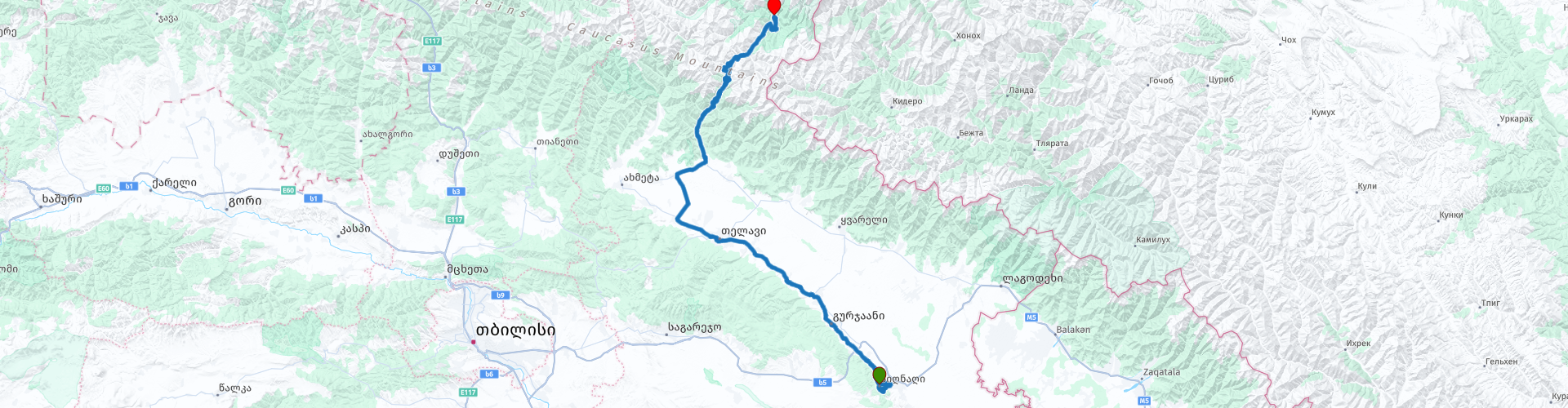
Georgia from Sighnaghi

This route was brought to you by:
RouteXpert Jan Koelstra - Senior Rx
Last edit: 14-01-2026
 Route Summary
 Before leaving Sighnaghi, the "City of Love," be sure to walk along the ancient city walls for breathtaking views of the Alazani Valley. After refueling, visit the nearby Bodbe Monastery, an oasis of tranquility where Saint Nino is buried.
As soon as you leave the valley and head north, the landscape changes dramatically near the village of Pshaveli. Here begins the infamous road to Tushetia, accessible only by off-road vehicle. The paved road gives way to a winding path of gravel and mud. You pass the spectacular Abano Pass, the highest point on the route at 2,850 meters. Here you literally drive through the clouds, flanked by steep precipices and cascading waterfalls that cascade over the road.
Along the way, you'll pass the Torna Waterfall and see shepherds herding their flocks over the perilous mountain ridges. The air becomes thinner, the vegetation sparser, until the Tushetian Valley opens up before you.
After an exhilarating drive, Omalo appears. The village is divided into a lower section and the historic Keselo, where medieval defensive towers tower like stone sentinels above the valley. In the shadow of these towers, surrounded by the rugged peaks of Tusheti National Park, the inhabited world of Sighnaghi feels further away than ever. It's a place where time has stood still and nature still reigns supreme. An unforgettable 5-star journey.
Advice:
For information about the pass and renting a suitable 4x4, please visit the official website of Georgia Travel.
 Share this route


Animation

Verdict


Duration
6h 40m

Mode of travel
Car or motorcycle

Distance
174.37 km

Countries

 RouteXpert Review
 This is no ordinary ride; it's an adventure, a transition from the cultivated vineyards of eastern Georgia to the raw, untamed wilderness of the Greater Caucasus.
Warning
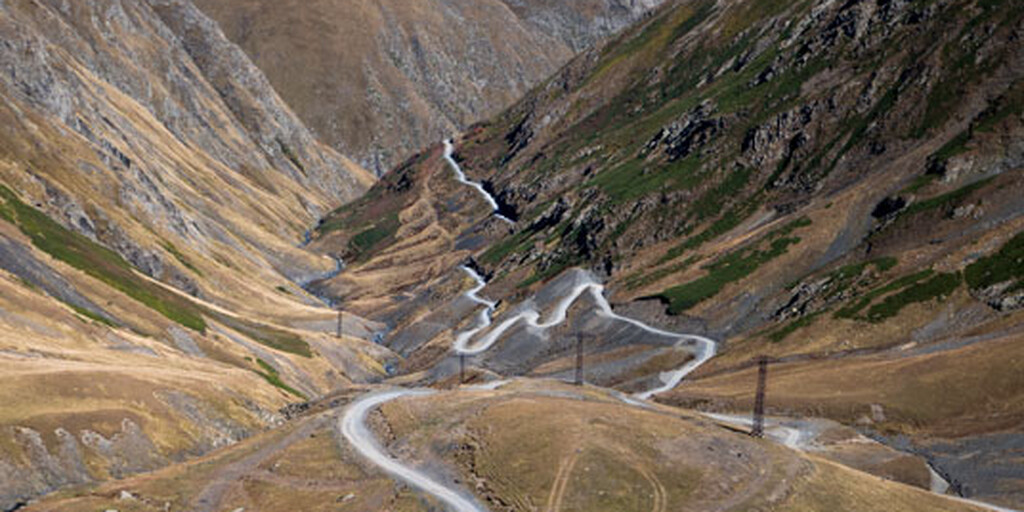
This route is designed for riders who enjoy challenges and adventure, as the last stretch of the route is unpaved. If you're up for this adventure, this will be the ultimate experience. The steep and narrow climb to the Abano Pass is described by some as one of the most adventurous (read: dangerous) roads in the world. The road over the mountain pass is open from June to October.
Sighnaghi (starting point)
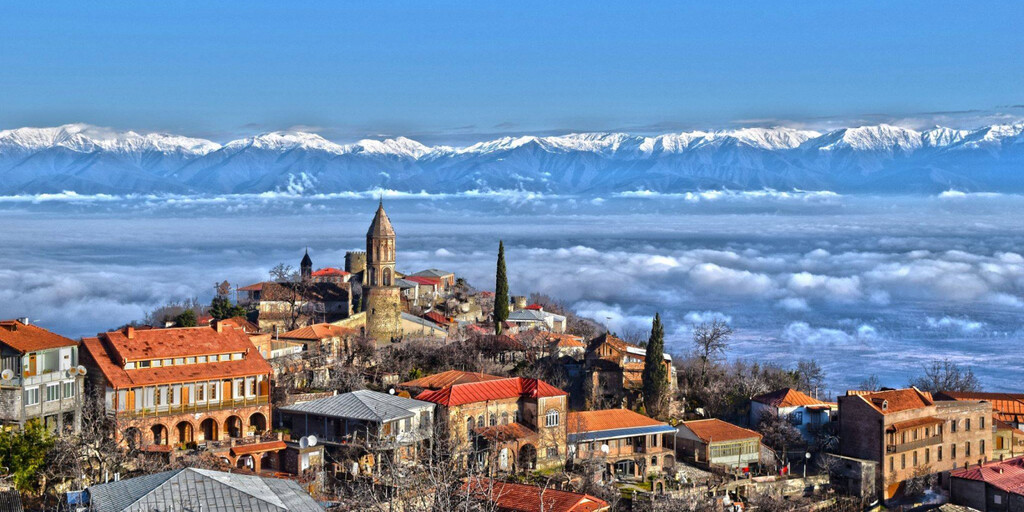
The tour begins in Sighnaghi, a town perched like an eagle's nest on a hill in the Kakheti region. In the early morning, as the sun illuminates the red roofs, you'll understand why it's called the "City of Love." The architecture is unique to Georgia: pastel-colored houses with ornate wooden balconies and cobblestone streets reminiscent of an Italian mountain village.
Sighnaghi is surrounded by one of the longest city walls in the world, over four kilometers of 18th-century fortifications with 23 towers. From these walls, you have an unobstructed view of the Alazani Valley. As you prepare for the climb into the mountains, you can still breathe in the soft, warm air so characteristic of the Georgian wine region.
Bodbe Monastery
Just two kilometers outside the city walls of Sighnaghi lies the Bodbe Monastery. This is one of the country's most important religious sites. Nestled among tall cypress trees, the monastery complex offers a serene tranquility. It is the final resting place of Saint Nino, the woman who brought Christianity to Georgia in the 4th century. Tradition dictates that travelers stop here for a blessing. The pilgrims descending to the sacred spring in the valley below remind you of the country's deep spiritual roots, a contrast to the physical challenge that lies ahead.
Telavi (coffee break)
The road then takes you deeper into the Alazani Valley to Telavi, the capital of Kakheti. Telavi breathes history. Here you pass Batonis Tsikhe, the castle of King Erekle II, and come face to face with the famous 900-year-old plane tree, a living monument that has seen generations of kings and invaders come and go.
Alaverdi Monastery
Shortly after Telavi, the monumental cathedral of the Alaverdi Monastery appears on the horizon. This 11th-century structure was the tallest church in the country until the construction of the Sameba Cathedral in Tbilisi. Its walls are pale and austere, but its scale is awe-inspiring against the backdrop of the approaching mountains. In 2026, the monks here still produce their famous wine in underground qvevris, a tradition unchanged for millennia.
Pshaveli (lunch break)
At the village of Pshaveli, everything changes. This is the gateway to the Tusheti region. It's a place where drivers check their tire pressure and mumble a final prayer. From here, there's no turning back; civilization is behind you, and the vertical world of the Caucasus beckons. Take care of your inner and outer self and vehicle. There's a restaurant and a gas station in the village. Also, remember to bring enough fuel for the return trip.
Alazani Pass and Abano Pass
The ascent is an exercise in patience and nerves of steel. The road winds along the mountainsides, with waterfalls sometimes cascading directly over the roof of the car. You pass the lower Alazani Pass, where the eponymous river roars deep below in the gorge. The vegetation changes from dense beech forests to alpine meadows and finally to bare rock. The absolute highlight is the Abano Pass (also called the Aboba Pass in local dialects). At 2,850 meters, it is one of the highest motorable passes in the Caucasus. The air here is thin and cold, even in summer. Here you are literally driving above the clouds. The pass marks the border between Kakheti and Tusheti. The view is both terrifying and magnificent: an endless sea of sharp peaks and deep valleys. At the summit there are often small memorials, nishis, decorated with ibex horns, which bear witness to the animistic traditions that still go hand in hand with Christianity here.
Omalo (end point)
After the nerve-wracking descent from the pass, where the road plunges downward in hairpin bends, you arrive in Omalo. This is the largest village in Tushetia, but "large" is a relative term in a region that is completely cut off from the outside world by snow for half the year. Omalo is divided into a lower part (Kvemo Omalo) and a higher part (Zemo Omalo).
Omalo is a place where time seems frozen. There are no large hotels, only the hospitable homes of local families where you're welcomed with fresh mountain cheese, khinkali, and the strong local chacha. The silence here is palpable, interrupted only by the distant murmur of flocks of sheep.
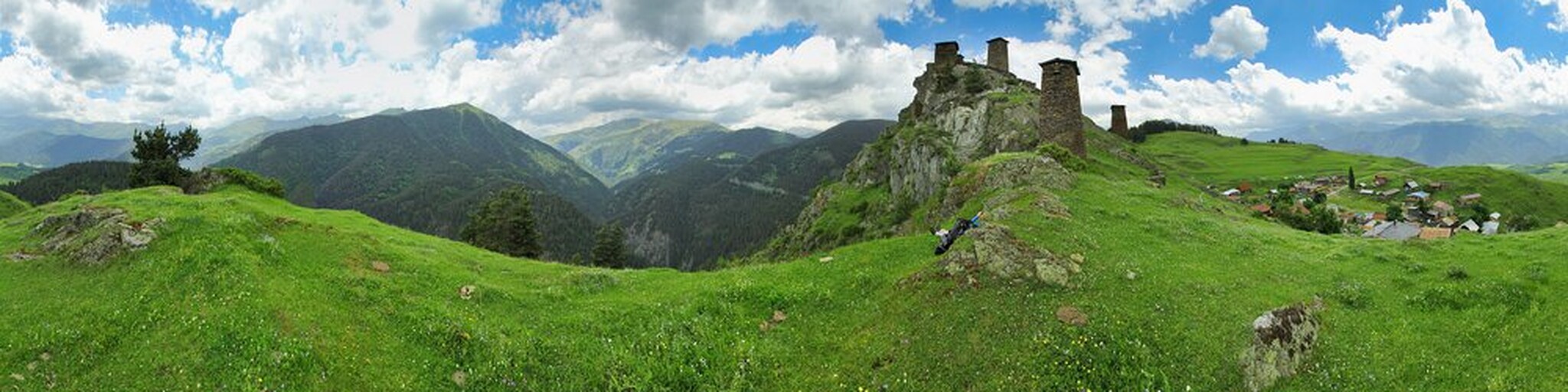
Keselo Fort
The highlight of the trip is a visit to Keselo, the historic fortress of Omalo. Situated on a rocky ridge above the village, Keselo comprises a cluster of thirteen medieval defensive towers. These towers were built in the Middle Ages to protect the villagers from raids by tribes from the North Caucasus.
As you walk between the slate walls of the towers, you sense the history of a people who refused to be subjugated by either nature or man. From the top of the towers, you have a 360-degree view of the Pirikiti and Gometsari Alazani valleys. The light of the setting sun paints the towers gold, and shadows fall across the Caucasus Mountains.
 Links
Links  Usage
Usage Want to download this route?
You can download the route for free without MyRoute-app account. To do so, open the route and click 'save as'. Want to edit this route?
No problem, start by opening the route. Follow the tutorial and create your personal MyRoute-app account. After registration, your trial starts automatically.  Disclaimer
Use of this GPS route is at your own expense and risk. The route has been carefully composed and checked by a MyRoute-app accredited RouteXpert for use on TomTom, Garmin and MyRoute-app Navigation.
Changes may nevertheless have occurred due to changed circumstances, road diversions or seasonal closures. We therefore recommend checking each route before use.
Preferably use the route track in your navigation system. More information about the use of MyRoute-app can be found on the website under 'Community' or 'Academy'.
Changes may nevertheless have occurred due to changed circumstances, road diversions or seasonal closures. We therefore recommend checking each route before use.
Preferably use the route track in your navigation system. More information about the use of MyRoute-app can be found on the website under 'Community' or 'Academy'.
 Nearby routes
Kacheti
About this region
Arthur Leist (8 July 1852 – 22 March 1927) was a German writer, journalist and translator of Georgian and Armenian literature.
He was born and educated at Breslau. During the Russo-Turkish War (1877–1878), he got interested in the Caucasus. After his three visits to Georgia between 1884 and 1892, Leist decided to permanently settle in Tiflis. He regularly wrote on the history, ethnography and culture of Georgia, and translated many pieces of classic Georgian and Armenian literature. He compiled the first anthology of Georgian poetry in German in 1887 and, with the help of the Georgian writer Ilia Chavchavadze, published the complete German translation of the medieval Georgian epic poem The Knight in the Panther's Skin by Shota Rustaveli in 1889. From 1906 to 1922, he edited Kaukasische Post, the only newspaper of the Caucasian German community. He died in Tiflis and was buried at the Didube Pantheon.
Read more on Wikipedia
He was born and educated at Breslau. During the Russo-Turkish War (1877–1878), he got interested in the Caucasus. After his three visits to Georgia between 1884 and 1892, Leist decided to permanently settle in Tiflis. He regularly wrote on the history, ethnography and culture of Georgia, and translated many pieces of classic Georgian and Armenian literature. He compiled the first anthology of Georgian poetry in German in 1887 and, with the help of the Georgian writer Ilia Chavchavadze, published the complete German translation of the medieval Georgian epic poem The Knight in the Panther's Skin by Shota Rustaveli in 1889. From 1906 to 1922, he edited Kaukasische Post, the only newspaper of the Caucasian German community. He died in Tiflis and was buried at the Didube Pantheon.
View region
 Statistics
  2
2Amount of RX reviews (Kacheti)
 63
63Amount of visitors (Kacheti)
 4
4Amount of downloads (Kacheti)
 Route Collections in this region
 Georgia
Georgia is a destination that awakens the senses and nourishes the soul. Situated at the crossroads of Europe and Asia, this country offers a rare combination of unspoiled nature, deep spirituality, and a culinary tradition that elevates every meal to a ceremony.
Your adventure undoubtedly begins in Tbilisi, the vibrant capital where futuristic glass architecture stands side by side with the iconic wooden balconies of the old town. The city exudes an atmosphere of creativity and history, especially in the wine bars where the 8,000-year-old winemaking tradition is still very much alive. A short distance away lies Mtskheta, the spiritual epicenter of the country. As the ancient capital, it is home to a UNESCO World Heritage site that brings Georgia's early conversion to Christianity to life. For the true history buff, Dmanisi is an absolute must; it is here that the oldest human remains outside of Africa have been discovered, giving the region an almost mythical status as the "cradle of Europe."
Traveling west, you'll find Kutaisi, one of the oldest continuously inhabited cities in the world and the ideal base for exploring spectacular caves and monasteries. For those who want to fill their lungs with pure mountain air, Baryumi (Borjomi) is the perfect stop. This historic spa town, world-famous for its healing mineral waters, serves as a gateway to dense forests and vast national parks.
The true visual spectacle, however, lies in the Greater Caucasus. Kazbegi offers the country's most iconic image: the Gergeti Trinity Church, which stands out boldly against the mighty, snow-capped peak of Mount Kazbek. For an even more rugged and authentic adventure, head to Mestia in Svaneti. This area is known for its unique medieval defense towers and offers access to the region's highest glaciers.
In the south lies the surreal Vardzia, a vast cave city carved out of the rock in the 12th century. This labyrinth of passageways and chapels is an architectural marvel. However, if you're looking for modern relaxation, Batumi on the Black Sea coast is the place to be. This city combines a subtropical climate with bold skyscrapers and a vibrant coastal nightlife.
End your journey in the east, in romantic Sighnaghi. Perched on a hill in the Kakheti wine region, this fortified town overlooks the endless Alazani Valley. With its cobbled streets and abundance of wine cellars, it's the perfect place to raise a glass to a land where a guest is always considered "a gift from God."
Your adventure undoubtedly begins in Tbilisi, the vibrant capital where futuristic glass architecture stands side by side with the iconic wooden balconies of the old town. The city exudes an atmosphere of creativity and history, especially in the wine bars where the 8,000-year-old winemaking tradition is still very much alive. A short distance away lies Mtskheta, the spiritual epicenter of the country. As the ancient capital, it is home to a UNESCO World Heritage site that brings Georgia's early conversion to Christianity to life. For the true history buff, Dmanisi is an absolute must; it is here that the oldest human remains outside of Africa have been discovered, giving the region an almost mythical status as the "cradle of Europe."
Traveling west, you'll find Kutaisi, one of the oldest continuously inhabited cities in the world and the ideal base for exploring spectacular caves and monasteries. For those who want to fill their lungs with pure mountain air, Baryumi (Borjomi) is the perfect stop. This historic spa town, world-famous for its healing mineral waters, serves as a gateway to dense forests and vast national parks.
The true visual spectacle, however, lies in the Greater Caucasus. Kazbegi offers the country's most iconic image: the Gergeti Trinity Church, which stands out boldly against the mighty, snow-capped peak of Mount Kazbek. For an even more rugged and authentic adventure, head to Mestia in Svaneti. This area is known for its unique medieval defense towers and offers access to the region's highest glaciers.
In the south lies the surreal Vardzia, a vast cave city carved out of the rock in the 12th century. This labyrinth of passageways and chapels is an architectural marvel. However, if you're looking for modern relaxation, Batumi on the Black Sea coast is the place to be. This city combines a subtropical climate with bold skyscrapers and a vibrant coastal nightlife.
End your journey in the east, in romantic Sighnaghi. Perched on a hill in the Kakheti wine region, this fortified town overlooks the endless Alazani Valley. With its cobbled streets and abundance of wine cellars, it's the perfect place to raise a glass to a land where a guest is always considered "a gift from God."
View Route Collection