
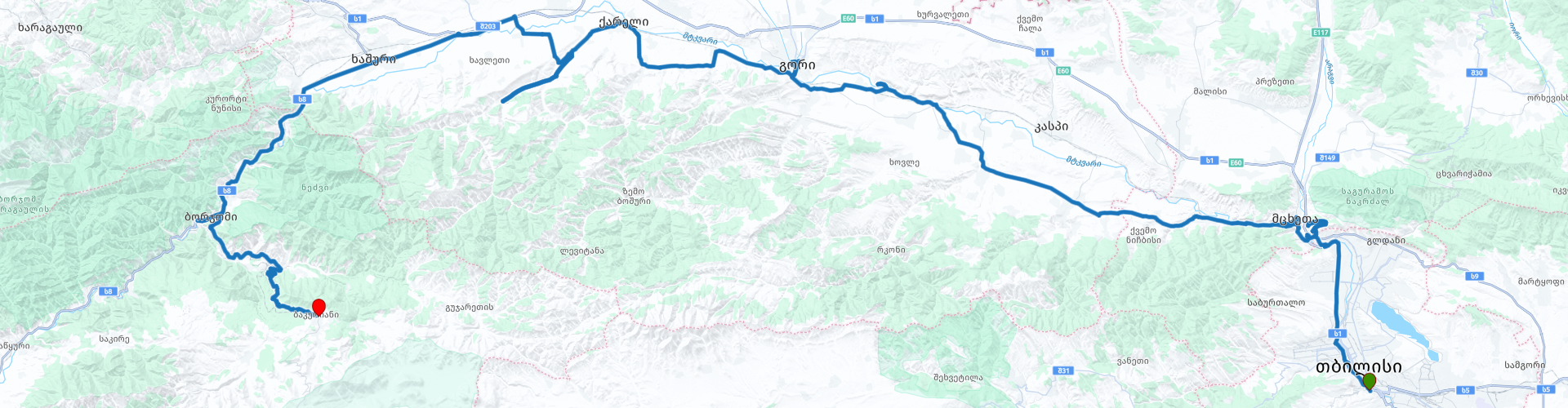
Georgia from Tbilisi

This route was brought to you by:
RouteXpert Jan Koelstra - Senior Rx
Last edit: 14-11-2025
 Route Summary
 You'll begin your tour in Georgia's capital, Tbilisi, near Narikala Castle. After refueling in the city, you'll head north to Mtskheta, the ancient capital of Georgia and a UNESCO World Heritage site. Explore the magnificent Svetitskhoveli Cathedral and the Jvari Monastery in Mtskheta.
Marvel at the ancient rock city of Uplistsikhe, an archaeological wonder from the early Iron Age. Wander through the tunnels, halls, and chambers carved into the rock, with breathtaking views of the surrounding landscape.
A little further afield lies Gori, the birthplace of Joseph Stalin. Visit the Stalin Museum to learn more about his life and legacy, or explore the castle and town center of this historic town.
After lunch, take a scenic drive through the picturesque Dzama Valley, home to no fewer than 60 historical monuments, including ancient and modern churches and monasteries, fortresses, towers, and natural sights such as the Kintsvisi Monastery complex, dating back to the 12th-13th centuries and containing majestic frescoes, and the Mdzovreti Fortress from the 17th century.
Borjomi is a great place for a drink, if only for the mineral water that bubbles up from the ground here, and then there's a beautiful drive through the gorge to the Barkoeriani ski resort, where the tour ends.
All things considered, the variety, the nature, the churches, towns, monasteries, mountains, so many impressions that only the highest rating is good enough: five stars!
 Share this route


Animation

Verdict


Duration
8h 40m

Mode of travel
Car or motorcycle

Distance
238.33 km

Countries

 RouteXpert Review
 A city steeped in heritage, where diverse cultures and religions coexist peacefully. Thanks to its historic location on the Silk Road, Tbilisi is a vibrant city where old-world charm blends with today's modern energy. Combined with its warm hospitality and delicious food and wine, Tbilisi is an absolute must-see as a starting point for a tour of Georgia.
Interesting sights include the Leaning Clocktower, located in the heart of the Old Town. This fairytale-like clock tower is part of a puppet theatre. Unique to this clock tower is that it houses both the largest and smallest clock in the city! Every hour, a little angel appears and rings the bell, but the most exciting part takes place daily at noon or 7 p.m. Then, the doors at the top of the clock tower open, and a small puppet show called "The Circle of Life" takes place!
The beauty of Tbilisi lies in the contrast between old and new. A 5-minute walk from the Leaning Clock Tower, you'll find the Tbilisi Peace Bridge. This modern pedestrian bridge crosses the river to Rike Park. This green lung of the city boasts fountains, art, and flora. It's a lovely place to relax and enjoy the city. The funicular departs from this park to Narikala Fortress, which is situated on a hill overlooking Tbilisi. From Rike Park, you can take the funicular to the fortress. This funicular is part of the public transport network, so tickets are very affordable and can be purchased on-site. With panoramic views of the city, this ride offers a beautiful perspective of the surrounding landscape. Once you reach the hill, you can walk to Narikala Fortress, built in the 4th century. You can also visit the National Botanical Garden of Georgia or simply enjoy a sunny terrace.
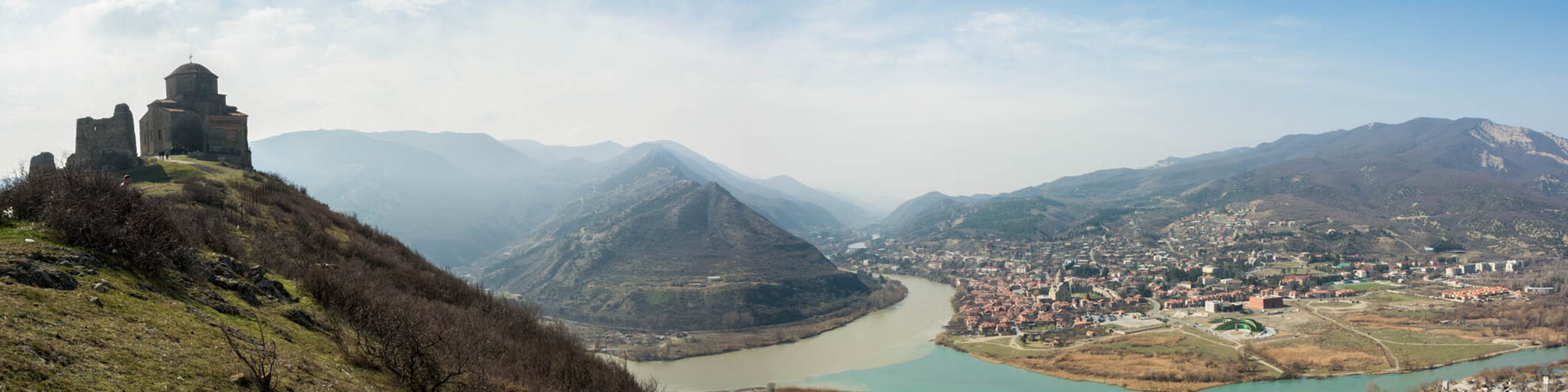
Your route starts near the old bathhouses and Narikala Castle. After a tour of the city and a fuel stop, you'll head towards Mtskheta, the former capital of Georgia. Along the way, you'll come to a fantastic viewpoint next to the 6th-century Jvari Monastery, the place where Georgia's Christianization is said to have begun. From the monastery, you'll have a magnificent view of the town of Mtskheta and see the confluence of two rivers. You can also stroll around the mountaintop for a bit.
Just before entering Mtskheta, if you're lucky with the water level, you'll see Pompey's Bridge, also known as the Bridge of the Magi, halfway in the river. It's an ancient Roman bridge built during the Roman general Pompey's campaign in Iberia and Colchis in 65 BC. The remains of the bridge are now largely submerged due to the construction of a hydroelectric power plant in 1926. However, when the river level drops, fragments of the old stonework are revealed, providing a tangible connection to the past.
Mtskheta (coffee stop)
Mtskheta is one of Georgia's oldest cities and a UNESCO World Heritage site. As the ancient capital of Georgia, Mtskheta is considered the spiritual heart of the country. For centuries, it was the center of political, cultural, and religious life, and many important historical events took place there. The Svetitskhoveli Cathedral, dating back to the 11th century, is considered one of Georgia's holiest sites. An impressive example of Georgian medieval architecture, the cathedral is adorned with beautiful frescoes and intricate stone carvings. To escape the crowds, you can also walk to the nearby Samtavro Monastery. Dating back to the 4th century AD, this monastery was restored in the 11th century and still serves quite well today. The coffee, too, by the way.
Uplistsikhe
Uplistsikhe is an ancient cave complex and a thriving town with a market, bakery, and shops until its destruction by Mongol armies in the 13th century. Many fascinating buildings remain within the caves, including ancient houses, temples, and even a theater carved directly into the rock.
Gori (lunch stop)
The Joseph Stalin Museum is dedicated to the life of Joseph Stalin, the leader of the Soviet Union, who was born in Gori. The museum has preserved the characteristics of the Soviet era. The grounds include the museum, his birthplace protected by a palazzo building above it, and the train carriage in which Stalin traveled from 1941 onward to international conferences, such as those in Yalta and Tehran.
St. George's Church and Monastery in Gori. The church was built after the 1920 earthquake on the site of an early medieval church. The site, surrounded by a 7th-century enclosure, is situated on a hill on the south side of Gori and offers a beautiful view of the town.
Gori Fortress is a medieval citadel in Georgia, perched on a rocky hill above the town of Gori. The fortress controlled important strategic and economic routes and housed a large garrison. In the 16th century, the Ottomans captured it to overwhelm Tbilisi.
A hidden gem with a homey atmosphere in the Shin da Gori restaurant. The menu features salads and Georgian dishes like khachapuri and khinkali.
Dzama Valley
From Gori, you drive to Kareli to enter the Dzama Valley, home to some 50 monasteries. Originally difficult to access, the route has now been made easily accessible for the growing number of tourists. One of the most important examples of Georgian architecture is the Kintsvisi Monastery, renowned for its high artistic value and stunning views. You can also visit the monasteries of Ortubani, Mzovreti, and Sarkineti here.
To continue your journey, you'll need to backtrack a bit, where a turnoff will put you back on track. You'll enter Borjomi-Kharagauli National Park from the main road. This is Georgia's largest national park and a true wilderness. The nature reserve is protected, and several trails have been laid out along lush forests and lakes. The national park is one of the largest protected natural parks in Georgia. You'll find more than 12,000 plant species (many endemic) and a diverse range of wildlife. Think of wolves, lynxes, deer, wild boars, bears, and various bird species, although larger animals are rarely spotted.
Borjomi (drink stop)
Borjomi is a balneological and climatic health resort. During the Soviet era, it held the status of a union resort. The mineral water is renowned for its healing properties. Bottled Borjomi mineral water is the most famous mineral water in Georgia and is a major export.
Likani Palace was the summer residence of the Russian Imperial Family. At the lower station of the funicular, in Central Park, is a public spring of healing spring water.
The final leg of your journey takes you into the mountains to the winter sports resort of Bakuriani. You'll be accompanied by the narrow-gauge railway from Borjomi to the mountain and winter sports resort of Bakuriani, built around 1900. If you'd rather not drive yourself, this is a nice alternative. The journey takes about 2.5 hours and takes you through dense forests, over bridges, and along steep mountain slopes. Along the way, you'll enjoy breathtaking views of the Caucasian landscape. The train itself is a charming example of early 20th-century engineering and design, adding to the nostalgic experience of the journey. This journey is especially special during the winter months, when the snow transforms the surroundings into a fairytale-like landscape.
Bakuriani (end point)
Bakuriani is primarily known as a ski resort and is considered the "winter sports capital" of Georgia. It is situated in the Trialeti Mountains at 1,700 meters above sea level. In summer, the area around Bakuriani is popular with hikers and hikers. With the opening of the narrow-gauge railway from Borjomi in 1902, Bakuriani's true development began. Hotels were built, and during the Soviet era, sanatoriums and spas were added.
 Links
Links  Usage
Usage Want to download this route?
You can download the route for free without MyRoute-app account. To do so, open the route and click 'save as'. Want to edit this route?
No problem, start by opening the route. Follow the tutorial and create your personal MyRoute-app account. After registration, your trial starts automatically.  Disclaimer
Use of this GPS route is at your own expense and risk. The route has been carefully composed and checked by a MyRoute-app accredited RouteXpert for use on TomTom, Garmin and MyRoute-app Navigation.
Changes may nevertheless have occurred due to changed circumstances, road diversions or seasonal closures. We therefore recommend checking each route before use.
Preferably use the route track in your navigation system. More information about the use of MyRoute-app can be found on the website under 'Community' or 'Academy'.
Changes may nevertheless have occurred due to changed circumstances, road diversions or seasonal closures. We therefore recommend checking each route before use.
Preferably use the route track in your navigation system. More information about the use of MyRoute-app can be found on the website under 'Community' or 'Academy'.
 Nearby routes