
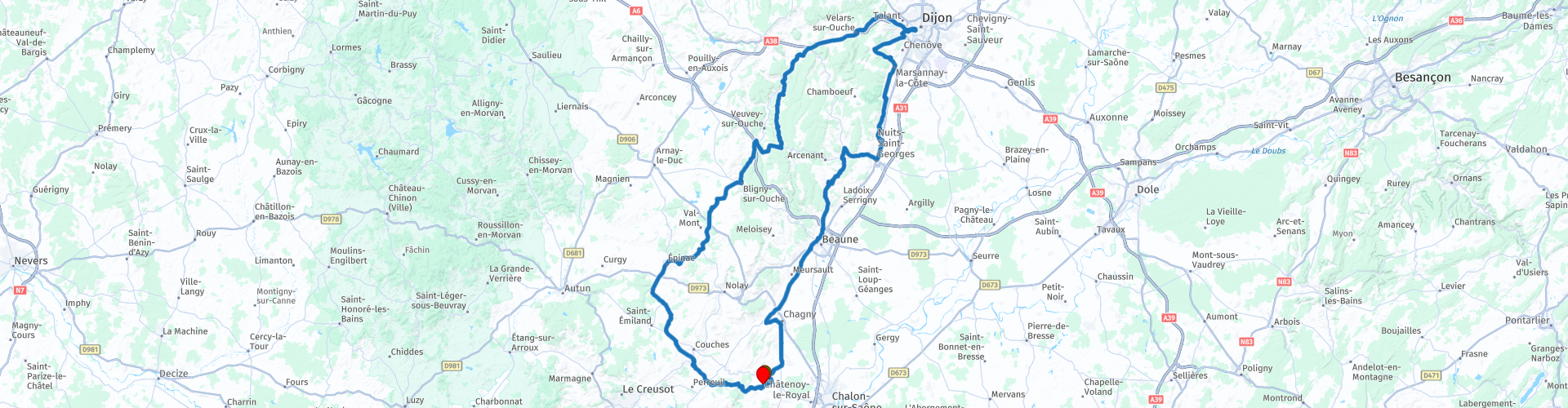
Roundtrip from Mercurey through the Hauts Cote de Nuits vineyards to Dijon

This route was brought to you by:
RouteXpert Catherine De Groote RouteXpert
Last edit: 12-12-2025
 Route Summary
 You'll ride mainly on departmental roads with good asphalt, little traffic, plenty of bends, and rolling hills – ideal for motorcycling. This route undoubtedly deserves a 5-star rating.
 Share this route


Animation

Verdict


Duration
9h 23m

Mode of travel
Car or motorcycle

Distance
202.04 km

Countries

 RouteXpert Review
 You'll ride mainly on departmental roads with good asphalt, little traffic, plenty of bends, and rolling hills – ideal for motorcycling. This route undoubtedly deserves a 5-star rating.
The starting point is just outside Mercurey – known for its excellent red wines – at the Gîtes des Vignes. This holiday home sleeps four and is quietly situated. The owner, who lives next door, makes his garage available for motorcycles.
At the start of the route, after about 1 km, you can refuel at Mercurey.
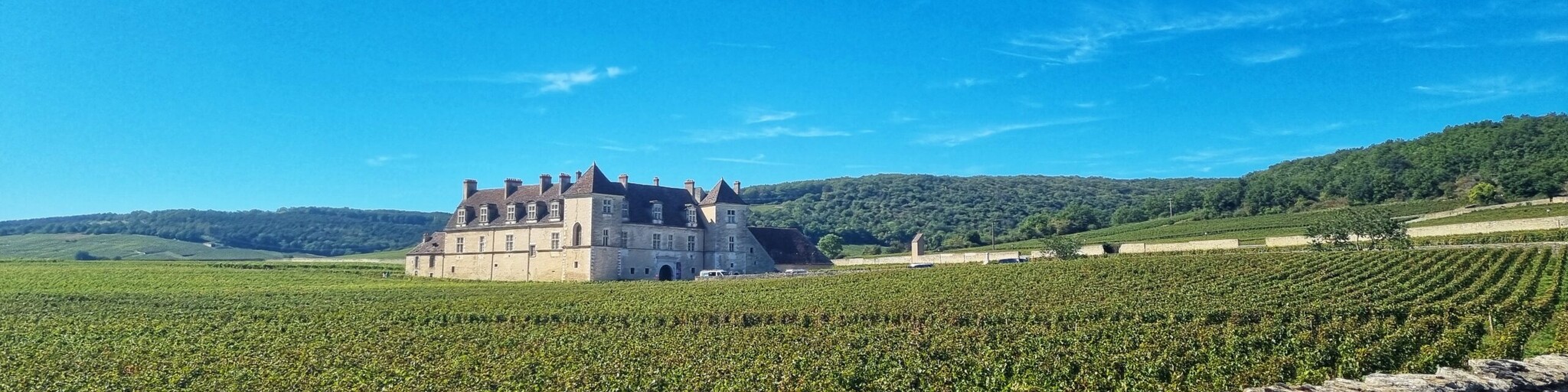
You'll immediately find yourself on quiet country roads with beautiful views among the vineyards. A perfect warm-up for the ride. You're already in the heart of the Côte Châlonnaise, a wine region less crowded than the more well-known areas, yet just as charming. This stretch is a feast of vineyards, quiet roads, and picturesque villages.
From Fontaines, follow the D981, a straight road with beautiful views but sometimes a bit heavier traffic. In Chagny, you can make a loop around the town. The road winds through the vineyards of the Grands Crus of the Côte de Beaune. On the bend in the road or at the corner of an alley, you might spot the architecture of a wine château. Sometimes you'll recognize it because at its foot lies a vineyard where the prized grapes grow.
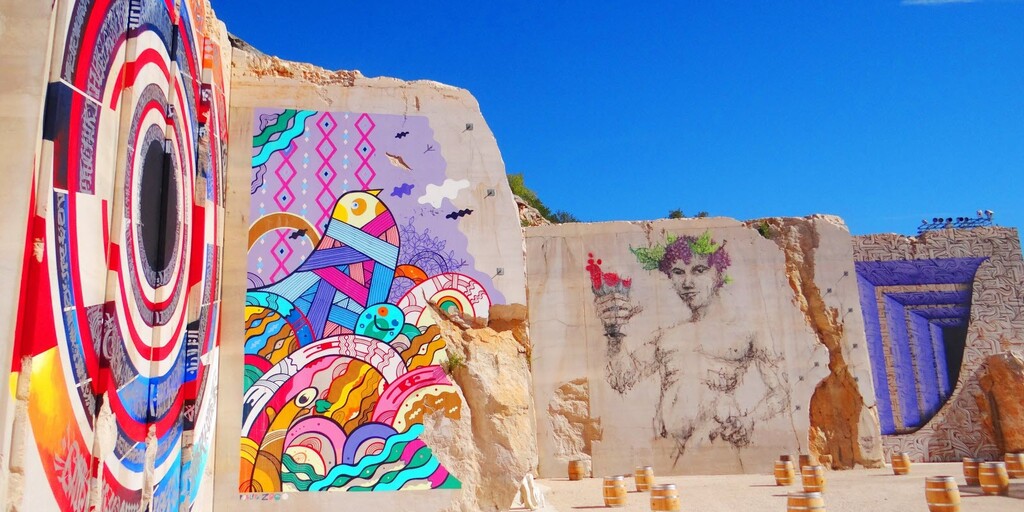
In Meuilley, exit the D25 and pass La Karrière. This former Comblanchien quarry was founded by the Vill'Art association and is now experiencing a unique new life! From urban frescoes to contemporary sculptures by renowned artists, La Karrière is THE benchmark for street art! Open on weekends and public holidays. With a bit of luck, the gate will be open if you pass by on another day, allowing you to take a look and take photos.
Nuits-Saint-Georges, a town of 5,700 inhabitants, is world-renowned for its wines and its illustrious characters who have left their mark on history with their scientific and artistic expertise. The winemakers are proud and eager to help you discover their craft and their terroirs. The landscapes you'll explore require careful care and attention year-round.
The "Climats de Bourgogne" wine region is the specific Burgundian term for a wine-growing terroir. Carefully defined over the centuries (and virtually unchanged since), each "climat" is a parcel of vines with its own name, history, flavor, and place in the hierarchy of crus. The beautiful wine region of the Côte de Nuits and Hautes Côtes de Nuits stretches along every side of the road. Vineyards as far as the eye can see.
Dijon is slowly approaching. Before exploring the city, turn off to the Puits de Moïse. This is located on the La Chartreuse hospital site. You can ride your motorcycle all the way to the Puits de Moïse.
Founded by Philip the Bold at the end of the 14th century as a necropolis for the Dukes of Burgundy, the Chartreuse de Champmol was a fertile artistic center where French and northern artists collaborated. The monastery, which was dismantled during the French Revolution, preserves two important works by the Flemish sculptor Claus Sluter: the church portal, which depicts Philip the Bold and his wife Margaret of Flanders, and the Well of Moses. The well, adorned with majestic statues of King David and Moses, and those of the four prophets (Isaiah, Daniel, Zechariah, and Jeremiah), was erected in the center of the large cloister. This strikingly realistic masterpiece by Sluter brilliantly illustrates the richness and finesse of Burgundian-Flemish sculpture from the late 14th century.
To visit some of Dijon's sights, it's best to park your motorcycle at the cathedral. There's a motorcycle parking lot there. If you want to see everything, you should budget at least half a day to a full day.
But what you definitely shouldn't miss is the Saint-Benigne Cathedral and the Palais des Ducs.
What you see of the cathedral today dates from the 13th and 14th centuries. The crypt was even part of the 11th-century Romanesque basilica that stood on the same site. Part of the roof is covered with glazed tiles. The interior of the church is somber and simple. This is because much of the church's contents were stolen during the French Revolution.
Down in the crypt, you'll see several sarcophagi, including that of Saint Bénigne. There's also a remarkable chapel of the dead, a chapel that refers to the tomb of Christ in Jerusalem, where a similar structure once stood.
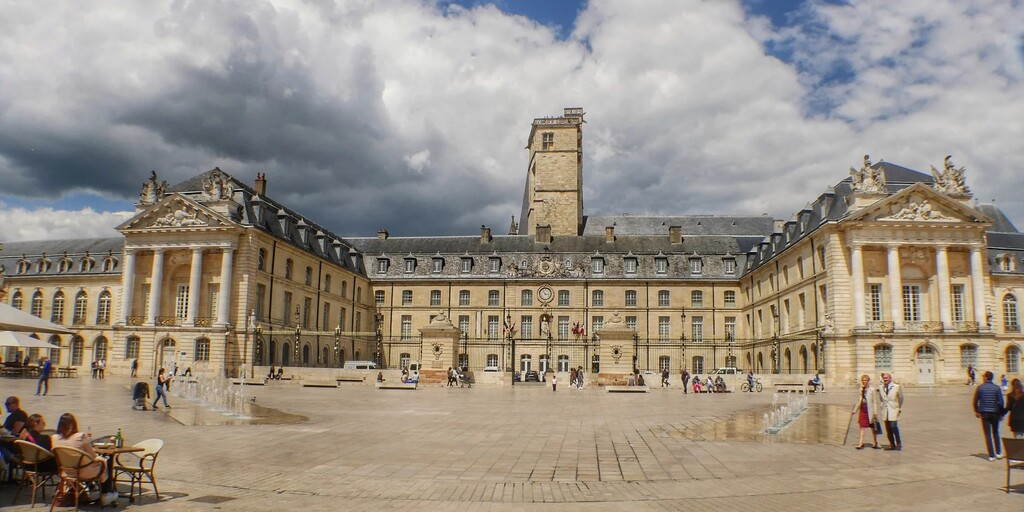
The impressive Palais des Ducs, a palace of the Dukes of Burgundy, houses the Musée des Beaux-Arts. You can admire collections ranging from the Roman period to 15th-century Italian painting, and from the French Renaissance and Baroque periods to contemporary art. In the Salle des Gardes, originally a banquet hall, you can see the extravagant tombs of Dukes Philip the Bold, John the Fearless, and Margaret of Bavaria. Philip the Bold's tomb was created between 1385 and 1410 by the French artist Jean de Marville and the Dutch artists Klaas van de Werve and Claus Sluter. Take a moment to appreciate the figures at the bottom. They are in a mourning pose, wearing mourning clothes, and their heads are veiled. The other tomb (1443-1470) shows the statues of John the Fearless and Margaret of Bavaria. Jean de la Huerta and Le Moiturier worked on this tombstone. The graves have been on display in this hall since 1827.
We also recommend climbing the tower. After 316 steps, you reach a platform with a magnificent view of the city. The tower was part of the residence of Duke Philip the Good (1396-1467).
The Place de la Libération was built at the end of the 17th century, when Dijon was at the height of its parliamentary power. Its construction was part of the redevelopment of the entire district surrounding the Ducal Palace. The square has a semicircular shape and is lined with arcades and sandstone houses.
Here you'll find several restaurants. Brasserie Aperitivo is definitely recommended. It welcomes you in a very cozy atmosphere. The atmosphere is relaxed and the welcome is always warm, ensuring an unforgettable experience. There's a large terrace with a view of the Palais des Ducs. Every dish is carefully prepared with fresh ingredients. You can choose from delicious platters to share, as well as authentic pizzas and specialties of Italian and regional cuisine. There's continuous service and it's an ideal spot for lunch.
You leave Dijon heading west. The bustle of the city immediately gives way to the tranquility of nature.
In the heart of the Côte-d'Or, the Ouche Valley boasts beautiful, green, and refreshing landscapes. The peaceful river of the same name and the famous Burgundy Canal flow through this valley. Several bridges cross the canal, offering stunning views of the valley and the locks through which boats pass.
After Bligny-sur Ouche you can – if necessary – fill up with fuel because this is the last petrol station before you reach the holiday home.
Time to enjoy a drink at Café Restaurant De la Place in Epinac. It's a typical French bar-restaurant with a small terrace. Parking is available at Place Charles de Gaulle.
A final stop on this tour is the Menhirs d'Epoigny, a group of seven menhirs, some 5,000 years old, erected by the Neolithic civilization. Their heights are respectively: 7.35 m, 5.60 m, 5.30 m, 4 m, 2.83 m, and 2 m. This is the most important megalithic site in Burgundy. The largest menhir is a block of Brandon granite (a local stone) weighing 30 tons, called the Pierre des Tourteaux.
These menhirs, whose engravings testify to ancient phases of megalithic art, were buried. Six were excavated in 1984, the last in 1990. During the excavation of the stones, flints and ceramics were found, testifying to the area's habitation from the Neolithic to the Gallo-Roman period. A gravestone from the late Bronze Age was also found beneath the megalith.
Another 20 km along winding roads to Saint-Martin-sous-Montaigu and the holiday home where you can relax on the terrace and enjoy this fascinating tour.
 Links
Links  Usage
Usage Want to download this route?
You can download the route for free without MyRoute-app account. To do so, open the route and click 'save as'. Want to edit this route?
No problem, start by opening the route. Follow the tutorial and create your personal MyRoute-app account. After registration, your trial starts automatically.  Disclaimer
Use of this GPS route is at your own expense and risk. The route has been carefully composed and checked by a MyRoute-app accredited RouteXpert for use on TomTom, Garmin and MyRoute-app Navigation.
Changes may nevertheless have occurred due to changed circumstances, road diversions or seasonal closures. We therefore recommend checking each route before use.
Preferably use the route track in your navigation system. More information about the use of MyRoute-app can be found on the website under 'Community' or 'Academy'.
Changes may nevertheless have occurred due to changed circumstances, road diversions or seasonal closures. We therefore recommend checking each route before use.
Preferably use the route track in your navigation system. More information about the use of MyRoute-app can be found on the website under 'Community' or 'Academy'.
 Nearby routes