
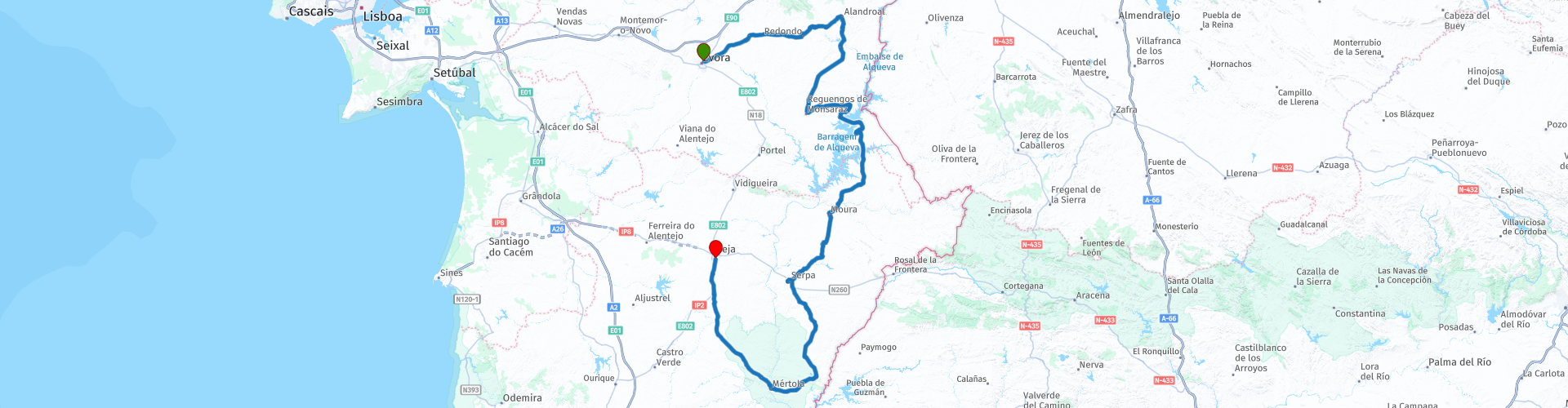
Heart of Alentejo Evora to Beja

This route was brought to you by:
RouteXpert CorsaroG
Last edit: 11-12-2025
 Route Summary
 From the hilltop village the route turns lakeward, crossing a long modern viaduct over an arm of Lake Alqueva and dropping to the engineered river beach at Mourão. It then threads along the inlets and side valleys of the reservoir before entering classic olive-belt country. The middle of the day explores everyday Alentejo life, with lunch on the main square in Moura and a run through regimented groves that feed the region’s protected olive oils.
Beyond Serpa the route swings into Vale do Guadiana Natural Park, where open montado pasture and schist hills lead you towards the “museum town” of Mértola perched over the river. A final, clean link brings you to Beja and the cloisters of Pousada de São Francisco. The day blends medieval strongholds, major modern bridges, reservoir shores and working farmland into a coherent Alentejo story rather than a simple transfer between hotels. Overall this is a 4 star day: scenic, varied and well-paced, with only short connector stretches and a strong sense of place.
Star Rating: ★★★★
 Share this route


Animation

Verdict


Duration
7h 39m

Mode of travel
Car or motorcycle

Distance
297.16 km

Countries

 RouteXpert Review
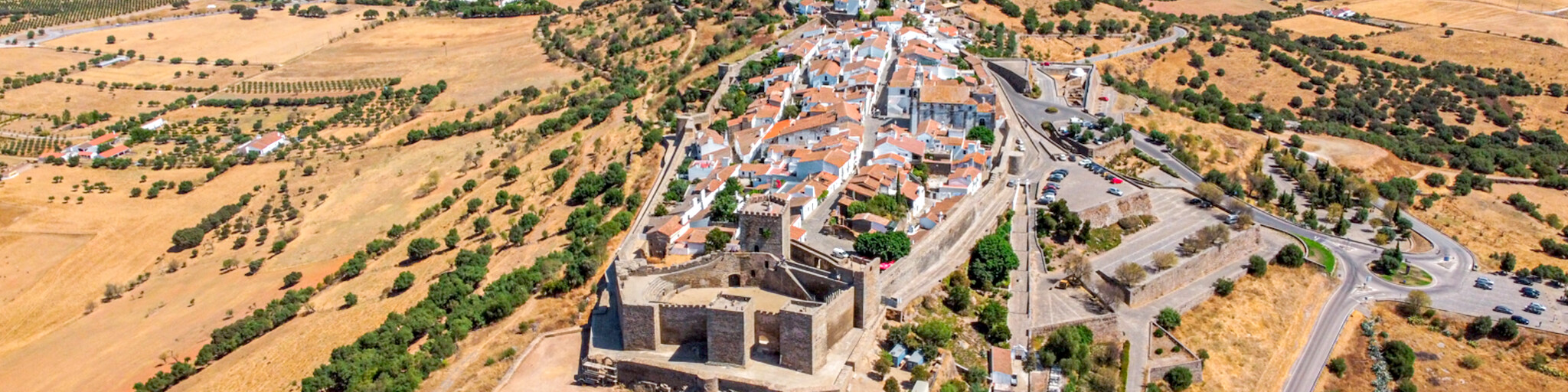
 From here the ride gains height as it approaches Monsaraz. The village suddenly appears on its ridge, walls and keep silhouetted above the reservoir basin. The approach roads tighten slightly and then the pace drops as you pass through the gate onto cobbles and narrow lanes. Inside, the layout still speaks of a frontier stronghold: houses packed along the crest, church and castle commanding the ridge, and beyond the parapets the huge surface of Lake Alqueva filling much of the old Guadiana valley.
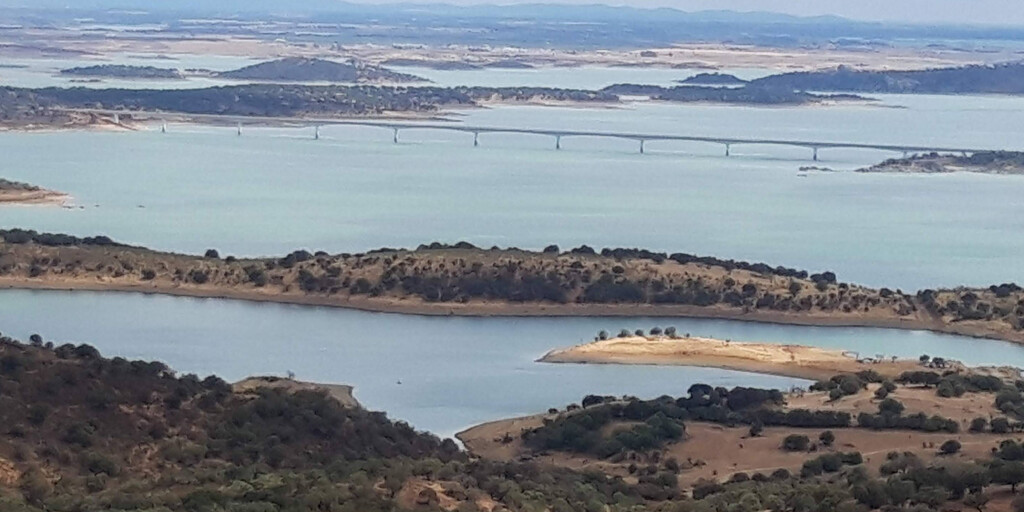
Dropping back off the ridge, the line joins the modern alignment towards the lake and immediately commits to the long viaduct of Ponte de Xerez de Baixo. The span feels engineered for big skies: the deck stretches over open water and semi-submerged islands, and you get an uninterrupted sense of how the dam has reshaped the river. The short spur down to Praia Fluvial de Mourão then brings you back to water level, with sand, pontoons and a low, wide horizon emphasising the scale of the reservoir from shore height rather than bridge height.
South of Mourão, Ponte de Alcarrache tells a subtler part of the same story. Here the road is carried over a drowned tributary valley, with narrower inlets and more enclosed views, and the viaduct feels like a deliberate stitching-together of landscape that was cut by the rising water. Once clear of the reservoir margins the route settles onto a rural plateau and swings towards Moura, where low hills and small farms give way to the symmetry of the main square. Central Café on Praça Sacadura Cabral is pitched exactly where you need it: informal, quick to use, and rooted in a square that sits directly below the castle garden.
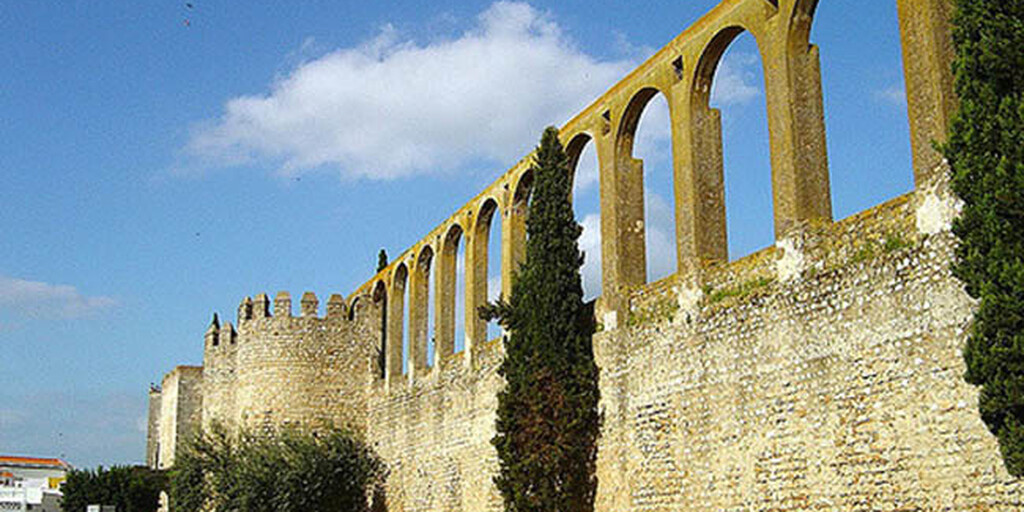
The next leg through the olive belt is visually repetitive in a good way. Grid-planted groves and irrigation systems run away from the roadside, illustrating how traditional olive culture has been mechanised to produce Azeite de Moura oils for export. Approaching Serpa, the town’s defensive role becomes obvious as towers and walls begin to dominate the skyline. Instead of just skirting on the ring road, the route pauses so you can see the 17th-century aqueduct arches meeting the medieval wall, a precise bit of stonework where water supply and fortification are literally joined.
Beyond Serpa the feel changes again as you enter Vale do Guadiana Natural Park. The road crosses low schist ridges and shallow saddles, dipping into side valleys and climbing out over montado pasture and fields. There is a sense of space, but the landscape is more varied than the morning’s wide plains, and the approach to Mértola sharpens this further as the Guadiana gorge closes in. The town itself piles up on the rock above the river, with the castle and former mosque–church highlighting the Islamic and medieval layers that underpin its “museum town” concept.
Café Guadiana on Largo Vasco da Gama works well as an afternoon anchor: it sits at the hinge point between riverfront and upper town, so you can see bridge, water and the lower quarters while still being close to the climb up to the castle streets. When you finally point the bike away from Mértola, the emphasis shifts decisively from exploration to connection. A broad main road leads north towards Beja, letting you cover the remaining distance smoothly before turning into the town centre and finishing inside the thick walls of Pousada de São Francisco. Ending the day in a 13th-century convent converted to a pousada mirrors the historic start in Évora and closes the loop of castles, churches, bridges and reservoirs in a satisfying way.
This day is suitable for most riders who are comfortable with a full, varied schedule. Urban sections in Évora, Monsaraz, Moura, Serpa, Mértola and Beja involve cobbles, tight junctions and occasional pedestrians; low speed and patience are key. The reservoir bridges at Xerez de Baixo and Alcarrache are exposed to crosswinds, especially on gusty days. In high summer, heat across the Alentejo can be intense, so frequent hydration and sun protection matter. Wildlife is mostly limited to birds, but you may encounter stray dogs near villages and slow-moving agricultural machinery on the olive corridors; both can appear unexpectedly.
 Links
Links  Usage
Usage Want to download this route?
You can download the route for free without MyRoute-app account. To do so, open the route and click 'save as'. Want to edit this route?
No problem, start by opening the route. Follow the tutorial and create your personal MyRoute-app account. After registration, your trial starts automatically.  Disclaimer
Use of this GPS route is at your own expense and risk. The route has been carefully composed and checked by a MyRoute-app accredited RouteXpert for use on TomTom, Garmin and MyRoute-app Navigation.
Changes may nevertheless have occurred due to changed circumstances, road diversions or seasonal closures. We therefore recommend checking each route before use.
Preferably use the route track in your navigation system. More information about the use of MyRoute-app can be found on the website under 'Community' or 'Academy'.
Changes may nevertheless have occurred due to changed circumstances, road diversions or seasonal closures. We therefore recommend checking each route before use.
Preferably use the route track in your navigation system. More information about the use of MyRoute-app can be found on the website under 'Community' or 'Academy'.
 Nearby routes
Evora
About this region
Évora (US: EV-uurr-ə, Portuguese: [ˈɛvuɾɐ] (listen); Proto-Celtic: *Ebora) is a city and a municipality in Portugal. The population in 2011 was 56,596, in an area of 1307.08 km2. It is the historic capital of the Alentejo and serves as the capital of the Évora District. The present Mayor is Carlos Pinto de Sá of the CDU coalition. The municipal holiday is 29 June.
Due to its well-preserved old town centre, still partially enclosed by medieval walls, and many monuments dating from various historical periods, including a Roman Temple, Évora is a UNESCO World Heritage Site.
Due to its inland position, Évora is one of Portugal's hottest cities in the summer, frequently subject to heat waves.
Évora is ranked number two in the Portuguese most livable cities survey of living conditions published yearly by Expresso. It was ranked first in a study concerning competitiveness of the 18 Portuguese district capitals, according to a 2006 study made by University of Minho economic researchers.
Read more on Wikipedia
Due to its well-preserved old town centre, still partially enclosed by medieval walls, and many monuments dating from various historical periods, including a Roman Temple, Évora is a UNESCO World Heritage Site.
Due to its inland position, Évora is one of Portugal's hottest cities in the summer, frequently subject to heat waves.
Évora is ranked number two in the Portuguese most livable cities survey of living conditions published yearly by Expresso. It was ranked first in a study concerning competitiveness of the 18 Portuguese district capitals, according to a 2006 study made by University of Minho economic researchers.
View region
 Statistics
  6
6Amount of RX reviews (Evora)
 11716
11716Amount of visitors (Evora)
 124
124Amount of downloads (Evora)
 Route Collections in this region
 Paradors Pousadas And Iberian Passes
This collection is an end-to-end motorcycle journey across northern Spain and Portugal, shaped deliberately to unfold over eleven days with a clear sense of progression. Each stage builds naturally on the last, carrying the rider from the Atlantic edge of northern Spain, south through Portugal’s mountain heartlands and open plains, before returning north across Spain to finish back on the Cantabrian coast.
The journey begins on the Cantabrian coast, leaving Santander behind and climbing steadily inland towards Cervera de Pisuerga. The opening day sets the tone immediately, trading sea air for rising ground and greener hills as the road threads through northern Spain’s quieter interior. It feels purposeful without being rushed, easing the rider into the rhythm of the tour.
From Cervera de Pisuerga, the route pushes deeper into the Cantabrian highlands, crossing broad upland terrain and remote border regions on the way to Bragança. The scenery becomes more expansive, the roads quieter, and the sense of travelling through less familiar Spain grows stronger as the journey approaches Portugal.
Crossing into Portugal, the character tightens again through Montesinho and the Peneda-Gerês region. Roads fold into wooded hills and granite villages, with more frequent elevation changes and a greater sense of enclosure. This is riding that rewards attention and flow rather than outright speed, and it marks a clear transition into Portugal’s mountainous north.
The route then opens into the Douro highlands, running south towards Viseu. Valleys deepen, viewpoints lengthen and the riding alternates between fast, open sections and more intimate stretches that follow the land closely. The sense of scale increases without losing the feeling of remoteness that defines this part of the journey.
Climbing into the Serra da Estrela plateau, the collection reaches one of its defining high points. Portugal’s highest mountain range delivers wide horizons, exposed passes and a feeling of space that contrasts sharply with the valleys below. This stage stands out for its elevation, light and long views, and it feels like a natural midpoint landmark in the overall journey.
Dropping south from the mountains, the route transitions into the Beiras and Alentejo, carrying the rider from high ground into warmer, more open landscapes on the way to Évora. The roads relax into longer, flowing lines, and the pace of the journey subtly changes without losing interest or intent.
From Évora to Beja, the ride settles fully into the heart of the Alentejo. Cork forests, reservoirs and historic hill towns define the scenery, while the riding becomes smoother and more measured. These stages offer breathing space within the collection, allowing the rider to absorb the scale and atmosphere of southern Portugal.
Turning back towards the Spanish border, the route climbs again through Castelo and the border ridges to Marvão. Elevation returns, views stretch out, and the landscape regains a rugged edge. The dramatic setting of Marvão feels earned, sitting high above the surrounding plains and marking a clear shift back towards frontier territory.
Crossing back into Spain, the journey continues through the serranías and frontier regions of Castile, heading for Ciudad Rodrigo. Historic borderlands, rolling terrain and quiet roads reinforce the feeling of travelling through lesser-known landscapes, with riding that remains engaging through variety rather than intensity.
From Ciudad Rodrigo to Benavente, the route crosses the Castilla y León plains. Big skies, long sightlines and subtle changes in terrain define this stage, providing contrast after the mountains while maintaining a strong sense of direction as the journey turns decisively north.
The final day carries the rider from the Meseta back to the Cantabrian coast, closing the loop at Santander. As greener hills return and the Atlantic air reappears, the transition from inland Spain back to the coast provides a fitting and satisfying conclusion, both geographically and emotionally, to the journey.
Throughout the collection, the choice of Paradors and Pousadas anchors each day in history and landscape. These are not simply places to stop, but destinations that reinforce the character of each region and give the journey a sense of occasion from start to finish.
Taken as a whole, this is a coherent and rewarding Iberian tour: varied without feeling fragmented, demanding enough to stay engaging without becoming tiring, and designed to be ridden as a complete journey rather than a series of disconnected stages. It is best suited to riders who value flow, scenery and progression, and who appreciate the satisfaction of a route that unfolds naturally over time.
The journey begins on the Cantabrian coast, leaving Santander behind and climbing steadily inland towards Cervera de Pisuerga. The opening day sets the tone immediately, trading sea air for rising ground and greener hills as the road threads through northern Spain’s quieter interior. It feels purposeful without being rushed, easing the rider into the rhythm of the tour.
From Cervera de Pisuerga, the route pushes deeper into the Cantabrian highlands, crossing broad upland terrain and remote border regions on the way to Bragança. The scenery becomes more expansive, the roads quieter, and the sense of travelling through less familiar Spain grows stronger as the journey approaches Portugal.
Crossing into Portugal, the character tightens again through Montesinho and the Peneda-Gerês region. Roads fold into wooded hills and granite villages, with more frequent elevation changes and a greater sense of enclosure. This is riding that rewards attention and flow rather than outright speed, and it marks a clear transition into Portugal’s mountainous north.
The route then opens into the Douro highlands, running south towards Viseu. Valleys deepen, viewpoints lengthen and the riding alternates between fast, open sections and more intimate stretches that follow the land closely. The sense of scale increases without losing the feeling of remoteness that defines this part of the journey.
Climbing into the Serra da Estrela plateau, the collection reaches one of its defining high points. Portugal’s highest mountain range delivers wide horizons, exposed passes and a feeling of space that contrasts sharply with the valleys below. This stage stands out for its elevation, light and long views, and it feels like a natural midpoint landmark in the overall journey.
Dropping south from the mountains, the route transitions into the Beiras and Alentejo, carrying the rider from high ground into warmer, more open landscapes on the way to Évora. The roads relax into longer, flowing lines, and the pace of the journey subtly changes without losing interest or intent.
From Évora to Beja, the ride settles fully into the heart of the Alentejo. Cork forests, reservoirs and historic hill towns define the scenery, while the riding becomes smoother and more measured. These stages offer breathing space within the collection, allowing the rider to absorb the scale and atmosphere of southern Portugal.
Turning back towards the Spanish border, the route climbs again through Castelo and the border ridges to Marvão. Elevation returns, views stretch out, and the landscape regains a rugged edge. The dramatic setting of Marvão feels earned, sitting high above the surrounding plains and marking a clear shift back towards frontier territory.
Crossing back into Spain, the journey continues through the serranías and frontier regions of Castile, heading for Ciudad Rodrigo. Historic borderlands, rolling terrain and quiet roads reinforce the feeling of travelling through lesser-known landscapes, with riding that remains engaging through variety rather than intensity.
From Ciudad Rodrigo to Benavente, the route crosses the Castilla y León plains. Big skies, long sightlines and subtle changes in terrain define this stage, providing contrast after the mountains while maintaining a strong sense of direction as the journey turns decisively north.
The final day carries the rider from the Meseta back to the Cantabrian coast, closing the loop at Santander. As greener hills return and the Atlantic air reappears, the transition from inland Spain back to the coast provides a fitting and satisfying conclusion, both geographically and emotionally, to the journey.
Throughout the collection, the choice of Paradors and Pousadas anchors each day in history and landscape. These are not simply places to stop, but destinations that reinforce the character of each region and give the journey a sense of occasion from start to finish.
Taken as a whole, this is a coherent and rewarding Iberian tour: varied without feeling fragmented, demanding enough to stay engaging without becoming tiring, and designed to be ridden as a complete journey rather than a series of disconnected stages. It is best suited to riders who value flow, scenery and progression, and who appreciate the satisfaction of a route that unfolds naturally over time.
View Route Collection
Southern Spain and Portugal
The Iberian Border: A Journey Through Two Worlds
Here, in the far southwestern corner of the European continent, two countries lie side by side. At first glance, Spain and Portugal seem almost identical... and yet, once we cross the invisible border, we suddenly find ourselves in a completely different world.
It's a remarkable phenomenon. With just a single step—or the revolution of a wheel—everything changes. The language, the pulse of the music, the smells from the kitchen... even time itself shifts. It's an abrupt transition that captivates the senses.
Just look at this landscape. A spectacular display of Mother Nature. As we travel along the winding roads, we see vast olive groves give way to shady, cool cork oak forests. And there, where the land meets the ocean, we encounter a dramatic contrast: ancient, rugged cliffs standing guard over tranquil, golden beaches.
In the heart of Portugal lies Lisbon. A city pulsating with a life all its own. Here, you can hear the melancholic sounds of Fado, while historic trams weave their way through narrow streets, side by side with restless tuk-tuks. It's a place where history and culture are etched in every stone.
For the traveler on two wheels, this is paradise. The roads wind through the landscape like rivers, virtually undisturbed by heavy traffic. And so, with the rich taste of port wine in their luggage and the echo of flamenco still in their ears, the traveler completes their migration... and finally returns to the familiar port of Malaga. A truly... fascinating journey.
Here, in the far southwestern corner of the European continent, two countries lie side by side. At first glance, Spain and Portugal seem almost identical... and yet, once we cross the invisible border, we suddenly find ourselves in a completely different world.
It's a remarkable phenomenon. With just a single step—or the revolution of a wheel—everything changes. The language, the pulse of the music, the smells from the kitchen... even time itself shifts. It's an abrupt transition that captivates the senses.
Just look at this landscape. A spectacular display of Mother Nature. As we travel along the winding roads, we see vast olive groves give way to shady, cool cork oak forests. And there, where the land meets the ocean, we encounter a dramatic contrast: ancient, rugged cliffs standing guard over tranquil, golden beaches.
In the heart of Portugal lies Lisbon. A city pulsating with a life all its own. Here, you can hear the melancholic sounds of Fado, while historic trams weave their way through narrow streets, side by side with restless tuk-tuks. It's a place where history and culture are etched in every stone.
For the traveler on two wheels, this is paradise. The roads wind through the landscape like rivers, virtually undisturbed by heavy traffic. And so, with the rich taste of port wine in their luggage and the echo of flamenco still in their ears, the traveler completes their migration... and finally returns to the familiar port of Malaga. A truly... fascinating journey.
View Route Collection