
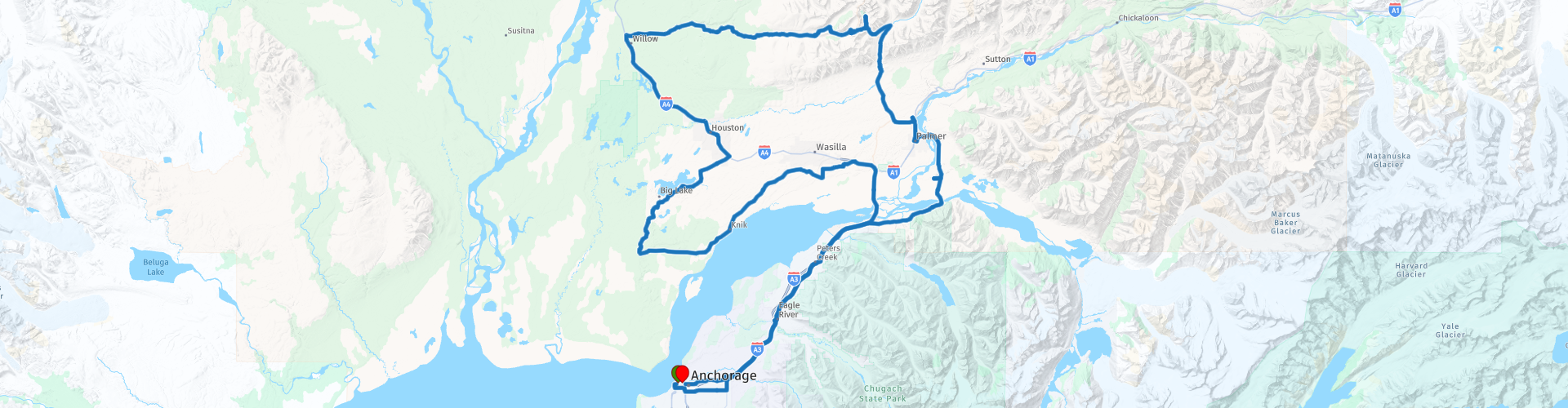
Roundtrip Anchorage Palmer Willow Anchorage

This route was brought to you by:
RouteXpert René Plücken (MRA Master)
Last edit: 28-09-2025
 Route Summary
 The roads vary greatly from nice straight highways to unpaved narrow winding country roads.
There are several motorcycle rental companies in Anchorage, where you can choose from various types of motorcycles. These are listed as points of interest.
Alaska is large and quite unpopulated, but you will still pass through a number of small towns and settlements where you can stop for a drink and a bite to eat.
A number of POI have been included as options to visit.
This route features beautiful roads, plenty of stunning scenery, and several wonderful sights to visit. I rate this route 4**** stars.
 Share this route


Animation

Verdict


Duration
8h 37m

Mode of travel
Car or motorcycle

Distance
355.57 km

Countries

 RouteXpert Review
 After leaving Anchorage, we drive past Delaney Park, where you'll see Alaska Railroad No. 556 Steam Locomotive on your right. This locomotive is one of twelve "Gypsy Rose" locomotives (named after a famous burlesque dancer) sent to Alaska in 1943 to transport passengers and freight along the Seward-Anchorage-Fairbanks route. It has been a permanent landmark in the park since 1959, making it a nice photo stop.
Just outside the city, you can visit the Alaska Native Heritage Center, which shares the heritage of 11 major cultural groups in Alaska. These 11 groups are the Athabaskan, Eyak, Tlingit, Haida, Tsimshian, Unangax (Aleut), Alutiiq, Yup'ik, Cup'ik, Siberian Yupik, and Inupiaq. The Hall of Cultures hosts activities and demonstrations, and a theater and meeting place. Outside, six larger-than-life Native American dwellings surround Tiulana Lake.
We leave Anchorage behind us and drive via the Glenn Highway AK-1 (Freeway) to Eagle River where we leave the highway to take the Old Glenn Highway to Birchwood.
You can visit Thunderbird Falls. To get there, you'll need to hike the 1.5-kilometer trail to Thunderbird Falls. This trail traverses a beautiful birch forest along the Eklutna River Canyon to reach a viewing platform with a view of a 6-meter-high waterfall.
You can visit the Palmer Museum of History & Art, where exhibits tell the story of the Palmer area, from the Ahtna era through the Gold Rush and finally through the Matanuska Colony.
You can visit the Musk Ox Farm, where you can take a lovely 45-minute guided walk around the farm, learning about the project's history, the natural history of musk oxen, and the incredible potential these ungulates offer in the Arctic. You'll see playful calves, seasoned old bulls, and the largest herd of musk oxen in the world. Don't forget your camera!
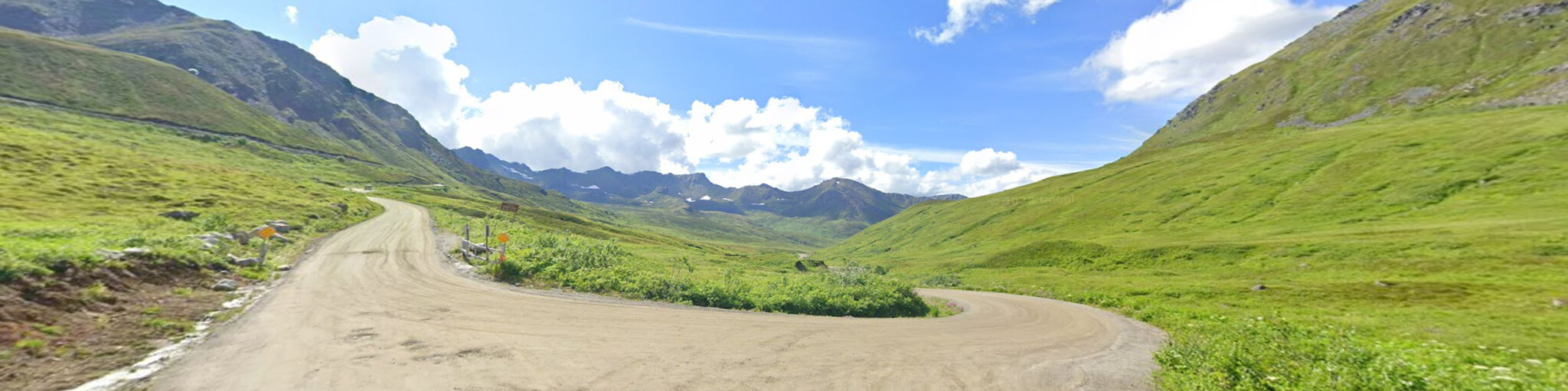
We drive along the Hatcher Pass Road, a wonderfully winding road through beautiful scenery, partly along the Little Susitna River.
You can visit Independence Mine State Historical Park and learn what it was like to live and work in one of Alaska's largest gold mining camps. Independence Mine was once two mines: the Alaska Free Gold (Martin) Mine on Skyscraper Mountain and the Independence Mine on Granite Mountain. In 1938, the two were merged into one company, the Alaska-Pacific Consolidated Mining Company (APC). With a block of 83 mining claims, APC became the largest gold producer in the Willow Creek Mining District.
We continue our drive over Hatcher Pass, which also runs through the small but beautiful Summit Lake State Recreational Park. The view is magnificent, and there are plenty of opportunities to stop and enjoy the scenery and take a photo.
The next road is the unpaved Willows Fishhook Road, along the fast-flowing Willow Creek. This is over 40 kilometers of rugged scenery, beautiful panoramas, and a delightful winding road along this small river. Note that this road is unpaved.
In Houston, there are opportunities to refuel and have lunch. After Houston, you can shorten this route by 80 kilometers if time is of the essence. The long route is another beautiful, winding, partially unpaved route through a lovely area with numerous lakes.
Just before Gateway, the two routes come together again for the final leg back to Anchorage.


 Links
Links  Usage
Usage Want to download this route?
You can download the route for free without MyRoute-app account. To do so, open the route and click 'save as'. Want to edit this route?
No problem, start by opening the route. Follow the tutorial and create your personal MyRoute-app account. After registration, your trial starts automatically.  Disclaimer
Use of this GPS route is at your own expense and risk. The route has been carefully composed and checked by a MyRoute-app accredited RouteXpert for use on TomTom, Garmin and MyRoute-app Navigation.
Changes may nevertheless have occurred due to changed circumstances, road diversions or seasonal closures. We therefore recommend checking each route before use.
Preferably use the route track in your navigation system. More information about the use of MyRoute-app can be found on the website under 'Community' or 'Academy'.
Changes may nevertheless have occurred due to changed circumstances, road diversions or seasonal closures. We therefore recommend checking each route before use.
Preferably use the route track in your navigation system. More information about the use of MyRoute-app can be found on the website under 'Community' or 'Academy'.
 Nearby routes
 .jpg/774px-Aerial_view_of_Fairbanks_Alaska_skyline_(Quintin_Soloviev).jpg)
Alaska
About this region
Alaska ( Aleut: Alax̂sxax̂; Inupiaq: Alaasikaq; Alutiiq: Alas'kaaq; Yup'ik: Alaskaq; Tlingit: Anáaski) is a U.S. state at the northwest extremity of North America. A semi-exclave of the U.S., it borders the Canadian province of British Columbia and the territory of Yukon to the east and has a maritime border with Russia's Chukotka Autonomous Okrug to the west, just across the Bering Strait. To the north are the Chukchi and Beaufort seas of the Arctic Ocean, while the Pacific Ocean lies to the south and southwest.
Alaska is by far the largest U.S. state by area, comprising more total area than the next three largest states (Texas, California, and Montana) combined. It represents the seventh largest subnational division in the world. It is the third-least populous and the most sparsely populated state, but by far the continent's most populous territory located mostly north of the 60th parallel, with a population of 736,081 as of 2020—more than quadruple the combined populations of Northern Canada and Greenland. Approximately half of Alaska's residents live within the Anchorage metropolitan area. The state capital of Juneau is the second-largest city in the United States by area, comprising more territory than the states of Rhode Island and Delaware. The former capital of Alaska, Sitka, is the largest U.S. city by area.
Alaska was occupied by various indigenous peoples for thousands of years before the arrival of Europeans. The state is considered the entry point for the settlement of North America by way of the Bering land bridge. The Russians were the first Europeans to settle the area beginning in the 18th century, eventually establishing Russian America, which spanned most of the current state. The expense and difficulty of maintaining this distant possession prompted its sale to the U.S. in 1867 for US$7.2 million (equivalent to $133 million in 2020), or approximately two cents per acre ($4.74/km2). The area went through several administrative changes before becoming organized as a territory on May 11, 1912. It was admitted as the 49th state of the U.S. on January 3, 1959.While it has one of the smallest state economies in the country, Alaska's per capita income is among the highest, owing to a diversified economy dominated by fishing, natural gas, and oil, all of which it has in abundance. United States armed forces bases and tourism are also a significant part of the economy; more than half the state is federally owned public land, including a multitude of national forests, national parks, and wildlife refuges.
The indigenous population of Alaska is proportionally the highest of any U.S. state, at over 15 percent. Close to two dozen native languages are spoken, and Alaskan Natives exercise considerable influence in local and state politics.
Read more on Wikipedia
Alaska is by far the largest U.S. state by area, comprising more total area than the next three largest states (Texas, California, and Montana) combined. It represents the seventh largest subnational division in the world. It is the third-least populous and the most sparsely populated state, but by far the continent's most populous territory located mostly north of the 60th parallel, with a population of 736,081 as of 2020—more than quadruple the combined populations of Northern Canada and Greenland. Approximately half of Alaska's residents live within the Anchorage metropolitan area. The state capital of Juneau is the second-largest city in the United States by area, comprising more territory than the states of Rhode Island and Delaware. The former capital of Alaska, Sitka, is the largest U.S. city by area.
Alaska was occupied by various indigenous peoples for thousands of years before the arrival of Europeans. The state is considered the entry point for the settlement of North America by way of the Bering land bridge. The Russians were the first Europeans to settle the area beginning in the 18th century, eventually establishing Russian America, which spanned most of the current state. The expense and difficulty of maintaining this distant possession prompted its sale to the U.S. in 1867 for US$7.2 million (equivalent to $133 million in 2020), or approximately two cents per acre ($4.74/km2). The area went through several administrative changes before becoming organized as a territory on May 11, 1912. It was admitted as the 49th state of the U.S. on January 3, 1959.While it has one of the smallest state economies in the country, Alaska's per capita income is among the highest, owing to a diversified economy dominated by fishing, natural gas, and oil, all of which it has in abundance. United States armed forces bases and tourism are also a significant part of the economy; more than half the state is federally owned public land, including a multitude of national forests, national parks, and wildlife refuges.
The indigenous population of Alaska is proportionally the highest of any U.S. state, at over 15 percent. Close to two dozen native languages are spoken, and Alaskan Natives exercise considerable influence in local and state politics.
View region
 Statistics
  2
2Amount of RX reviews (Alaska)
 20523
20523Amount of visitors (Alaska)
 34
34Amount of downloads (Alaska)