
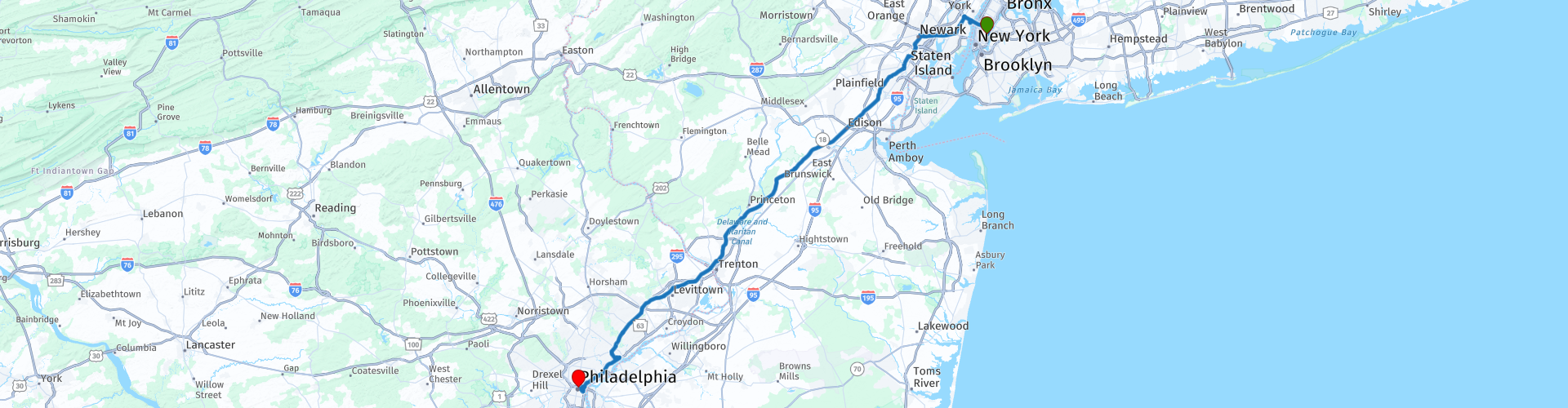
01 Lincoln Highway New York NY to Philadelphia PA

This route was brought to you by:
RouteXpert Paul Hedges - Adv RouteXpert
Last edit: 06-10-2025
 Route Summary
  Share this route


Animation

Verdict


Duration
8h 40m

Mode of travel
Car or motorcycle

Distance
161.59 km

Countries

 RouteXpert Review
 Roads in America Before 1912
In 1912, the United States had few roads suitable for automobiles. Of the 2.5 million miles of roads, most were unpaved dirt—bumpy and dusty in dry weather, and nearly impassable when wet. The few “improved” roads were typically found near towns and cities and were considered upgraded if they had been graded. Gravel or brick surfaces were rare luxuries, while concrete and tarmac had yet to be introduced.
Even more problematic, these roads often didn’t connect settlements. Instead, they radiated outward from town centers without forming a coherent network. For long-distance travel, trains remained the most reliable
The Birth of the Lincoln Highway
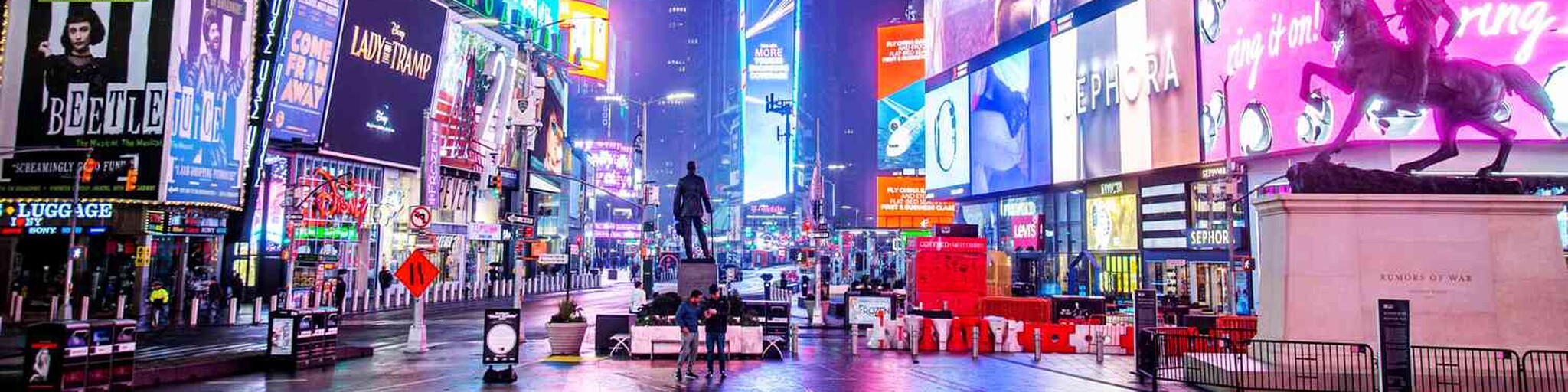
The Lincoln Highway changed everything. Conceived as the first improved transcontinental automobile road in the United States, it stretched from Times Square in New York City to Lincoln Park in San Francisco, California, covering over 3,400 miles and passing through 13 states.
This ambitious project marked a turning point in American infrastructure, offering a continuous route for motorists across the country. Today, portions of the Lincoln Highway are designated as a National Scenic Byway in Illinois, Iowa, and Nebraska, and as state byways in western Pennsylvania, Ohio, and Indiana. The route also continues through New York, New Jersey, West Virginia, Wyoming, Utah, Nevada, and California, though these segments are not officially designated as byways.
A Tribute to Abraham Lincoln
More than just a road, the Lincoln Highway was also the first national memorial to President Abraham Lincoln, established nine years before the dedication of the Lincoln Memorial in Washington, D.C., in 1922. It was a symbolic and practical tribute to Lincoln’s legacy, reflecting the spirit of unity and progress.
"The Main Street Across America"
As the first automobile road to span the continent, the Lincoln Highway brought prosperity to hundreds of cities, towns, and villages along its path. Businesses flourished, tourism grew, and communities became more connected. The highway earned the affectionate nickname “The Main Street Across America”, symbolizing its central role in shaping the nation’s road culture and economy.
Day 1 of 19: From Times Square to Philadelphia – The Start of the Lincoln Highway
Start each day with a full tank of fuel.
The eastern terminus of the Lincoln Highway is located in Times Square, New York City. From this iconic starting point, the highway stretches across 13 states and approximately 3,400 miles, ending at Lincoln Park in San Francisco, California. Along the way, it passes through the heart of small-town America, offering a rich tapestry of history and culture.
Leaving New York and crossing into New Jersey, travelers encounter the first state line of the journey. During the early days of the Lincoln Highway, the route through Newark, NJ was already the busiest roadway in the country—a testament to the growing importance of automobile travel.
Continuing westward, the highway passes through the university town of Princeton, where American history begins to unfold. One notable landmark is the Princeton Battle Monument, which commemorates the Battle of Princeton on January 3, 1777. In this pivotal Revolutionary War encounter, George Washington led his troops to a surprising victory, proving that his amateur army could stand against British forces.
The day concludes in Philadelphia, the third state visited on this leg of the journey. The city is steeped in American history and offers several must-see sites:
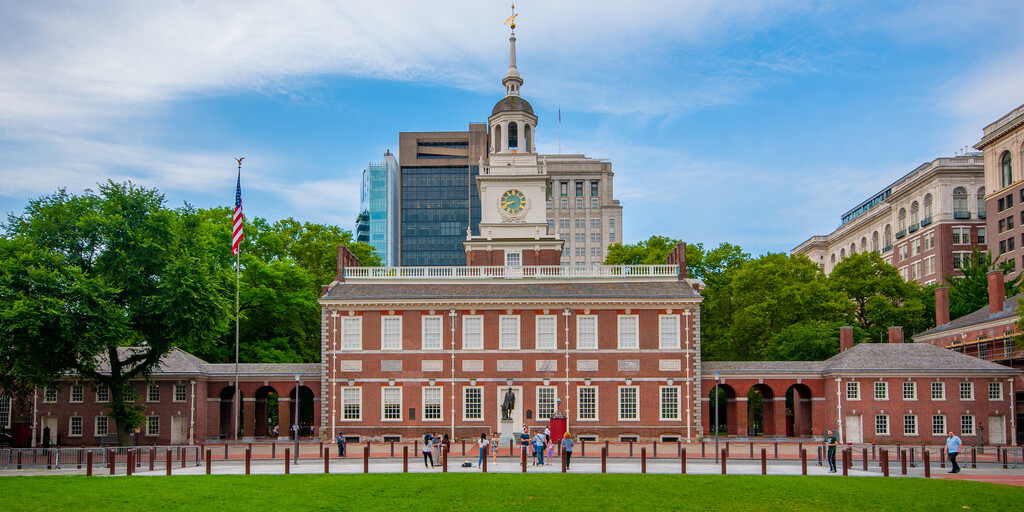
Independence Hall: Known as the birthplace of the United States, this historic building is where both the Declaration of Independence (1776) and the U.S. Constitution (1787) were debated and signed. Entry is free, though a $1 administrative fee applies per ticket.
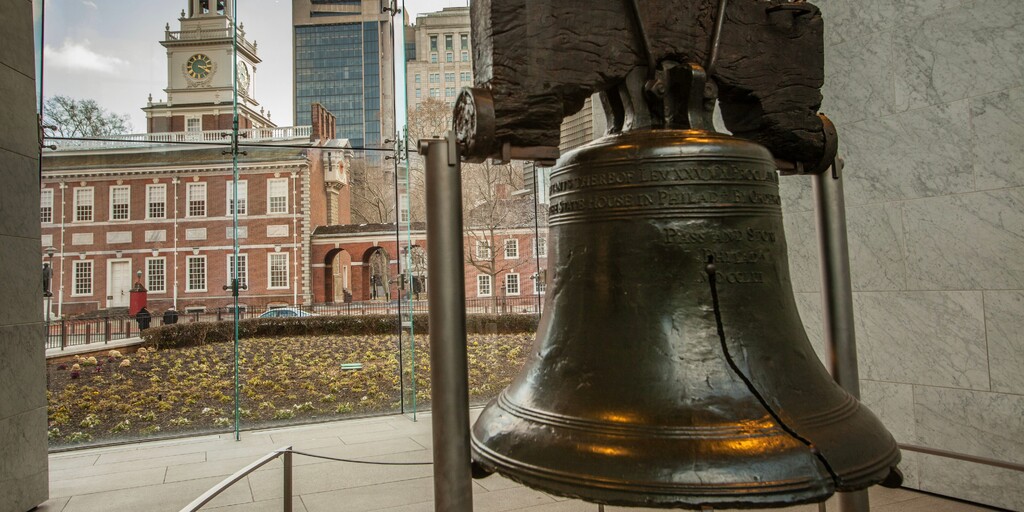
The Liberty Bell: A powerful symbol of American freedom, the Liberty Bell is housed in the Liberty Bell Center, which spans nearly an entire city block on 6th Street between Market and Chestnut Streets. Visitors can view the bell from both inside and outside the center.
Museum of the American Revolution: Located at 101 South Third Street, this museum opened in 2017 and features thousands of artifacts, including artwork, textiles, weapons, manuscripts, and rare books. It explores the enduring relevance of the American Revolution (1765–1783). Admission is $24 for adults (as of June 2024).
For those who enjoy walking tours, several companies offer 75-minute guided experiences covering more than 20 historic sites, including Independence Hall and the Liberty Bell. These tours span 1.25 miles and provide a deeper look into the city’s revolutionary past. I would actually recommend going to the hotel first and then walk to the HIstoric Section
This 4 star day is day one of an epic adventure that tracks history of the United States as well as the history of cross country travel
 Links
Links  Usage
Usage Want to download this route?
You can download the route for free without MyRoute-app account. To do so, open the route and click 'save as'. Want to edit this route?
No problem, start by opening the route. Follow the tutorial and create your personal MyRoute-app account. After registration, your trial starts automatically.  Disclaimer
Use of this GPS route is at your own expense and risk. The route has been carefully composed and checked by a MyRoute-app accredited RouteXpert for use on TomTom, Garmin and MyRoute-app Navigation.
Changes may nevertheless have occurred due to changed circumstances, road diversions or seasonal closures. We therefore recommend checking each route before use.
Preferably use the route track in your navigation system. More information about the use of MyRoute-app can be found on the website under 'Community' or 'Academy'.
Changes may nevertheless have occurred due to changed circumstances, road diversions or seasonal closures. We therefore recommend checking each route before use.
Preferably use the route track in your navigation system. More information about the use of MyRoute-app can be found on the website under 'Community' or 'Academy'.
 Nearby routes
New York
About this region
New York is a state in the Mid-Atlantic and Northeastern regions of the United States. It was one of the original thirteen colonies forming the United States. With a total area of 54,556 square miles (141,300 km2), New York is the 27th largest state geographically. Its population of more than 20 million people makes it the fourth most populous state in the United States as of 2020. The state is bordered by New Jersey and Pennsylvania to the south, and Connecticut, Massachusetts, and Vermont to the east; it has a maritime border with Rhode Island, east of Long Island, as well as an international border with the Canadian provinces of Quebec to the north and Ontario to the northwest. It is sometimes called New York State to distinguish it from New York City, its largest city.
With a population of 8,804,190 in 2020, New York City is the most populous city in the United States. Two-thirds of the state's population lives in the New York metropolitan area, one of the most populous in the world. New York City is home to the United Nations Headquarters, and has been described as the cultural, financial, and media capital of the world, as well as the world's most economically powerful city. The next four most populous cities in the state are Buffalo, Rochester, Yonkers, and Syracuse, while the state capital is Albany.
New York has a diverse geography. The southern part of the state is in the Atlantic coastal plain and includes Long Island and several smaller associated islands, as well as New York City and the lower Hudson River Valley. The larger Upstate New York region comprises several ranges of the wider Appalachian Mountains, and the Adirondack Mountains in the northeastern lobe of the state. The north–south Hudson River Valley and the east–west Mohawk River Valley bisect these more mountainous regions. Western New York is part of the Great Lakes region and borders on the Great Lakes of Lake Ontario and Lake Erie, as well as Niagara Falls. The central part of the state is dominated by the Finger Lakes, a popular vacation and tourist destination.
The area of present-day New York had been inhabited by tribes of the Algonquians and the Iroquois confederacy Native Americans for several hundred years by the time the earliest Europeans arrived. French colonists and Jesuit missionaries arrived southward from Montreal for trade and proselytizing. In 1609, the region was visited by Henry Hudson sailing for the Dutch East India Company. The Dutch built Fort Nassau in 1614 at the confluence of the Hudson and Mohawk rivers, where the present-day capital of Albany later developed. The Dutch soon also settled New Amsterdam and parts of the Hudson Valley, establishing the multiethnic colony of New Netherland, a center of trade and immigration. England seized the colony from the Dutch in 1664, with the Dutch recapturing their colony in 1673 before definitively ceding it to the English as a part of the Treaty of Westminster the following year. During the American Revolutionary War (1775–1783), a group of colonists of the Province of New York attempted to take control of the British colony and eventually succeeded in establishing independence. In the early 19th century, New York's development of its interior, beginning with the Erie Canal, gave it incomparable advantages over other regions of the east coast and built its political and cultural ascendancy.
Many landmarks in New York are well known, including four of the world's ten most-visited tourist attractions in 2013: Times Square, Central Park, Niagara Falls, and Grand Central Terminal. New York is also home to the Statue of Liberty. In the 21st century, New York has emerged as a global node of creativity and entrepreneurship, social tolerance, and environmental sustainability. New York has approximately 200 colleges and universities, including the State University of New York. Several universities in New York have been ranked among the top 100 in the nation and world.
Read more on Wikipedia
With a population of 8,804,190 in 2020, New York City is the most populous city in the United States. Two-thirds of the state's population lives in the New York metropolitan area, one of the most populous in the world. New York City is home to the United Nations Headquarters, and has been described as the cultural, financial, and media capital of the world, as well as the world's most economically powerful city. The next four most populous cities in the state are Buffalo, Rochester, Yonkers, and Syracuse, while the state capital is Albany.
New York has a diverse geography. The southern part of the state is in the Atlantic coastal plain and includes Long Island and several smaller associated islands, as well as New York City and the lower Hudson River Valley. The larger Upstate New York region comprises several ranges of the wider Appalachian Mountains, and the Adirondack Mountains in the northeastern lobe of the state. The north–south Hudson River Valley and the east–west Mohawk River Valley bisect these more mountainous regions. Western New York is part of the Great Lakes region and borders on the Great Lakes of Lake Ontario and Lake Erie, as well as Niagara Falls. The central part of the state is dominated by the Finger Lakes, a popular vacation and tourist destination.
The area of present-day New York had been inhabited by tribes of the Algonquians and the Iroquois confederacy Native Americans for several hundred years by the time the earliest Europeans arrived. French colonists and Jesuit missionaries arrived southward from Montreal for trade and proselytizing. In 1609, the region was visited by Henry Hudson sailing for the Dutch East India Company. The Dutch built Fort Nassau in 1614 at the confluence of the Hudson and Mohawk rivers, where the present-day capital of Albany later developed. The Dutch soon also settled New Amsterdam and parts of the Hudson Valley, establishing the multiethnic colony of New Netherland, a center of trade and immigration. England seized the colony from the Dutch in 1664, with the Dutch recapturing their colony in 1673 before definitively ceding it to the English as a part of the Treaty of Westminster the following year. During the American Revolutionary War (1775–1783), a group of colonists of the Province of New York attempted to take control of the British colony and eventually succeeded in establishing independence. In the early 19th century, New York's development of its interior, beginning with the Erie Canal, gave it incomparable advantages over other regions of the east coast and built its political and cultural ascendancy.
Many landmarks in New York are well known, including four of the world's ten most-visited tourist attractions in 2013: Times Square, Central Park, Niagara Falls, and Grand Central Terminal. New York is also home to the Statue of Liberty. In the 21st century, New York has emerged as a global node of creativity and entrepreneurship, social tolerance, and environmental sustainability. New York has approximately 200 colleges and universities, including the State University of New York. Several universities in New York have been ranked among the top 100 in the nation and world.
View region
 Statistics
  13
13Amount of RX reviews (New York)
 15637
15637Amount of visitors (New York)
 276
276Amount of downloads (New York)
 Route Collections in this region
 The ultimate Great Lakes Tour
This is a tour from Chicago to Staten Island, New York visiting the 5 Great Lakes of North America.
Starting from EagleRider Motorcycle rental at Illinois Harley-Davidson in Chicago and ending at EagleRider Motorcycle rental in Staten Island.
The Ultimate Great Lakes tour is a route through the United States and Canada to scenic destinations along Lakes Michigan, Superior, Huron, Erie and Ontario.
What are the Great Lakes? The Great Lakes are a series of five interconnected freshwater lakes located on the border of the United States and Canada. They are the largest group of freshwater lakes in the world by area and have sea-like characteristics such as rolling waves, strong currents, miles of sandy and rocky beaches, and distant horizons. This tour of 8 routes includes places to stop for coffee, lunch and overnight hotels. It also visits well known historic and scenic sites along the way mostly avoiding major highways. I have suggested 2 nights at Lake Superior and 2 nights at Niagara Falls, making this a 10 day tour, but of course, that is up to you. The scenery and landscapes are breathtaking and each day is different to the next. Please enjoy.
Starting from EagleRider Motorcycle rental at Illinois Harley-Davidson in Chicago and ending at EagleRider Motorcycle rental in Staten Island.
The Ultimate Great Lakes tour is a route through the United States and Canada to scenic destinations along Lakes Michigan, Superior, Huron, Erie and Ontario.
What are the Great Lakes? The Great Lakes are a series of five interconnected freshwater lakes located on the border of the United States and Canada. They are the largest group of freshwater lakes in the world by area and have sea-like characteristics such as rolling waves, strong currents, miles of sandy and rocky beaches, and distant horizons. This tour of 8 routes includes places to stop for coffee, lunch and overnight hotels. It also visits well known historic and scenic sites along the way mostly avoiding major highways. I have suggested 2 nights at Lake Superior and 2 nights at Niagara Falls, making this a 10 day tour, but of course, that is up to you. The scenery and landscapes are breathtaking and each day is different to the next. Please enjoy.
View Route Collection
Ultimate USA road trip part 07
Michel van Hagen challenged me to follow the Roadtrip of Dr. Randy Olsen as a basis to create the Ultimate USA Road Trip for the MyRoute app RouteXpert Library. I took up that challenge and started in February 2022.
The scientist Dr. Randy Olsen, who became known for using his knowledge of algorithms to find 'Waldo' in the well-known American 'Where's Waldo' book series, has been challenged by Tracy Staedter, from Discovery News, to use the same algorithm to create the perfect Road Trip by creating the US, which will visit almost every state in the US. Alaska and Hawaii are not included in this Road Trip due to their geographical location.
The following three requirements formed the basis of the route: In all 48 countries there must be at least one stop at famous points, monuments, historical sites, national parks, etc. I have added additional interesting points, beautiful tours and routes.
After more than 26 months, the job is finished and, with a lot of support from Nick Carthew, I have created 129 routes that run through the 48 states of the USA and part of Canada. This is the seventh collection that takes you from Salem in ten days through Massachusetts, Maine, New Hampshire, Vermont, New York, Canada, Pennsylvania and Ohio to Mackinaw City, Michigan.
The scientist Dr. Randy Olsen, who became known for using his knowledge of algorithms to find 'Waldo' in the well-known American 'Where's Waldo' book series, has been challenged by Tracy Staedter, from Discovery News, to use the same algorithm to create the perfect Road Trip by creating the US, which will visit almost every state in the US. Alaska and Hawaii are not included in this Road Trip due to their geographical location.
The following three requirements formed the basis of the route: In all 48 countries there must be at least one stop at famous points, monuments, historical sites, national parks, etc. I have added additional interesting points, beautiful tours and routes.
After more than 26 months, the job is finished and, with a lot of support from Nick Carthew, I have created 129 routes that run through the 48 states of the USA and part of Canada. This is the seventh collection that takes you from Salem in ten days through Massachusetts, Maine, New Hampshire, Vermont, New York, Canada, Pennsylvania and Ohio to Mackinaw City, Michigan.
View Route Collection